Word of the Day: SUPERNACULAR

ETYMOLOGY
from supernaculum (a drink to be consumed to the last drop; a wine of the highest quality; anything excellent of its kind) + -ar

EXAMPLE
“…The last deposit will be made at Josh Hudson’s, to- morrow evening, when some spirited betting is expected. Both men are well, and something supernacular is expected …”

From: The Morning Chronicle
October 30, 1828
The Ring. Dick Curtis and Edwards

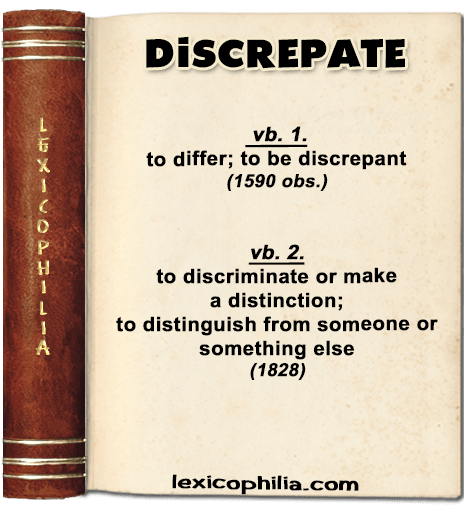
Word of the Day: DISCREPATE

ETYMOLOGY
from Latin discrepat-, past participial stem of discrepare (to differ in sound, to be out of tune, to be out of harmony or inconsistent with, to have differences or discrepancies, to lack agreement, to differ in opinion, to disagree,
from dis- + crepare (to make a noise, to creak)

EXAMPLE (for vb. 1.)
“… So that discrepating from his first propertie, vtterly corrupteth, decayeth, becommeth absumpt in the degree of death. …”

From: The Flower of Phisicke
By William Clever, 1590

Word of the Day: KELDER

ETYMOLOGY
from Dutch kelder a (cellar)

EXAMPLE
“… Angell of light, und darknesse too, I doubt,
Inspir’d within, and yet posses’d without.
Majestick twilight in the state of grace,
Yet with an excommunicated face.
Charles and his Mask are of a different mint,
A Psalme of mercy in a miscreant print.
The Sun wears Midnight, Day is beetle-brow’d,
And Lightning is in
Keldar of a cloud. …”

From: The Character of a London-Diurnall with Severall Select Poems
By John Cleveland, 1647
The Kings Disguise

Word of the Day: NABALITIC

ETYMOLOGY
either  from nabal (a churlish or miserly person) + -itic;
or from nabalite (a foolish person) + -ic

EXAMPLE
“… since they see no reason, why these, as Christs Agents, and Gods Embassadours, should not as well deserve, and enjoy a competent, and comely maintenance, as any publique Officers, either Civill, or Military: Who have more of power to exact, but not more of right, either humane or divine; nor yet more of merit, to require their payes, and fees; Yea, Ministers still dare to hope, that those in power have not any such Nabalitick and churlish humor, as to feast those that shear, and sometimes slay the sheep; while they starve the Shepheards: …”

From: Hieraspistes a Defence by way of Apology for the Ministry and Ministers of the Church of England
By John Gauden, 1653

Word of the Day: CONDOG

ETYMOLOGY
conjectured to be a whimsical imitation of concur (cur = dog);
but no evidence has been found of its actual origin

EXAMPLE
“… Alcum. So is it, and often doth it happen, that the iust proportion of the fire and all things concurre.

Rafe. Concurre, condogge. I will away.

Alcum. Then away. …”

From: Gallathea
By John Lyly, 1592

Word of the Day: PECKSNIFF

ETYMOLOGY
from the name of Mr. Pecksniff, a hypocritical character in Charles Dickens’s novel “The Life and Adventures of Martin Chuzzlewit

EXAMPLE
“… Should Welby Pugin ever favour us with a Supplement to his Contrasts, he will uo doubt bring forward as one most egregious instance of architectural bathos the unlucky structure commented upon in the preceding paragraph. He might also hold up for reprehension a good many Pecksniff specimens of Gothic and Tudor of very recent date – certainly more recent than would be imagined, for some of them seem to be almost twin-brothers to Strawberry Hill, or else to the front of Guildhall …”

From: The Civil Engineer and Architect’s Journal, Scientific and Railway Gazette
Volume 7, 1844

Word of the Day: DECUMANAL

ETYMOLOGY
from Latin decumanus (very large, immense; usually of waves) + -al

EXAMPLE
“… till in the closure of the luxuriant period, the decumanal wave of the oddest whimzy of al, enforced the charmed spirits of the auditory (for affording room to its apprehension) suddenly to burst forth into a laughter; which commonly lasted just so long, as he had leasure to withdraw behind the skreen, shift off with the help of a Page, the suite he had on, apparel himself with another, and return to the stage to act afresh; for by that time their transported, disparpled, and sublimated fancies, by the wonderfully operating engines of his solacious inventions, had from the hight to which the inward scrues, wheeles, and pullies of his wit had elevated them, descended by degrees into their wonted stations, he was ready for the personating of another carriage; …”

From: Εκσκυβαλαυρον [Ekskybalauron]: or, The Discovery of a Most Exquisite Jewel, More Precious Then Diamonds Inchased in Gold, the Like Whereof Was Never Seen in Any Age
By Thomas Urquhart, 1652
Word of the Day: RATTLE-NODDLED

ETYMOLOGY
from rattle (succession of short, sharp sounds) + noddled

EXAMPLE
“… Well, take this monster all together, and hees a clubfooted, hamble shanck’t, burstengutted, long-neck’t, rattlenodled, large lugg’d eagle eyd Hircocerous, a meere chimera, one of the devils best boys ; but having served him an apprentiship he’s now set up for himself and came out with his wares the last summer cave tertio. …”

From: Confused Characters of Conceited Coxcombs
By K.W., 1661

Word of the Day: DISTRACTIOUS

ETYMOLOGY
from distraction + -tious

EXAMPLE
“… There were indeed bruits of fear, and there were companies of suspicious persons who at the best, live upon the vices of the Nation, and who like Coasters ride out at Sea, to expect prey from wrecks, and small Boats which they can Master and prey upon, such Cormorants of pillage and snaps of ruine My Lodgings were an eminent instance of before they were burned yet open violence there was none to speak of, but much even of exemplary Justice, and charitable Mercy, In the time of the Fires raging, and of the distractious impetuosity; which I write not to vindicate the dissolute Multitude of pretended Labourers, and other instruments of carriage (who exhansed the rates of their own portadge, while perhaps their Wives, Children, and Servants, or some of them, were busie at other work, all becoming theirs which their hook could reach, or their Net drag away.) …”

From: A short narrative of the late dreadful fire in London
By Edward Waterhouse, 1667