Word of the Day: STERQUILINIOUS

ETYMOLOGY
from Latin sterquilinium (a dunghill), (from stercus (dung))

EXAMPLE
“… The itching of scriblers, was the scab of the time; It is just so now, that any triobolary pasquiller evry tressis agaso, any sterquilinious raskall, is licenc’d to throw dirt in the faces of Soveraign Princes in open printed language: But I hope the times will mend, and your Man slo if he hath any face, you have so well corrected him, So I rest …”

From: A New Volume of Letters
By James Howell, 1647
Letter to Dr. D. Featley, 1 Aug. 1644

Word of the Day: GIG-LAMPS

ETYMOLOGY
from gig (a light two-wheeled one-horse carriage) + lamp

EXAMPLE (for n. 1.)
“… A “Wo-ho-ho, my beauties!” brought the smoking wheelers upon their haunches; and Jehu, saluting with his elbow and whip finger, called out in the husky voice peculiar to a dram-drinker, “Are you the two houtside gents for Hoxfut?” To which Mr. Green replied in the affirmative; and while the luggage (the canvas-covered, ladylike look of which was such a contrast to that of the other passengers) was being quickly transferred to the coach-top, he and Verdant ascended to the places reserved for them behind the coachman. Mr. Green saw at a glance that all the passengers were Oxford men, dressed in every variety of Oxford fashion, and exhibiting a pleasing diversity of Oxford manners. Their private remarks on the two new-comers were, like stage “asides,” perfectly audible.

“Decided case of governor!” said one.

“Undoubted ditto of freshman!” observed another.

“Looks ferociously mild in his gig-lamps!” remarked a third, alluding to Mr. Verdant Green’s spectacles.

And jolly green all over!” wound up a fourth. …”

From: The Adventures of Mr. Verdant Green
By Cuthbert Bede, (real name Edward Bradley), 1853

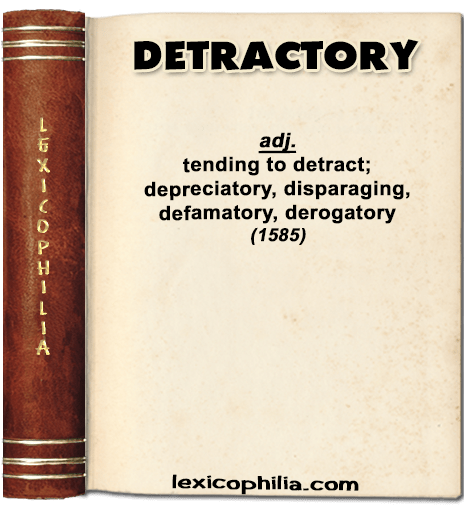
Word of the Day: DETRACTORY

ETYMOLOGY
from Latin detractorius (disparaging, slanderous), from detractor (a defamer, slanderer) + -ory

EXAMPLE
“… Let him say al this, and much more, which idle and slothfull Christians are accustomed to bring for their excuse: let him alleage the same as much and as often times as he wil: it is but an excuse, and a false excuse, and an excuse moste dishonourable and detractorie to the force of Christ holie grace purchased vnto vs by his bitter passion …”

From: A Christian Directorie guiding men to their saluation
By Robert Parsons, 1585

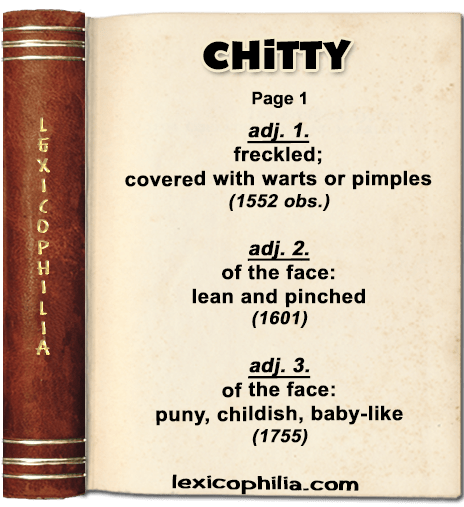
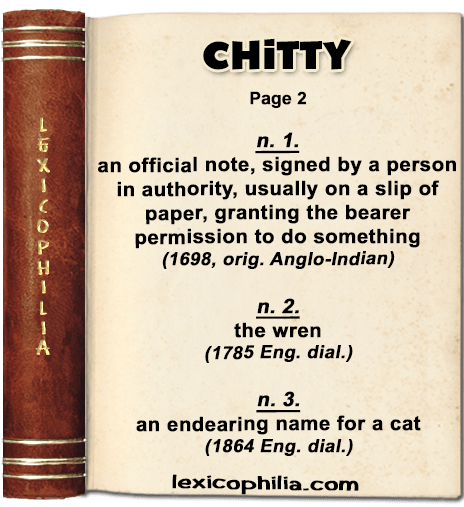
Word of the Day: CHITTY

ETYMOLOGY
adj. 1.: from chit (a freckle or wart, obsolete) + -y
adj. 2. & 3..: apparently deduced from chitty-face, (thin face), but afterwards associated with chit (the young of a beast)
n. 1.:  from Hindi chiṭṭhi, Marathi chitthi, chithi and its cognate
Hindi ciṭṭhi (document, letter, note, promissory note, pass), of uncertain origin

EXAMPLE (for adj. 1.)
“… How shall I stifle now my rising Phlegm,
Are all, are all his Thoughts employ’d on them
Shall they such
Chitty Jades so happy be,
And can he not bestow one word on me;
Hence from my Sight, avoid this wicked Room,
Go you ungracious Minxes, get you home.
…”

From: The Rival Milliners: or, the Humours of Covent Garden
A Tragi-Comi-Operatic-Pastoral Farce
By Robert Drury, 1737

Word of the Day: SMUSS

ETYMOLOGY
from muss (a game in which small objects are thrown down to be scrambled for; a scramble);
the verb muss occurs in Lincolnshire dialect ( to scramble for, to take forcibly and by surprise)

EXAMPLE
“… because this their Cadet, from his very Cradle, had shewed so strong a Propension to hoarding, that being but five or six Years old, he denied himself the Enjoyment of such Knicknacks as were given him, and would scramble for and smuss those of other Children, his Play-fellows; yet was he so very careful and saving of his own, that he let his Fruit and Sweatmeats spoil and grow mouldy rather than he would eat them. …”

From: Histoire du Prince Titi,
A.R. The history of Prince Titi, a royal allegory
By Themiseul de Saint-Hyacinthe
Translated by Eliza Stanley, 1736

Word of the Day: LEIGHSTER

ETYMOLOGY
representing Old English type líegestre, feminine agent-noun to leogan,
from lie (to tell a lie)

EXAMPLE
“… “Yif ich say ich hadde a hi-leman,
“That ich leighe meselue opon :
“Than ich worth of old and yong
“Be hold
leighster and fals of tong.
“Yete me is best take mi chaunce,
“And sle me childe, and do penaunce.
…”

From: Lai le Freine, c1325
in Metrical romances of the thirteenth, fourteenth, and fifteenth centuries: published from ancient manuscripts
By Henry William Weber, 1810

Word of the Day: CELEBRIOUS

ETYMOLOGY
from Latin celebris (crowded, much frequented; festive), variant of celeber (famous, well-known) + -ous

EXAMPLE (for adj. 1.)
“… Howe happy are those men, who for their constant standing in the gappe, against Sathan & Antichrist, are every day illustrated, and made celebrious, by the maligning
of the adversaries of truth? Their soules are in peace, and their glory is promulgated by their enemies trumpets, who the more they oppugne them, the more we doe loue them, and eternise the memory of them.
…”

From: The Reasons vvhich Doctour Hill hath brought, for the vpholding of papistry, which is falselie termed the Catholike religion
By George Abbot, 1604

Word of the Day: BAISIER

ETYMOLOGY
from Old French baisier (modern baiser) (to kiss)

EXAMPLE
“… Fynably Medea conueyed Iason vnto his chambre dore and their began there amorouse baisiers & kyssinges vnto the time that it was force that Medea must withdrawe her & thenne she recommanded Iason in the garde of the goddes and shette fast the dore. …”

From: The History of Jason
By Raoul Le Fevre
Translated by William Caxton, 1477