Word of the Day: PRITTLE-PRATTLE

ETYMOLOGY
reduplicated extension of prattle (to talk in a foolish, childish, or inconsequential way)

EXAMPLE (for vb.)
“… they are poore honest folkes, and haue here an honest company at their mariage, now they lacke wyne, I pray you helpe, She was not long in bibble bable, with saying she wist not what, but sayth at one word, helpe for it is nede. She doth not, as our Papistes do, whiche prittle prattle a whole day uppon their Beades, saying our Ladyes Psalter. But she only sayth, they haue no wyne; helpe. etc. …”

From: Frutefull Sermons
A Sermon Preached by Hugh Latymer, a1552
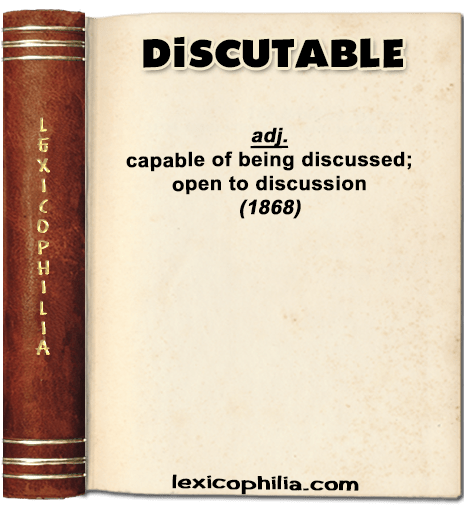
Word of the Day: DISCUTABLE

ETYMOLOGY
from French discutable,
from discuter (to discuss),
(from Latin discutere (to discuss) + -able)

EXAMPLE
“… A definite and complete study of all literary works of the period inspired by the event would be not only an enterprise worthy of an inquisitive erudition, but also a useful help in tracing a line of demarcation between legend and history, and would throw a flood of light on many insoluble or discutable points. …”

From: The Saturday Review of Politics, Literature, Science and Art, 1893
Christopher Columbus and Lope de Vega

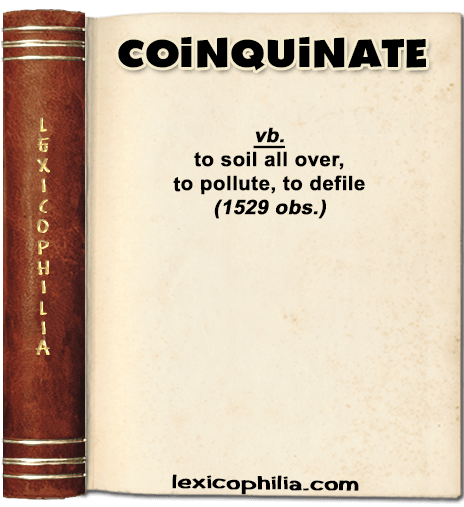
Word of the Day: COINQUINATE

ETYMOLOGY
from Latin coinquinat- participial stem of coinquinare (to defile all over),
from co- (together) + inquinare (to defile)

EXAMPLE
“... For the wele publyke
Of preesthode in this case
And alwayes to chase
Suche maner of sysmatykes
And halfe-heretykes
That wolde intoxicate
That wolde
conquinate
That wolde contemminate
And that wolde vyolate
And that wolde derogate
And that wolde abrogate
The churche hygh estates
…”

From: Colyn Cloute
By John Skelton, a1529

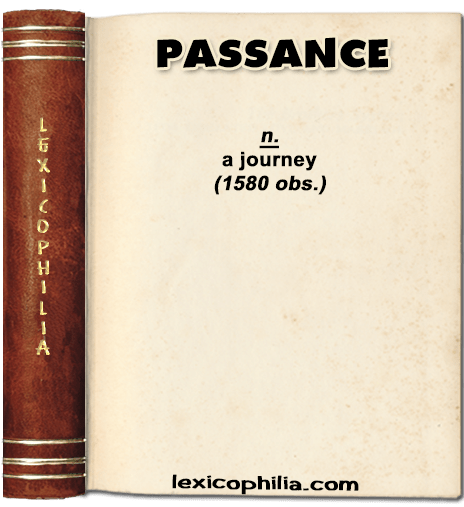
Word of the Day: PASSANCE

ETYMOLOGY
from passant (passing by or along, going, proceeding; travelling, journeying)

EXAMPLE
“… Thus passed they their passance, and wore out the wéerie way with these pleasant discourses, & prettie posies, where after their tedious toyle, they came to their Inne, where Phemocles coulde neither eate meate for ioy, nor sléepe in his bedde for the pleasure he cōceiued of his trauell. ..”

From: Narbonus The Laberynth of Libertie
By Austin Saker, 1580

Word of the Day: PRIDIAN

ETYMOLOGY
from Latin pridianus (relating to the previous day),
from pridie (adv. on the day before),
from pri- before + dies a day + -anus (-an)

EXAMPLE
“… This Gann, I take it, has similar likings, for I hear him occasionally at midnight floundering up the stairs (his boots lie dirty in the passage)—floundering, I say, up the stairs, and cursing the candlestick, whence escape now and anon the snuffers and extinguisher, and with brazen rattle disturb the silence of the night. Thrice a−week, at least, does Gann breakfast in bed—sure sign of pridian intoxication; and thrice a−week, in the morning, I hear a hoarse voice roaring for ‘my soda−water.’ How long have the rogues drunk soda−water? …”

From:  A Shabby Genteel Story,
And Other Tales.
By: William M. Thackeray, 1840
How Mrs. Gann received two lodgers.

Word of the Day: SINISTER-HANDED

ETYMOLOGY
from sinister:  from Old French  senestresinistre or Latin sinister (left, left-hand)

EXAMPLE
… That which still makes her mirth to flow,
Is our
sinister-handed woe,
Which downwards on its head doth go,
And, ere that it is sown, doth grow.
This makes her spleen contract,
And her just pleasure feast:
For the unjustest act
Is still the pleasant’st jest.
…”

From: Lucasta: Posthume Poems
Lucasta Laughing
By Richard Lovelace, a1657

Word of the Day: ASMATOGRAPHER

ETYMOLOGY
from Greek aσµατογράϕος (from ᾀ̑σμα, -µατ– (song, lyric) + -γράϕος writing, writer) + -er

EXAMPLE
” … (Title) 1639 Songs: – A Collection of Original Songs, by Oddibus, Funnybus, Asmatographer to the Court of Comus…”

From: Catalogue of the Singularly Curious, Very Interesting, and Valuable Library
of Edward Skegg,
Arranged by S. Leigh Sotheby, Auctioneer of Literary Property, and Works of Art,
1842

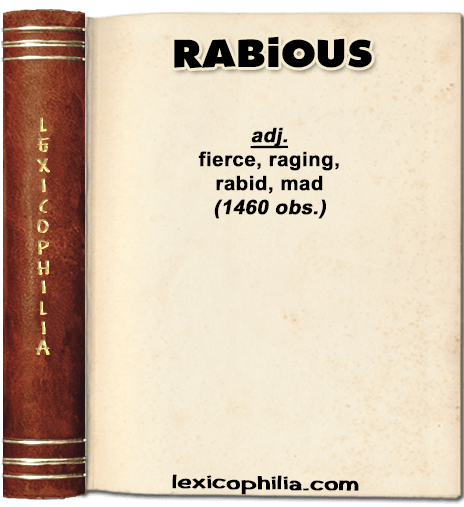
Word of the Day: RABIOUS

ETYMOLOGY
from Latin rabiosus (rabid, mad, frenzied, furious), from rabies (rabies) + –osus (-ous)

EXAMPLE
“… Ethelred, languishing in minde and body, Edmond his sonne, surnamed Ironside (to oppose youth to youth) was imployed against this rabious inuador. A Prince worthy of a better time, and had he found faith, had made it so, and deliuered his country at that turne, from the worst of miseries, the conquest by strangers. …”

From: The First Part of the Historie of England
By Samuel Daniel, 1612