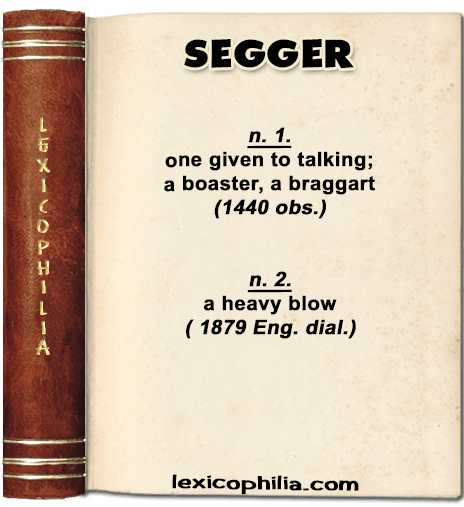
Word of the Day: SEGGER

ETYMOLOGY
from segge (to say) + -er

EXAMPLE (for n.1.)
“… As yoe are a lorde most lofsom of lyre
Vndir sir Pilate that lyfis in this empire,
Ȝone
segger that callis hymselffe a sire
With tresoure and tene sall we taste hym.
Of yoone losell his bale schall he brewe,
Do trottes on for that traytoure apas
In hast.
…”

From: York Mysteries, c1440
The Agony and Betrayal

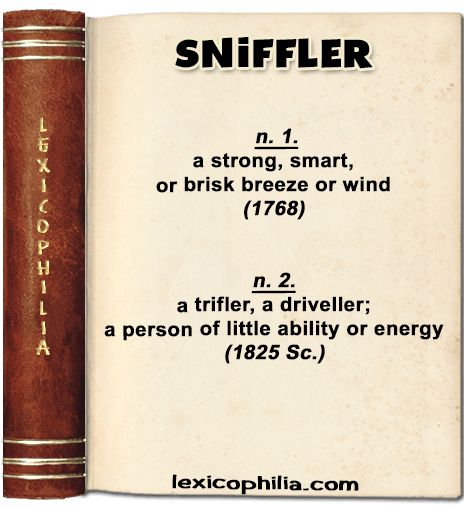
Word of the Day: SNIFFLER

ETYMOLOGY
from sniffle (vb.) + -er

EXAMPLE (for n. 1.)
“… Gin this be courting, well I wat ’tis clear,
I gat na sik a teazle this seven year :
Sae ye maun gee your answer now perqueer,
I maunna ilka day be coming here,
To get sic
sniflers ; courting’s nae a jest.
Another day like this’ll be my priest.’
…”

From: Helenore: Or the Fortunate Shepherdess, a Pastoral Tale
By Alexander Ross, 1768

Word of the Day: OSCITATE

ETYMOLOGY
from Latin oscitat-, past participial stem of oscitare (to open (as a mouth)), 
also oscitari (to gape, yawn), from os mouth + citare (to move, actuate)

EXAMPLE
“… and if he will but imitate some drowsy people at church, by taking a sternutatory, he will arrive at the close without feeling fatigue or ascribing his heaviness to the writer; There are persons whose physical constitutions are so delicate that mere thoughts of taking snuff, (and medicines generally) produce the same effect as inhaling the powder itself: now, if the imagination of the reader has a similar influence over his system, he can have no disposition to oscitate while finishing the chapter; on the contrary, the greatest obstacle to his progress will arise from a disposition to sneeze. …”

From: Transactions of the Society of Literary and Scientific Chiffonniers;
Being Essays on Primitive Arts In Domestic Life.
The Spoon
By Hab’k O. Westman, 1844
Chapter X, Snuff taken with Spoons
Word of the Day: GAINSTAND

ETYMOLOGY
from gain- (against, in opposition to) + stand (vb.)

EXAMPLE (for vb.)
“… Throuch his falsheid and craftynes
He sall flow in to welthynes
The Godlye pepyll he sall noye
By creuell deith, and thame distroye
The kyng of Kyngis, he sall ganestand
Syne be distroyit withouttin hand. …”

From: Ane Dialog Betuix Experience and ane Courteour off the Miserabyll Estait of the Warld
By David Lindsay, 1554

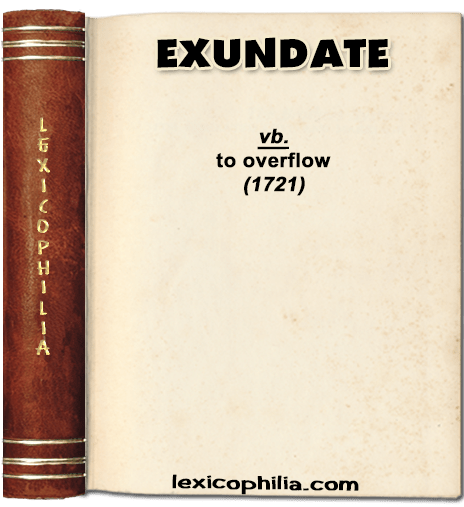
Word of the Day: EXUNDATE

ETYMOLOGY
from Latin exundat- participial stem of exundare,
from ex- (out) + undare (to rise in waves), from unda (wave)

EXAMPLE
“… Thus armed, he advanced to the well. The yew-twig struck the bright motionless water, and strongly agitated it. The stream exundated on every side, kindled as it mounted, and, tumbling and commingling, in a few seconds, like an enormous flame of fire, rolled forwards and backwards round the margin of the fountain. …”

From: Blackwood’s Edinburgh Magazine
Volume LVI. July-December 1844
Traditions and Tales of Upper Lusatia
No. III. The Dwarf’s Well

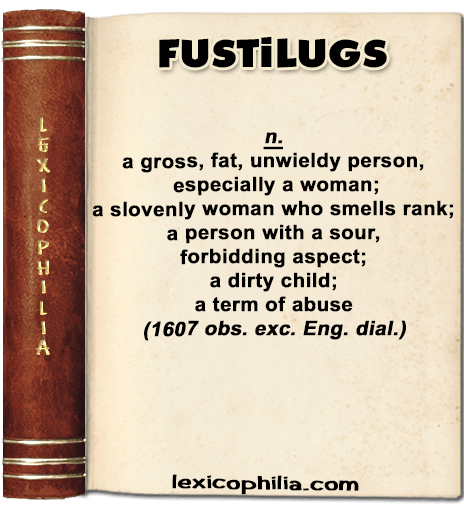
Word of the Day: FUSTILUGS

ETYMOLOGY
? from fusty (having an unpleasant or stuffy smell), + lug (something heavy and clumsy), in the sense of something heavy or slow

EXAMPLE
“… Whereupon the richest Babylonians intending to marry, buy the fairest and most beautifull virgins in the company, one out-bidding another in the bargain. The country swains contenting themselues though they haue not the fairest, take the woodden-fac’d wenches, and the ill-fauourd-foule-fustilugs for a small summe, …”

From: A World of Wonders,
Or an Introduction to a Treatise Touching the Conformitie of Ancient and Moderne Wonders.
By Henri Estienne
Translated by R.C., 1607

Word of the Day: TROIL

ETYMOLOGY
vb.: from Old French troilliertruilliertreuiller, from Middle High German trüllen

EXAMPLE (for vb.)
“… Thus with treison and with trecherie · þow troiledest hem boþe,
And dudest hem breke [here] buxomnesse · þorw false by-heste;
Thus haddest þou hem oute · and hyder atte laste.
…”

(Thus with treason and with treachery · thou troiledest them both,
And diddest them break their buxomness · through false byhest;
Thus haddest thou them out · and hither at the last.
)

From: The Vision of William concerning Piers the Plowman
By William Langland, 1393

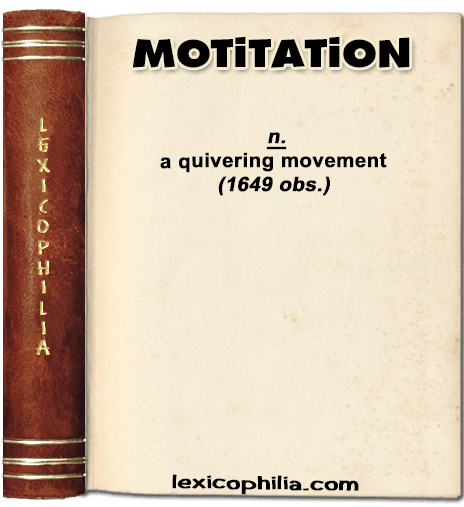
Word of the Day: MOTITATION

ETYMOLOGY
from Latin motitat-, past participial stem of motitare (to move),
from motare (to set in motion, to keep moving) + -itare (-itate) + -ion

EXAMPLE
“… because muscles in this, scarce otherwise then in other functions, are strained; & therefore you rest a trembling Head upon a cush∣on, you shall soon stay the trembling, and free it from that motitation. And hence it is that we know this motion of the Head is voluntary …”

From: Pathomyotamia, or, A dissection of the significative muscles of the affections of the minde
By John Bulwer, 1649