Word of the Day: COCKLEBELL

ETYMOLOGY
apparently originally from cock (an edible bivalve mollusc found on the coasts of Britain, probably a cockle, obs.) + bell

EXAMPLE (for n. 2)
“… My beard had sometimes yce on it as big as my little finger, my breath turning into many cock-bells as I walked…”

From: The Bargrave MS. Diary, 1645
in A Dictionary of the Kentish Dialect and Provincialisms in use in the County of Kent
By William Douglas Parish, & William Francis Shaw, 1887

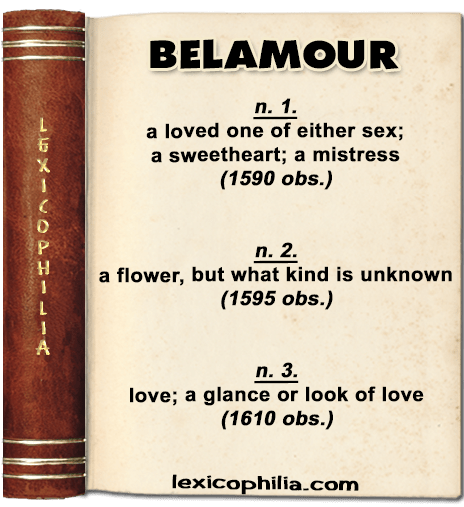
Word of the Day: BELAMOUR

ETYMOLOGY
from French bel (fair) + amour (love)

EXAMPLE (for n. 1)
“… Loe loe how braue she decks her bounteous boure,
  With silken curtens and gold couerlets,
  Therein to shrowd her sumptuous
Belamoure,
  Yet neither spinnes nor cardes, ne cares nor frets,
But to her mother Nature all her care she lets.
…”

From: The Faerie Queene
By Edmund Spenser, 1590

Word of the Day: MALIFEROUS

ETYMOLOGY
from Latin malus (bad) + -ferous (bearing, producing)

EXAMPLE
“… I had really forgotten to mention that gallant, fine-hearted soldier, who – as I heard to my infinite regret, shared by every one who knew his kindly, honest, genial nature – fell a victim to the maliferous climate of China! …”

From: From: My Diary in India,  In the Year 1858-9,
By William Howard Russell, Volume I, 1860
Cowasjee’s Shop

Word of the Day: HARE-HEARTED

ETYMOLOGY
from hare + hearted

EXAMPLE
“… Two right Hare-harted coward Fooles,
Would end their wrath with Cutlers tooles,
And two moft fhifting Knaues intends,
To make thofe Cowards louing friends:
One goes to th’one, and tell’s him tother,
Vowes he doth loue him as his Brother;
And would a Supper on him fpend :
That Cuppes of Sacke their ftrife might end, …”

From: A Fooles Bolt is Soone Shot
By Samuel Rowlands, 1614

Word of the Day: ORGULOUS

ETYMOLOGY
from Anglo-Norman orguillous, orgeillus, orgoilous, orgullous,
orgulous, orgulus, orgilousorgillus and Old French orguillus,
orgoillus, orguilleus, orgueilleux;
from  orgueil (pride, haughtiness) + ‑ous 

EXAMPLE 1 (for adj. 1.)
“… yet habbeþ manitime maked of watere wyn; gostliche. wanne þurch his grace maked of þo euele manne good man. of þe orgeilus umble. of þe lechur chaste. of þe niþinge large. and of alle oþre folies; so ha maket of þo watere wyn. þis his si signefiance of þe miracle. …”

From: An Old English miscellany containing a bestiary, Kentish sermons, Proverbs of Alfred, religious poems of the thirteenth century
Edited by Richard Morris, 1872


EXAMPLE 2 (for adj. 1)
”…I was banished from my own country, and was dishonoured, and with hard labour gained I what I have got ; and now I stand in the King’s favour, and he asketh of me my daughters for the Infantes of Carrion. They are of high blood and full orgullous, and I have no liking to this match ; but if our Lord the King adviseth it we can do no other-wise: …”

From: Chronicle of the Cid
By Robert Southey, 1808

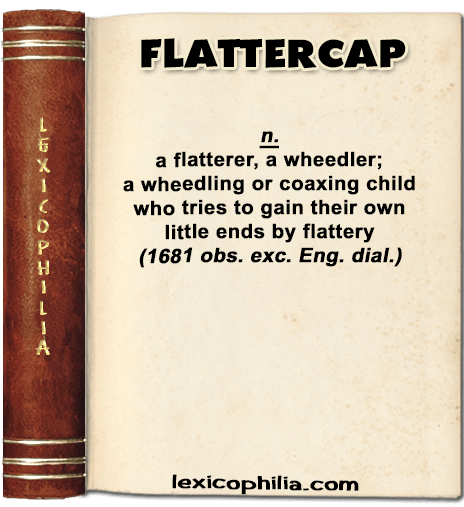
Word of the Day: FLATTERCAP

ETYMOLOGY
from flatter (vb.) + cap

EXAMPLE
“… He’s struggling to learn a lot of new things, but I also think he’s trying to do whatever he can to get on with the men.
I’ve seen him behaving like a 
flattercap, all yes sir, no sir, with a seaman named Brian Blount. …”

From: Trouble on the Voyage : The Strange and Dangerous Voyage of the Henrietta Maria
By Bob Barton, 2010