
ETYMOLOGY
from spill (to lose waste in a wasteful or accidental manner) + good
EXAMPLE
She was by no means a spill-good, but somehow all their money disappeared anyway.
ETYMOLOGY
from spill (to lose waste in a wasteful or accidental manner) + good
EXAMPLE
She was by no means a spill-good, but somehow all their money disappeared anyway.

ETYMOLOGY
from Latin pedisequus (following on foot, a foot-follower),
from pedi- (foot) + -sequus (following), sequī (to follow)
EXAMPLE
“…not onely melancholical and contumacious ones, but viscid and pituitous also, which sometimes put on the habit of Melancholly, and some adust bilious humours: and therefore we adde Rhabarb and Turbith, that we may with the Melancholical Captain-humour, educe the Pituitous, his companion inseparable, and also the Bilious, which is pedissequous.
And because this Medicament most respects melancholy, we have selected black Hellebore for this black humour; rejecting the white, as more convenient for Phlegm…”
From: A Medicinal Dispensatory: Containing the Whole Body of Physick
By Jean de Renou
Translated by Richard Tomlinson, 1657
The Apothecaries Shop: Of Liquid Electuaries
ETYMOLOGY
of fanciful formation
EXAMPLE
“…Curious enough, there is a Lady Erskine, wife of Lord E, her husband’s eldest brother living at Bollington, who tipples & ‘gets squiffy‘ just like this Mrs E. …”
From: The Letters of Mrs. Gaskell
By Elizabeth Cleghorn Gaskell, 1855
Edited by J. A. V. Chapple, Arthur Pollard, 1966

ETYMOLOGY
diminutive of faunt: aphetic form of Old French enfaunt, enfant;
the shortened form has not been found in French, but Italian has the corresponding fante (boy, servant, foot-soldier), whence German fant
EXAMPLE
“…”Þat is soth,” quod clergye “I se what þow menest,
I shal dwelle as I do my deuore to shewen,
And conformen fauntekynes and other folke ylered,
Tyl pacience haue preued þe and parfite þe maked…”
From: The Vision of William concerning Piers the Plowman,
By William Langland, 1377
ETYMOLOGY
perhaps from cheery + merry; possibly only a jingling combination
EXAMPLE
“…how few of you are enemies to a glass (or two or three) of generous wine, and how much food of such a heating nature, promotes the circulation of the bottle, it is not at all astonishing, that every convivial assistant should go home cherry-merry, after having been a guest at such a repast…”
From: Yorick’s Sentimental Journey Continued,
By John Hall-Stevenson, 1769

ETYMOLOGY
the first element, tara, is of obscure origin;
+ diddle (n. a swindle, deception) (vb. to cheat, to swindle)
EXAMPLE
“…Bar. My dear Anna Matilda, I don’t know myself; so how can I tell you?
Mrs. B. There’s a bare-faced tarradiddle, Mr. Barbottle…”
From: The Duel:
Or, My Two Nephews
A Farce, in Two Acts
By R. B. Peake, 1823
ETYMOLOGY
from gad (used to express strong feeling) + zooks (origin unknown)
EXAMPLE
“…Buz. Ile first take tother cup, and then out with’t altogether—And now it comes—If my Mistress do bring him home a bastard, she’s but even with him.
Nat. He has one I warrant. Has he cadzooks?…”
From: The English Moor or the Mock-Marriage,
in Five Nevv Playes, viz. The English Moor. The Love-sick Court. Covent Garden Eeeded. The New Academy. The Queen and Concubine,
By Richard Brome, 1659
ETYMOLOGY
from sarcasm + -ous
EXAMPLE
“…Like th’ Hebrew-calf, and down before it
The Saints fell prostrate, to adore it.
So say the Wicked—and will you
Make that Sarcasmous Scandal true.
By running after Dogs and Bears,
Beasts more unclean than Calves or Steers?…”
From: Hudibras: in three parts, the first part
By Samuel Butler, 1663

ETYMOLOGY
from Latin veriloquus (speaking truly)
EXAMPLE
“…Those ungrateful disingenuous Galenists (who always resisting the truth, set this Brazenface on work deceitfully to oppose Haematias.) contrived heretofore a scurrilous Pamphlet against a veriloquous treatise of mine, (namely A Chymical tryal of the Galenists) and injoyned Johnson their Pseudo-Chymist to patronize it…”
From: A Letter Sent to Mr. H. Stubbe,
By George Thomson, 1672
‘Animadversions on Mr. Stubbe’s Answer’
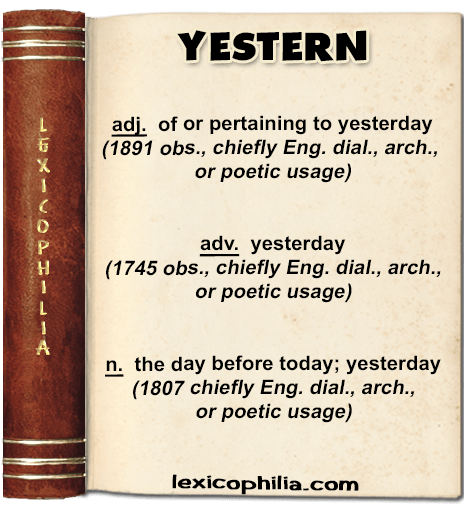
ETYMOLOGY
? partly a) (in English editions of Scots texts) a variant or alteration of yestreen (adv. during the evening of yesterday), after yester (adv. yesterday); and partly
b) a variant or alteration of yester (adv.), yester (n.), and yester (adj.), respectively
EXAMPLE
“…Now wat ye wha I met yestern,
Coming down the street, my jo?
My mistress in her tartan screen,
For bony, braw and sweet, my Jo…”
From: Allan Ramsay in Aviary, 1745
‘Edinburgh Kate’
 Lexicophilia