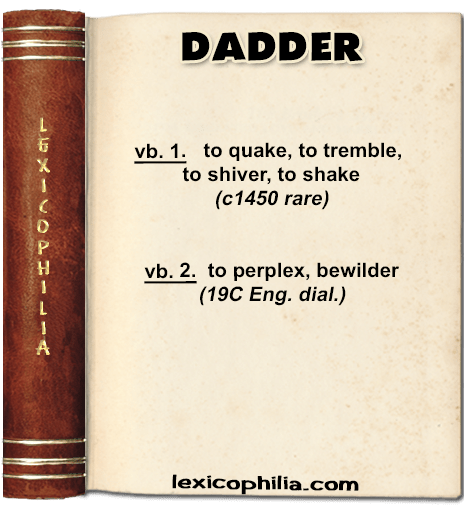
Word of the Day: DADDER


ETYMOLOGY
possibly imitative (perhaps of the chattering of teeth)


EXAMPLE
“…Full gayly was that grete lorde . girde in the myddis,
A brighte belte of ble, . broudirde with fewles,
With drakes and with dukkes, . daderande tham semede,
For ferdnes of fawcons fete, . less fawked thay were…”

From: Winnere and Wastoure 
(“Winner and Waster” is a Middle English poem written in alliterative verse around the middle of the 14th century)
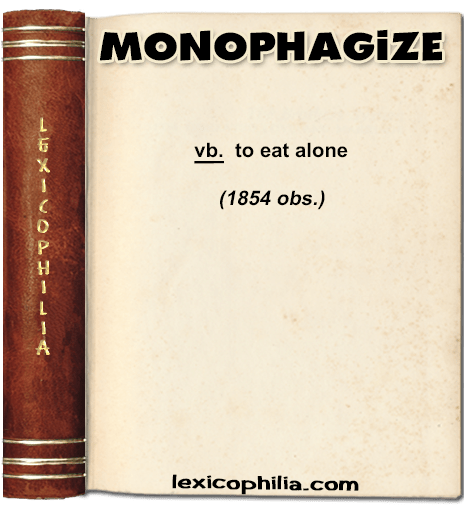
Word of the Day: MONOPHAGIZE


ETYMOLOGY
from Greek µονοϕάγος (monofagos) (that eats alone) + -ize


EXAMPLE
“…you who make us fight for every cabbage at the greengrocer’s, and prestige in its favour, that whereas the glutton might sometimes munch and monophagize in solitude, leading the life of a wolf or of a lion, those who drank generally drank together, and, as it was always said and supposed, to each other’s health and prosperity…”

From: Prose Halieutics
Or, Ancient and Modern Fish Tattle
By the Rev. C. David Badham, 1854
Chapter XXII. Opsophagy

Word of the Day: CHATTERMAG


ETYMOLOGY
from chatter + mag (a chatterbox)


EXAMPLE
“…Now then, stop that; we don’t want no such dal’d nonsense; we come here to work. Now then, you women, divide into twos, and begin at both ends, or we shan’t get any work done for your chattermagging…”

From: Stubble Farm;
Or, Three Generations of English Farmers
By Hubert A. Simmons, Vol. II, 1880
Chapter I. P. 14

Word of the Day: MORIGERATE


ETYMOLOGY
from Latin morigeratus, past participial stem of morigerari (to to be obedient or compliant), from morigerus


EXAMPLE
“…Certaynely in the auncient tyme, whan thou were peopled with ryght and trewe Romayns, and not as thou arte nowe with bastarde chylderne, than the armies, that wente froo Rome, were as well disciplyned and morigerate, as the schooles of the philosophies, that were in Grece…”

From: The Golden Boke of Marcus Aurelius,
By Antonio de Guevara, 1546

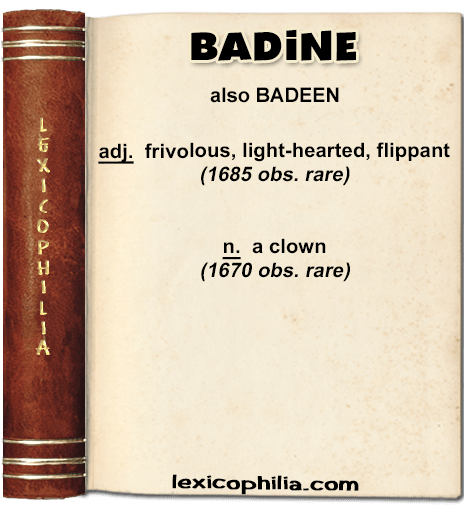
Word of the Day: BADINE


ETYMOLOGY
from French badin (as a noun – a light-hearted person, fool, idiot; also used to denote the fool or clown in drama), (as an adjective – light-hearted, cheerful, foolish, silly),
from Old Occitan badin, adjective and noun, from badar (to gape), from Latin badare (to gape) + -in (-ine)


EXAMPLE
“…Such a Badeen ne’er came upon the Stage,
So droll, so monkey in his play and rage;
Sprawling upon his back, and pitching pyes,
Twirling his head, and flurring at the flies.
A thousand tricks and postures would he show,
Then rise so pleas’d both with himself and you,
That the amaz’d beholders could not say
Whether the bird was happier, or they…”

From: Poems by Sir W.T.
By William Temple, 1670
‘Upon My Lady Giffard’s Loory’

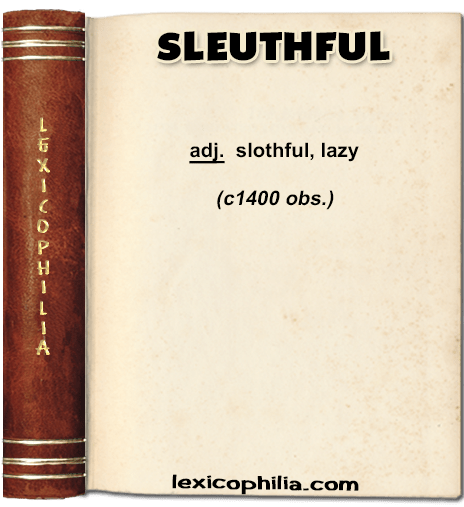
Word of the Day: SLEUTHFUL


ETYMOLOGY
from sleuth (sloth, laziness obs.) + -ful


EXAMPLE
“…And he þat hauys greet egℏen̛ ys enuyous & witℏ-outen shame, sleuthful, and vnobeyssant. He þat hauys lityƚƚ eghen̛, lyk to heuenly colour, or blake, ys of sharpe vnderstondynge, curteys, and leel…”

From: Secreta Secretorum,
(a treatise which purports to be a letter from Aristotle to his student Alexander the Great on an encyclopedic range of topics, including statecraft, ethics, physiognomy, astrology, alchemy, magic, and medicine)

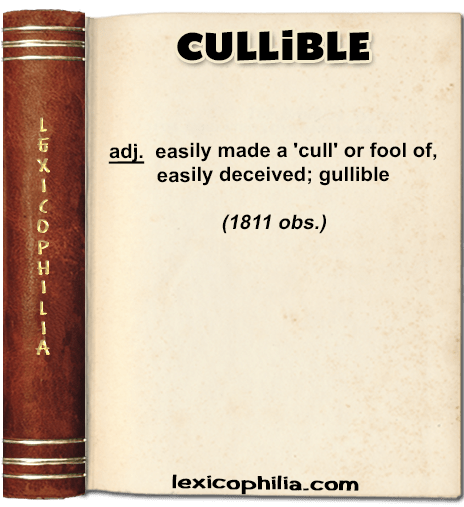
Word of the Day: CULLIBLE


ETYMOLOGY
from the Oxford English Dictionary:
“This adjective, which is presupposed in the derivative cullibility (known 1728), would normally be derived from a verb cull ; but none such is recorded”


EXAMPLE
“…The cullibity of man praeterite, I allow, but because men are & have been cullible, I see no reason why shd always continue so, – Have there not been fluctuations in the opinions of mankind; and as the stuff which soul is made of must be in every one the same …”

From: The Letters of Percy Bysshe Shelley,
Edited by Frederick Lafayette Jones, 1964,
– Shelley to Hogg, January 12, 1811

Word of the Day: MUNDICIDIOUS


ETYMOLOGY
from Latin mundus (world) + –cidious from –cida (killer)


EXAMPLE
“…Since I knew what to feare, my timerous heart hath dreaded three things: a blazing starre appearing in the aire: a State Comet, I mean a favourite rising in a Kingdome, a new Opinion spreading in Religion: these are Exorbitancies: which is a formidable word: a vacuum and an exorbitancy, are mundicidious evils…”

From: The Simple Cobler of Aggawam in America
By Rev. Nathaniel Ward, 1647