
ETYMOLOGY
? from Middle English hôd, hode (state, condition)
EXAMPLE
“…O my Child, my Child—Thy father is prettie hoddie again, but this will break his heart quite—O my Child—Has he not hurt thee?…”
From: The Cheats; A Comedy
By John Wilson, 1664
ETYMOLOGY
? from Middle English hôd, hode (state, condition)
EXAMPLE
“…O my Child, my Child—Thy father is prettie hoddie again, but this will break his heart quite—O my Child—Has he not hurt thee?…”
From: The Cheats; A Comedy
By John Wilson, 1664
ETYMOLOGY
of unknown origin;
possibly an altered form of vandie, vauntie
EXAMPLE
“…How lang shall our land thus suffer distresses,
Whilst traitors, and strangers, and tyrants oppress us!
How lang shall our old, and once brave warlike nation,
Thus tamely submit to a base usurpation?
Thus must we be sad, whilst the traitors are vaudie,
Till we get a sight of our ain bonnie laddie…”
From: Jacobite Songs, 1871
How Lang Shall Our Land
By William Meston,

ETYMOLOGY
from Latin inimīcitia unfriendliness, enmity + -ous
EXAMPLE
“..The first is the nocent, and inimicitious creatures, which are here enumerated to be seven; first the Wolfe, secondly the Leopard, thirdly the yong Lyon, fourthly the Beare, fiftly the Lyon, sixtly the Aspe, seventhly the Cockatrice …”
From: The True Euangelical Temper
By John Jackson, 1641
ETYMOLOGY
? from Celtic Cornish kwilken (a frog)
EXAMPLE
“…And yet ’tis the bestest thing as could fall ‘pon the gal. Er was lookin’ for the cheel in a month or so, they do say., Poor sawl! – so cold as a quilkin now, and the unborn baaby tu…”
From: Lying Prophets
A Novel, By Eden Phillpotts, 1896
Chapter Eight, The Destination of Joan
ETYMOLOGY
from Latin inanis (inane) + loquentem, pres. pple. of loquī (to speak)
EXAMPLE
“…But that is just the beginning. Beginning of the elegantly inaniloquent disassembling of bourgeois literary sensibilities vis-a-vis the text…”
From: The Politics of Style in the Fiction of Balzac, Beckett and Cortazar
By Mark Richard Axelrod, 1992
Beckett’s Metarrhetoric

ETYMOLOGY
from superstiti- + -ate
EXAMPLE
“…Wherefore I will say to such, as one wiser than Solomon said to the Jews, when they superstitiated the gift, in counting it more honourable than the altar, ‘Ye fools, and blind, for whether is greater, the gift, or the altar that sanctifieth the gift?…”
From: The Saints’ Privilege and Profit
Or, The Throne of Grace
By John Bunyan, a1688

ETYMOLOGY
from Latin luculentus, from luc-, lux (light)
EXAMPLE
“…Trie out the grape vnhurt, neither to ripe
Neither to sowre, as gemmys luculent,
Of soft and hard as goodly is to gripe…”
From: The Middle-English translation of Palladius De Re Rustica
ETYMOLOGY
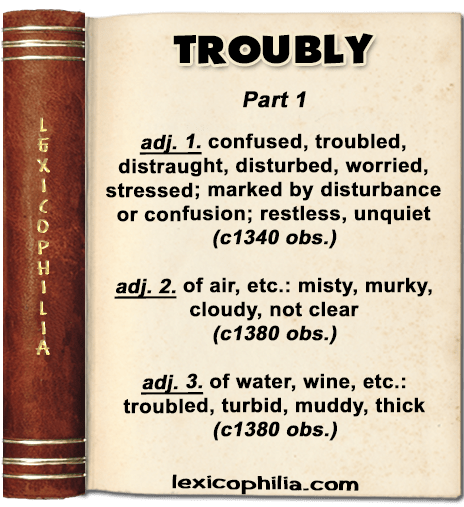
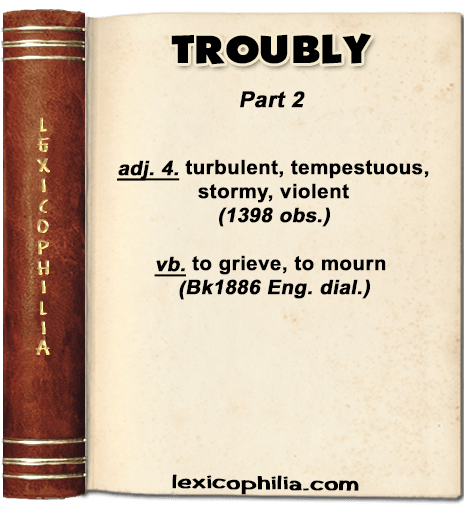
from trouble (n.) + -y or -ly
EXAMPLE (for adj. 1.)
“…Mvsyng vpon the restles bisynesse
Which that this troubly world hath ay on honde,
That othir thyng than fruyt of byttirnesse
Ne yeldeth nought, as I can vndirstonde,
At Chestre ynnë, right fast be the stronde,
As I lay in my bed vp-on a nyght,
Thought me bereft of sleep with force and myght…”
From: De Regimine Principum (The Governance of Kings and Princes)
By Thomas Hoccleve. c1412
ETYMOLOGY
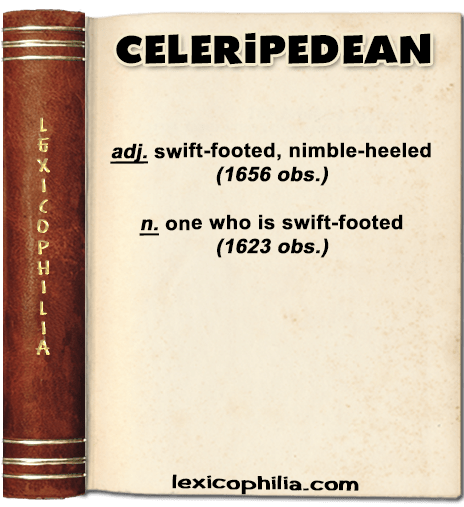
from Latin celeripedem (swift-footed),
(from celer (swift) + pedem (foot)) + -ean
EXAMPLE
“…with a decutient shrug of his stooped shoulders, as tho to desarcinate himself of funebrous thoughts, departed at a pace very different from the celeripedean gait of pristine years …”
From: American Speech, Volume 2
Edited by Arthur Garfield Kennedy, Kemp Malone, Louise Pound, William Cabell Greet, 1927
ETYMOLOGY
of obscure origin;
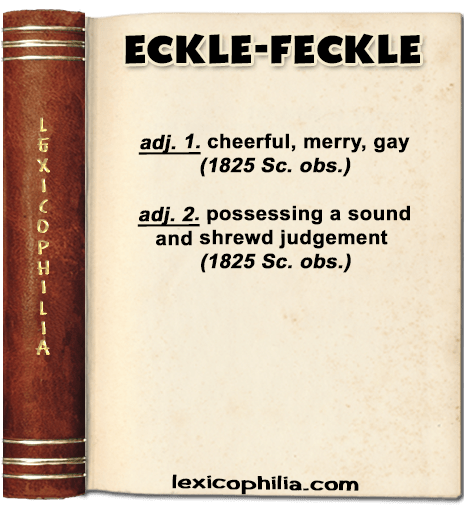
perhaps allied to eekfow (blithe, having an affable demeanour)
EXAMPLE
“…I ne’er weas ca’ad a crankous kimmer,
A crabbed, craiken, crack-brained limmer.
Auld grannie ay was eckle feckle –
Nor hogry mogry, nor kenspeckle –
Ay ready for a couthie clacky,
A pint o’ yill, a bit o’ baccy…”
From: Willie Wabster’s Wooing and Wedding on the Braes of Angus
By Dorothea M. Ogilvy, Julia O. Robertson, 1873
 Lexicophilia