Word of the Day

Word of the Day: GOOSTRUMNOODLE

ETYMOLOGY
? from goose (a foolish person) + noodle (a stupid or silly person); second syllable unknown

EXAMPLE
“… for “The Maister” seldom came there until much later in the evening, when he knew he should find some of those peculiarly constituted individuals there, whom Alrina generally designated “goostrumnoodles,” and whom he seldom found much difficulty in frightening to his heart’s content. …”

From: The Wizard of West Penwith,
A Tale of the Land’s-End,
By William Bentinch Forfar, 1871

Word of the Day: DROSSEL

ETYMOLOGY
of obscure origin

EXAMPLE
“… But lawfull weare it some be such, should all alike be coy’
Now dwels ech
Drossell in her Glas: when I was yong, I wot,
On Holly-dayes (for sildome els such ydell times we got)
A Tubb or Paile of water cleere stood vs in steede of Glas:
And yeat (which still I beare in mind) for it I schooled was,
Euen by an holy Fryer, that espyde me tooting so,
Who, softly stealing at my backe, cryde suddenly. Ho, Ho.
…”

From: Albions England: A Continued Historie of the same Kingdome, from the originals of the first inhabitants thereof
By William Warner, 1597

Word of the Day: CUMATICAL

ETYMOLOGY
from Greek κῡµατ- (wave) + -ic + -al. after Latin cumatilis (sea-coloured, blue)

EXAMPLE
“… A Prince blew.
Crimson, i.e. Scarlet.
Cumatical colour, i.e. blew.
Flesh colour, a certain mixture of red white.
Gangran colour, i.e. divers colours together, as in a Mallards, or Pigeons neck.
…”

From: The Compleat Gentleman: fashioning him absolute in the most necessary and commendable qualities, concerning mind, or body, that may be required in a person of honor.
By Henry Peacham, 1661
An Exposition of Colours

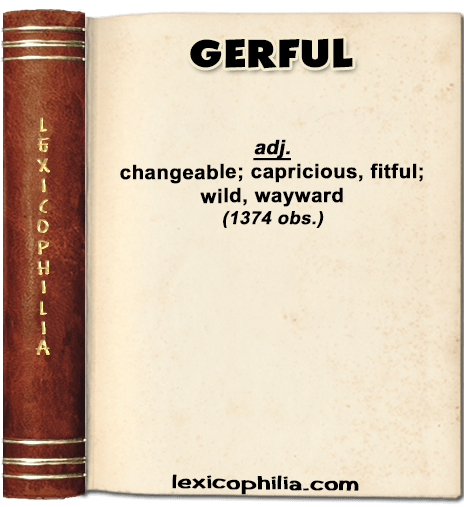
Word of the Day: GERFUL

ETYMOLOGY
from gere (a wild and changeful mood; a sudden fit of passion or feeling) + -ful

EXAMPLE
“… Now vp, now doun, as boket in a welle
Right as the friday, soothly for to telle
Now it shyneth, now it reyneth faste
Right so,/kan geery Venus ouer caste
The hertes of hir folk, right as hir day
Is
gereful, right so chaungeth she array
Selde is the friday, al the wowke ylike
Whan þat Arcite had songe, he gan to sike
…”

From: The Ellesmere MS of Chaucer’s Canterbury Tales
By Geoffrey Chaucer, c1386

Word of the Day: INGLUVIOUS

ETYMOLOGY
from Latin ingluviosus (gluttonous), from ingluvies (gluttony) 

EXAMPLE
“…Wee must haue a good eye and a diligent respect to our health, and we must vse moderate exercises of the bodye. We must not be to ingluvious, in taking our foode and repaste , wee muste not pamper and gourmandise our selues withe excesse of meate and drinke, but so much and such competencie thereof muste be taken, as sufficeth to refreshe the vitall powers and naturall strengthe, and not to empaire, hebetate, and vtterly to extinguish them. …”

From: The Worthye Booke of Old Age othervvyse entituled the elder Cato contayning a learned defence and praise of age, and aged men
By Marcus Tullius Cicero
Translated by Thomas Newton, 1569

Word of the Day: FIRE-FLAUGHT

ETYMOLOGY
from fire (n.) + flaught (a flash; a flash of lightning)

EXAMPLE (for n. 1.)
“… Bot lo, onon, a wonder thing to tell!
Ane huge bleys of flambys braid doun fell
Furth of the clowdis, at the left hand straucht,
In maner of a lychtnyng or
fyre flaucht,
And dyd alicht rycht in the sammyn sted
Apon the crown of fair Lavinias hed;
…”

From: The Æneid of Virgil
Translated by Gavin Douglas, a1522

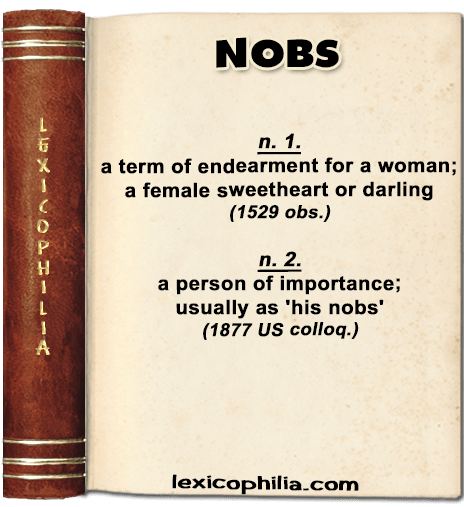
Word of the Day: NOBS

ETYMOLOGY
of unknown origin

EXAMPLE (for n. 1.)
“… And I haue found it trew
Drinke now whyle it is new
And ye may it broke
It shall make you loke
yonger than ye be
yeres two or thre
For ye may proue it by me
Behold she sayd and se
How bright I am of ble
Ich am not cast away
That can my husband say
Whan we kys and play
In lust and in lykyng
He calleth me his whytyng
His mullyng and his nytyng
His
nobbes and his conny
His swetyng and his honny
With bas my prety bonny
Thou art worth good and monny
This make I my falyre fonny
Tyll that he dreme and dronny
For after all our sport
Than wyll he rout and suort
Than swetely togither wely
As two pygges in a sty.
…”

From: Here after foloweth certayne bokes
By John Skelton, 1545
The tunnyng of Elynour Rummynge

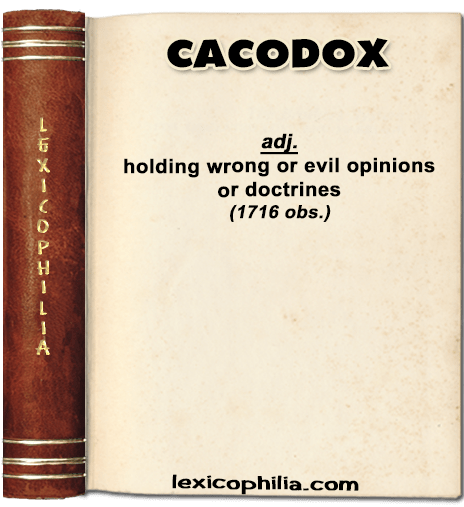
Word of the Day: CACODOX

ETYMOLOGY
from Greek κακόδοξος (kakodoxos) (of the wrong opinion)

EXAMPLE
“… But that Cacodox Alastor has not only abandon’d the true Principles of Reason and Religion, as identify’d with those of the Protestant Reformation and Church of England, but also those of their fore-Fathers of High-Church …”

From: Athenæ Britannicæ: or, A Critical History of the Oxford and Cambridge writers and writings
By Myles Davies, 1716

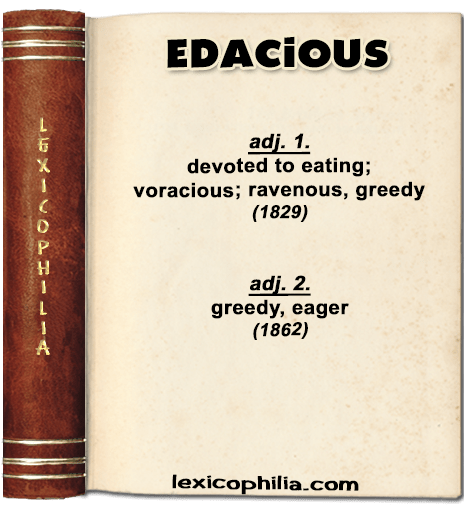
Word of the Day: EDACIOUS

ETYMOLOGY
from Latin edaci- (nominative edax), from edere (to eat) + -ous

EXAMPLE (for n. 1.)
“… Nor is this the sole circumstance that should, in mere justice, be
considered in connection with the rise of Christian monachism; for
before the mere facts can be understood, and certainly before the due
measure of blame can be assigned to the parties concerned, it is
indispensable that we divest ourselves of the prejudices, physical,
moral, and intellectual, which belong to our austere climate, high-toned
irritability,
edacious appetites, and pampered constitutions; to our
rigid style of thinking, and to our commercial habits of feeling.
…”

From: Natural History of Enthusiasm
By Isaac Taylor, 1829