Word of the Day

Word of the Day: EXTERRANEOUS

ETYMOLOGY
from  Latin exterraneus (from ex- (out) + terra (land)) + -ous

EXAMPLE
“… had they only a morsel of standing room – an exterraneous rock from which to pull. How the wheels crush and pulverise all that they come upon, under their three or four tons weight! …”

From: The Dublin University Magazine
A Literary and Political Journal
Volume II, July to December, 1833
Familiar Epistles from London. No. IV
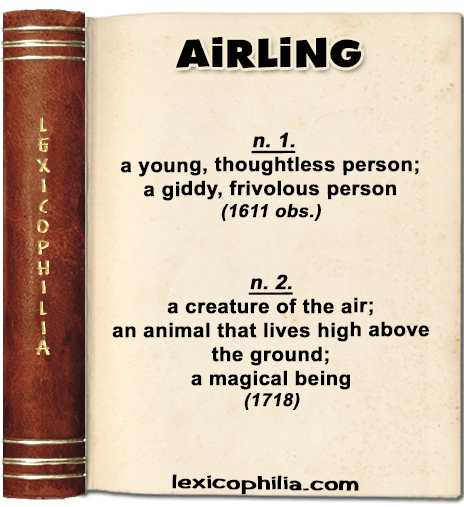
Word of the Day: AIRLING

ETYMOLOGY
apparently from air (n.) + -ling 

EXAMPLE (for n. 1.)
“… Some more there be, slight ayrelings, will be wonne,
With dogs, and horses ; or, perhaps, a whore ;
Which must be had : and, if they venter Hues,
For vs, AVRELIA, we must hazard honors
A little. Get thee store, and change of women,
As I haue boyes; and giue ‘hem time, and place, And all conniuence : be thy selfe, too, courtly ;
And entertayne, and feast, sit vp, and reuell ;
Call all the great, the faire, and spirited Dames
Of Rome about thee ; and beginne a fashion
Of freedome, and community.
…”

From: Catiline His Conspiracy
By Benjamin Jonson, 1611

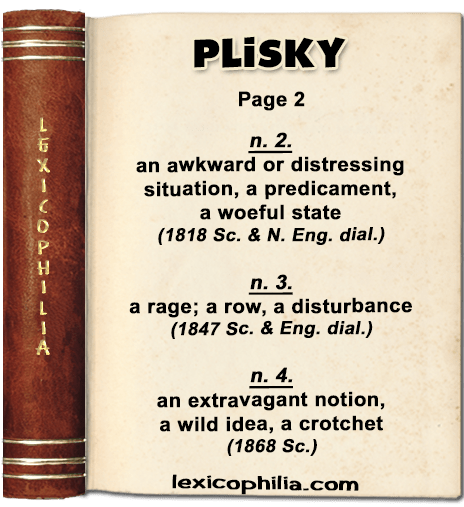
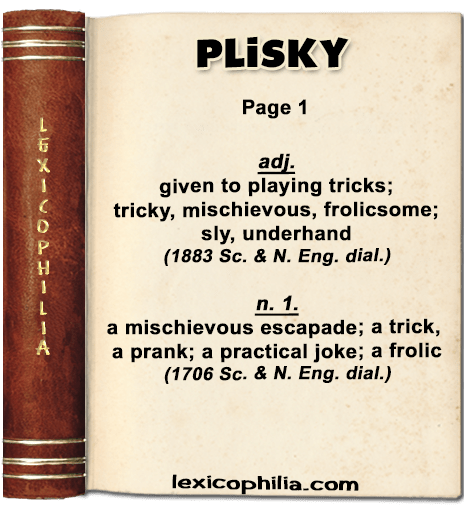
Word of the Day: PLISKY

ETYMOLOGY
of obscure origin

EXAMPLE (for n. 1.)
“… They ‘re fly’d at the heart, it’l be a black Bargain for poor Scotland: for the Engleses are owr auld farren for us, and there’s little Ground to think, they ‘ll gee
us a seen Vantage wee their will, they neer liked us sae well; and its naе forgotten yet, the foul
Plisk they play’d us about our Caledonia Business; …”

From: The Scottish Antiquary Or Northern Notes and Queries
Volume XII, January 1898
A Copy of a Letter from a Country Farmer To His Laird, a Member of Parliament, 1706

Word of the Day: DEXTERICAL

ETYMOLOGY
irregularly formed on Latin dexter (on the right hand or right side) + -ic + -al

EXAMPLE
“… It is called of the Hebrewes, … the hande of the Soule, or … the right hand of the minde, because it makes any conceit dexterical, one of the two things, for which a pregnant Poet (as imagine of Homer, Naso, or any other) especially is to be admired: …”

From: The optick glasse of humors.
Or The touchstone of a golden temperature
Or, The philosophers stone to make a golden temper.
By Thomas Walkington, 1607

Word of the Day: BAUBLING

ETYMOLOGY
from bauble (n.) + -ing

EXAMPLE (for adj. 1.)
“…euen so by the smalest booke that can be written, by ye most
babling ballet that can be made, and by the least word that can be spoken, his strange and wonderful workes in man, with his most liberall and incomparable guiftes vnto thē do as perfectly set forth and shew themselues as by the greatest volume yt euer was written, by the wayghtyest or wysest concept that euer was made, or by the most eloquente or learned oration that euer was vttered. …”

From: A Short Inuentory of Certayne Idle Inuentions
By C. Thimelthorpe, 1581

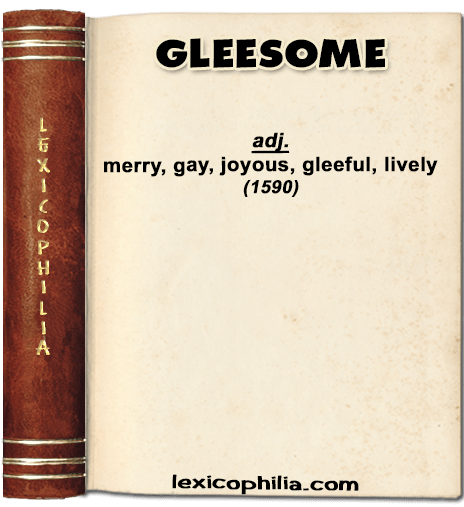
Word of the Day: GLEESOME

ETYMOLOGY
from glee (n.) + -some

EXAMPLE
“… This Smith was a quaint sire,
As merry as Bird on brier.
Iocund and
gleesome at euery sith,
His countenance aye, buxome and blith,
His face full coaly and full black,
Hued like vnto a Colliers sacke,
Or as if it had been soile in the mier,
Full of wrinkles was his cheeks with the fier
…”

From: The Merry Tales of the Cobler of Canterburie
Anonymous, 1590

Word of the Day: ALLEVE

ETYMOLOGY
from Latin adlevareallevare (to lift up, raise, relieve, lighten),
from ad– + levare (to raise )

EXAMPLE
“… there was a plat devised by me and penned by Mr. Southwell, for the winter garrison in such season as th’ enemy could not keep the field, to th’ intent his Majesty’s charges might be aleived, and the victual spared until the year should open: at which time it was thought his Majesty would resolve with what numbers his pieces might be defended. …”

From: The Works of Henry Howard, Earl of Surrey
And of Sir Thomas Wyatt, The Elder
Edited by George Frederick Nott, 1815
Letter XXVI. The Earl of Surrey to Mr. Secretary Paget, 15 March, 1544

Word of the Day: BATIE-BUM

ETYMOLOGY
apparently shortened from baty bummill (a lazy or feckless person; an idler), perhaps by association with bum (the buttocks)

EXAMPLE
“… For cozy skoug and rest;
Sae did that Abbey people a’
Effrey’t flee to the Frater-ha’,
Canon, and monk, and dean, and prior,
And
batie-bum, and beggin’ freir,
A congregation wode wi’ fear,
Though fat, in dulesome dreiry cheir:
…”

From: Papistry Storm’d
Or, The Dingin’ Down O’ The Cathedral
By William Tennant, 1827

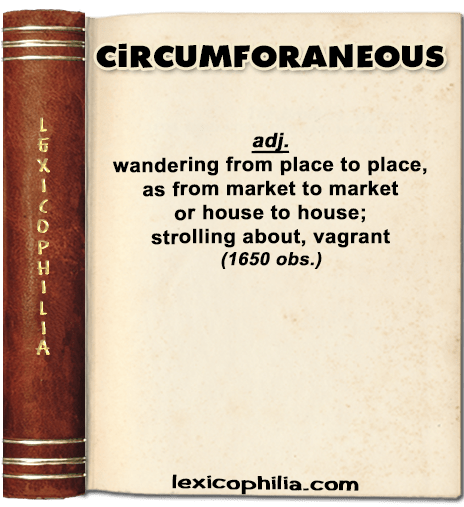
Word of the Day: CIRCUMFORANEOUS

ETYMOLOGY
from Latin circumforaneus (from circum + forum (market)) + -ous

EXAMPLE
“…  Water is good for any thing: It will part dogs, it will make Pottage, and howsoe’r and wheresoe’r the Barber found out this recipe for a dead sleep, it was no dry device, Veritatem è puteo hauriunt tantam, the truth of it is, the very Probatum for a Lethargy, and drawn out of a deep well cures a deep sleep. The Moon was alwaies beholding to the Pleiades, for waking of Endymion. I doe believe the Barber learned it of a Mountebanck, and ’twas first taught him to awaken drunken customers, who fell asleep in trimming-while, and with the sprinkling of this Frigida, were restor’d to their senses againe, and paid for the nap, as well as the snip. But the circumforaneous Emperick rais’d his Fame, in using this admirable Element upon any other disease. …”

From: Pleasant Notes upon Don Quixot
By Edmund Gayton, 1654