Word of the Day

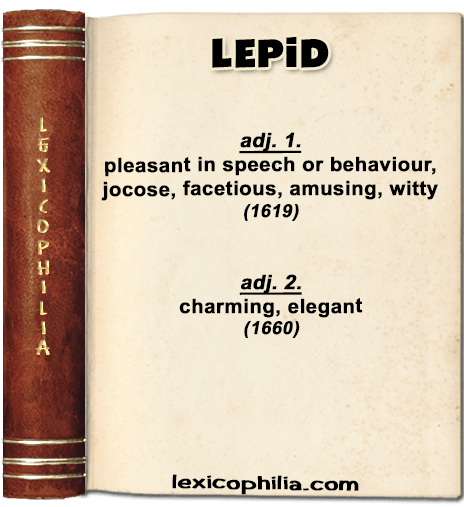
Word of the Day: LEPID

ETYMOLOGY
from Latin lepidus (pleasant; charming; witty)

EXAMPLE
“… In his daily walks into the fields, nothing pleased him so much as the chat of some well-informed fellow of the college, who would join him in quoting ‘sweet extemporaries’ from Gelius or Macrobius, or ‘in guessing at the lepid derivation’ of English words. To those who were of his own standing, it is to be feared that his conceit and pedantry proved in many cases offensive. …”

From: Simonds D’Ewes in John Howard Marsden’s College Life in the Time of James the First, 1851
Chapter IV: D’ewes’s Diligence in Study, and His Strict Observance of the Duties of Religion, c1619

Word of the Day: CONTRADICTORIOUS

ETYMOLOGY
from Latin contradictorius (contradictory) + -ous

EXAMPLE (for adj. 1.)
“… after the grete clerk Plinius, libro quinto, capitulo decimo octavo, what distaunce is betwene cenit of oure hedde and a poynte contradictorious to hit in heuyn, soe moche distaunce is from the este in to the weste;…”

From: Polychronicon 
By Ranulf Higden
Translated by John Trevisa, a1475

Word of the Day: DOG-BOLT

ETYMOLOGY
of origin uncertain

EXAMPLE (for n.1.)
“… And as for Ser John Hevenyngham, Ser John Wyndefeld, and othere wurchepfull men ben mad but here doggeboltes, the which I suppose wull turne hem to diswurchep here-after…”

From: Paston Letters and Papers of the fifteenth century
Edited by Norman Davis, Richard Beadle, and Colin Richmond, 2004
Letter from Margaret Paston to John Paston, 1465

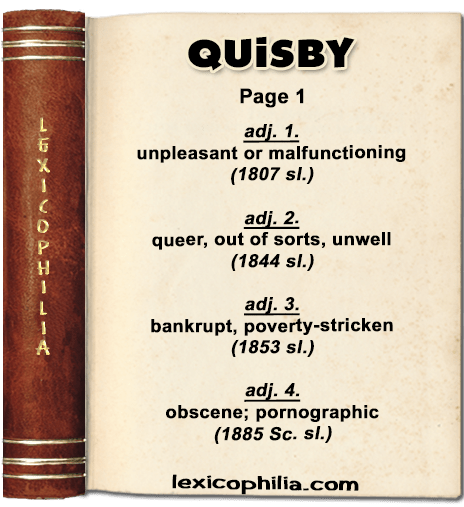
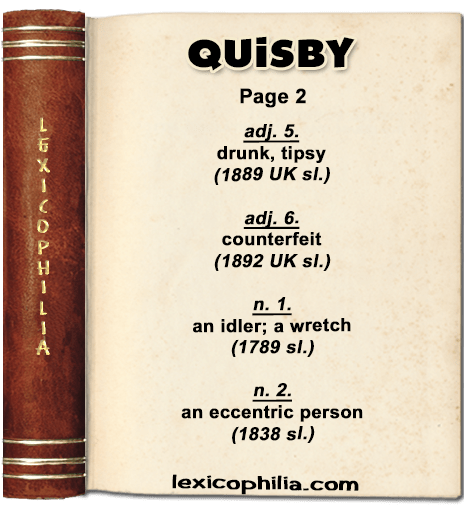
Word of the Day: QUISBY

ETYMOLOGY
of uncertain origin;
possibly from quiz (n.) + -by

EXAMPLE
“… Alibi. What wou’d I do then?
Air. Aye, Sir, what wou’d you do then?
Soph. Cou’dn’t he push a little feeble old quisby like you down into a chair?
Alibi, How, pray?
Soph. Shew him how, Robin?
Air. Why there – (puts him into a chair) Just that way
Alibi. Well, now Old Quisby’s down in the chair – what wou’d he do then?…”

From: The Toy
By John O’Keeffe, 1789

Word of the Day: MISOGELASTIC

ETYMOLOGY
from miso- (hatred or dislike of)+ Greek γελαστός (laughable) + -ic;
apparently after agelastic (never laughing, hating laughter)

EXAMPLE
“… We have in this world men whom Rabelais would call agelasts; that is to say, non-laughers; men who are in that respect as dead bodies, which if you prick them do not bleed. The old grey boulder-stone that has finished its peregrination from the rock to the valley, is as easily to be set rolling up again as these men laughing. No collision of circumstances in our mortal career strikes a light for them. It is but one step from being agelastic to misogelastic, and the μῖσογέλως, the laughter-hating, soon learns to dignify his dislike as an objection in morality. …”

From: New Quarterly Magazine, Vol. 8, 1877
On the Idea of Comedy, and of the Uses of the Comic Spirit
By George Meredith

Word of the Day: LETIFICATE

ETYMOLOGY
from Latin laetificat-, participial stem of laetificare (to make glad),
from laetificus (gladdening), from laetus (joyful)

EXAMPLE
“… There is nothing that doeth comfort the heart so much beside God, as honest myrth and good companie. And wine moderately taken, doeth letificate and doeth comforte the hearte, and good bread doeth confyrme and doeth stablyshe a mannes heart. …”

From: The Breuiary of Helthe
By Andrew Boorde, 1547

Word of the Day: RENIANT

ETYMOLOGY
from French reniant, pres. pple. of renier (to deny, renounce)

EXAMPLE
“… No helpe to me wardes is shapen: howe shal than straungers in any wyse after socoure loke, whan I that am so privy yet of helpe I do fayle? Further maye I not but thus in this prison abyde: what bondes and chaynes me holden, lady, ye se wel yourselfe? A renyant forjuged hath not halfe the care. But thus syghyng and sobbyng, I wayle here alone, and nere it for comfort of your presence, right here wolde I sterve. …”

From:
The Testament of Love
By Thomas Usk, 1388
In The workes of Geffray Chaucer newly printed. 1532

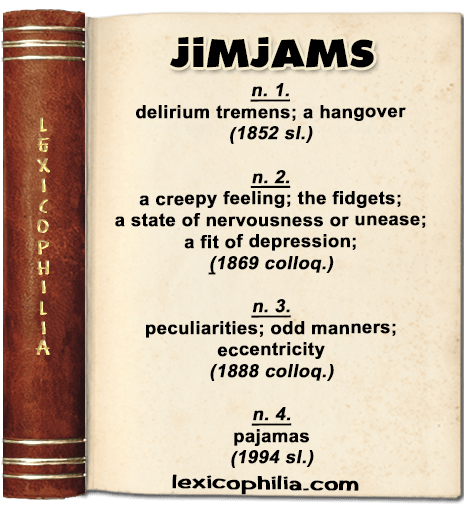
Word of the Day: JIMJAMS

ETYMOLOGY
a reduplicated term, of which the elements are unknown;
from the mid 16th century – in the singular, originally denoted a knickknack or small article

EXAMPLE (for n. 1)
“… Andy Collins, an Irishman, who has lived alone in his cabin, about a mile below us, for a year or more, has been a hard drinker ever since we have known him. He bought his rum by the gallon and kept soaked all the time. Tuesday night he had a bad attack of the jim-jams, and his nearest neighbor, O’Neil, heard him yelling and shrieking like all possessed. …”

From: The Diary of a Forty-Niner
By Chauncey Canfield, 1906
Chapter XVI, February 1, 1852