Word of the Day

Word of the Day: LONGITY

ETYMOLOGY
from Latin longitas (length, long duration), from longus (long) + -tas (-ty)

EXAMPLE
“…And had not this beene: yet if your brevity (which is but a shuffling colour, to make shewe of some things which are not) had beene turned into one yeeres or seaven yeeres longity, you could not have shewed, that in substantiall points of faith there was variace among vs. And therfore for that matter you do wel to do as you do, that is, put vp your pipes & make no more noise. …”

From: The Reasons vvhich Doctour Hill hath brought, for the Vpholding of Papistry, which is falselie termed the Catholike religion: Vnmasked and Shewed to be very weake, and vpon examination most insufficient for that purpose.
By George Abbot, 1604
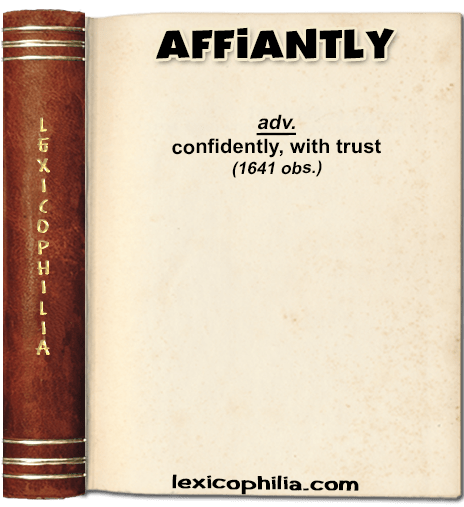
Word of the Day: AFFIANTLY

ETYMOLOGY
apparently from affy (to trust in someone or something) + – ant ‑ly 

EXAMPLE
“…St. John saith expressely, Jesus did many things which are not written. Indeed we may chuse whether we will affiantly beleeve any thing that is not written; but to say positively, It never was, because it is not written, is unworthy Hieromes learning, and is elsewhere by him rejected, out of the humour of opposition. …”

From: The Acts and Monuments of the Church Before Christ Incarnate
By Richard Montagu, 1642

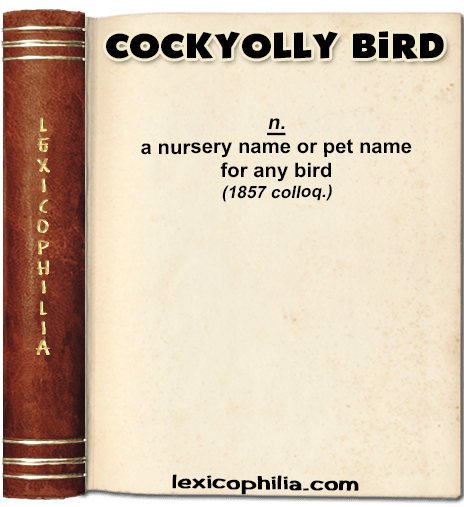
Word of the Day: COCKYOLLY BIRD

ETYMOLOGY
probably from an extended form of cock (a mature male of the domestic chicken) + bird 

EXAMPLE
“…The artist’s occupation is gone henceforth, and the painter’s studio, like ‘all charms, must fly, at the mere touch of old philosophy.’ So Major Campbell prepares the charming little cockyoly birds, and I call the sun in to immortalize them. …”

From: Two Years Ago
By Charles Kingsley, 1857

Word of the Day: HOBBLEDEHOY

ETYMOLOGY
of uncertain origin;
the first element is possibly hob (clown, prankster);
the second element may be from French de haye (worthless, untamed, wild, literally ‘of the hedge’)

EXAMPLE
“…he began to clayme or chalenge his right more and more, and to cal in good lawes … and to desyre to haue the benefite or the succour of the lawes, whiche (were good and reasonable) by whiche they stryue … men vpholde or maynteyne suche as haue ouer shotte … ouer passed theyr fyrste parte of youthe … theyr hobledehoye tyme … the yeres that one is neyther a man nor a boye, at which yeres our voyce chagetij … that suche as haue passed theyr nonage, and be no longer berdelesse boyes, be to be loused from theyr fathers right … that theyr fathers haue no longer the guyding or correction of them, but that they be set at theyr lybertie…

From: The Comedye of Acolastus
By Gulielmus Gnaphaeus
Translated by John Palsgrave, 1540

Word of the Day: FEROCIENT

ETYMOLOGY
from Latin ferocientem, present participle of ferocire (to be fierce) , from ferox (fierce)

EXAMPLE
“…November 18 about four in the morning a lamentable fire seised upon the Lord Wimbletons house in the Strand, it being then the lodging of the States Lieger Ambassador, which consumed and demolisht it with all the rich furniture and utensils to the ground; so ferocient and impetuous it was, as the Ambassadour, his wife and children hardly, though half naked, escaped; all their other apparel, Jewels, money, &c. yea even the Commission it self perisht in the combustion…

From: The Reign of King Charles
By Hamon L’Estrange, 1655

Word of the Day: PORCUS LITERARUM

ETYMOLOGY
from Latin porcus (a pig, hog) + literarum (letters, written knowledge, literature)

EXAMPLE
“…Epics he wrote and scores of rebusses,
All as neat as old Turnebus’s;
Eggs and altars, cyclopædias,
Grammars, prayer books – oh! ’twere tedious,
Did I but tell the half, to follow me,
Not the scribbling bard of Ptolemy,
No – nor the hoary Trismegistus,
(Whose writings all, thank heaven! have miss’d us,)
E’er fill’d with lumber such a ware-room
As this great “
porcus literarum!” …”

From: Epistles, Odes, and Other Poems
By Thomas Moore, 1807
“The Devil Among The Scholars”

Word of the Day: DUBITABLE

ETYMOLOGY
from Latin dubitabilis, from dubitare (to doubt)

EXAMPLE
“…Has my goodneesse,
Clemency, loue, and fauour gracious rays’d thee
From a condition next to popular labour,
Tooke thee from all the
dubitable hazards
Of Fortune her most vnsecure aduentures?
And grafted thee into a branch of honour,
And dost thou fal from the top bough by the rottennes
Of thy alone corruption, like a fruite
That’s ouer-ripned by the beames of fauour,
Let thy owne weight reward thee, I haue forgot thee
, …”

From: A Game at Chæss as it was acted nine dayes to gether at the Globe on the banks side
By Thomas Middleton, 1625

Word of the Day: RAMFEEZLED

ETYMOLOGY
apparently from Scots ram- (used with intensive force before words which generally imply something forcible, vigorous or disorderly) + the second element is obscure;
but perhaps feeze (to beat, to ‘do for’ – Eng dial.) + ‑le ‑ed 

EXAMPLE
“…The tappetless, ramfeezl’d hizzie,
She’s saft at best, an’ something lazy:
Quo’ she, ‘Ye ken we’ve been sae busy
‘This month an’ mair,
That trouth, my head is grown right dizzie,
An’ something sair.’ …”

From: Poems,
By Robert Burns, 1786
Epistle to J. L*****K,
An Old Scottish Bard.
April 21, 1785

Word of the Day: SPLENDIDIOUS

ETYMOLOGY
from Latin splendidus (bright, glittering, splendid) + -ious

EXAMPLE
“…Of whom Gregorius Naz[i]anzen spekethe, seyenge, “Suche men reprove liȝhtely straunge thinges, but vnnethe with grete difficulte thei folowe goode thynges.” Wherefore y seenge the poverte and insufficience of my connynge after so splendidious laboures dredde to proferre a raw thynge with bareyne eloquence and to purpose as a thynge bytter to so mellifluous delices….”

From: Polychronicon Ranulphi Higden maonachi Cestrensis
By Ranulf Higden 
Translated by John Trevisa, a1475

Word of the Day: DIGLADIATE

ETYMOLOGY
from Latin digladiari from di-dis- (asunder, in different directions) + gladius (a sword)

EXAMPLE
“…For what else are the Writings of many men, but mutual Pasquils and Satyrs against each others lives, wherein digladiating like Eschines and Demosthenes, they reciprocally lay open each others filthiness to the view and scorn of the world. The fear therefore of being stained, and publickly disgraced, might be reason enough to keep them back from entring these contentions. …”

From: Golden Remains of the Ever Memorable Mr. John Hales
By John Hales, 1659