Word of the Day

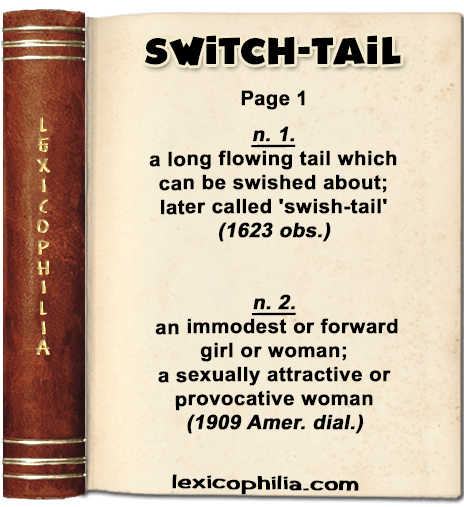
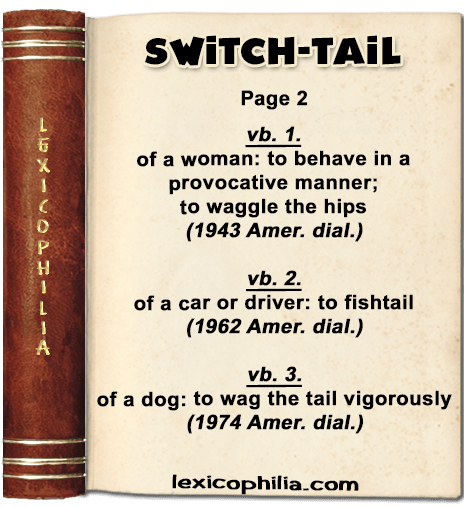
Word of the Day: SWITCH-TAIL


ETYMOLOGY
from switch + tail


EXAMPLE 1 (for n.1)
“…she was observed to ride forth in a Cavalcade somewhat extraordinary pleasant , viz. a good rich Velvet Saddle, and fashionable upon a sorry Horse with a Switch-Tail that us’d to carry Lime, and not Ladies; A gentile Surtout or riding-Suit; with her Shoulders warmly wrapt up in a good White Serge whittle: A pretty handsome Commode of the newest fashion, upon which was gracefully plac’d a good homely Straw Hat, with a long Pole like a Sugar Loaf, so that Cit and Bumpkin seem’d never better met or set off since the Creation …”

From: The Adventures of the Helvetian Hero, with the Young Countess of Albania;
Or, The Amours of Armadorus and Vicentina: a Novel
Unknown author, 1694


EXAMPLE 2 (for n. 2.)
“…I can look a gangster in the eye and make him change his mind, but I can’t do a thing with a woman no more. At one time I had nine big switch-tail women on my personal payroll, and they all stole from me, picked me clean. Buzzards!

From: McSorley’s Wonderful Saloon
By Joseph Mitchell, 1943

Word of the Day: TERRACULTURE


ETYMOLOGY
irregularly from Latin terra (earth) + culture


EXAMPLE
“…We venture at the outset to introduce a new term, and that for the only justifiable reason, viz: because there is no single word heretofore in use in our language expressive of the idea we wish to express. Agriculture is the culture of the field, and includes the operations of farming or the tillage of large portions of land. Horticulture is the culture of the garden, and has reference to the production of kitchen vegetables, fruits and flowers. We have often felt at a loss for a word to include all these, and as Terraculture, or the culture of the earth, exactly expresses the idea, and as it is derived from the Latin in a manner exactly similar to the other terms, we think there must result a decided advantage from its introduction. It comprehends all things which are produced from the earth, by the labor of man and beast, through the agency of vegetable life. Every thing that germinates and grows by receiving its nourishment from the soil, belongs to this department…”

From: The Franklin Farmer,
Devoted to Improvements in the Science of Agriculture, the Practice of Husbandry, and the Mind, Morals, and Interests, of the Cultivators of the Soil.
Vol. I., Edited by Tho. B. Stevenson, 1837-8

Word of the Day: MISPROUD


ETYMOLOGY
from mis- (wrong, unfavourably) + proud


EXAMPLE 1
“…Ȝyf a man haue mysdo or seyde,
And men hym blame for þat mysbreyde,
Ȝyf he susteynë hys mysdede,
And hys mysawe wyl nat drede,
Þat cumþ of mysprout herte and hy
Þat wyl nat knowe hys owne foly
…”

From: Robert of Brunne’s “Handlyng Synne” (Harley MS)
By Robert Mannyng, a1400


EXAMPLE 2
“…It was in 1397, ninety years since the first assertion of Swiss independence, when Leopold the Handsome, Duke of Austria, a bold but misproud and violent prince, involved himself in one of the constant quarrels with the Swiss that were always arising on account of the insulting exactions of toll and tribute in the Austrian border cities…”

From: A Book of Golden Deeds of All Times and All Lands
By Charlotte Mary Yonge, 1864

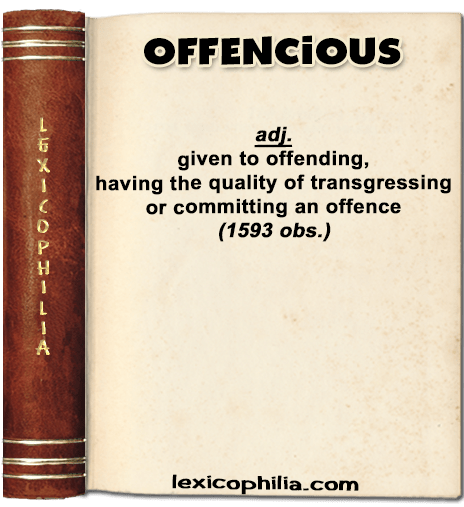
Word of the Day: OFFENCIOUS


ETYMOLOGY
from offence (an illegal act) + -ious


EXAMPLE
“…Retes
Tis Ramus, the Kings professor of Logick.

Guise,
Stab him.

Ramus.
O good my Lord, wherein hath Ramus been so offencious.

Guise.
Marry sir, in hauing a smack in all,
And yet didst neuer sound any thing to the depth.
Was it not thou that scoftes the Organon,
And said it was a heape of vanities?
He that will be a flat decotamest,
And seen in nothing but Epetomies:
Is in your iudgment thought a learned man….”

From: The Massacre at Paris:
With the Death of the Duke of Guise
By Christopher Marlowe, a1593

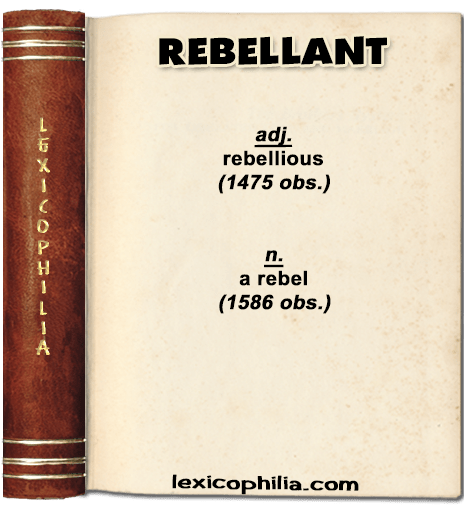
Word of the Day: REBELLANT


ETYMOLOGY
from Old French rebellant, pr. pple. of rebeller (to rebel),
(used as adj. and n. in 14th–16th c.)


EXAMPLE 1 (for adj.)
“…That other infortuny is exterialle, that man scholde haue his inferior rebellante to hym, in that he was inobediente to God his maker…”

From: The Chronicles and Memorials of Great Britain and Ireland During the Middle Ages,
Edited by Churchill Babington, 1869
Polychronicon Ranulphi Higden Monachi Cestrensis (Harley MS. 2261)
By Ranulf Higden


EXAMPLE 2 (for n.)
“…With Tantalus hild starued Ghosts, whose pleasure was their paine,
Whose euer Hords had neuer vse, and gettings had no gaine.
To Besides assisted Soules of Vnthrifts, whose supplies
Did passe from them as Sea through Cieues, whose wastes no wealthes suffise.
Vnto Ixeon stood their Sprights that had their lusts for law,
Rebellants to a common good, and sinning without awe.
To Titius lastly ioyned Ghosts, whose hearts did emptie hate
As Todes their poyson, growing when it seemeth to abate.…”

From: Albions England; or, historicall map of the same island 
By William Warner,

Word of the Day: EXFLUNCTICATE


ETYMOLOGY
quasi-Latin elaboration of flunk (to fail)


EXAMPLE
“…Though at my old Kenawa home,
They named me there afore I come,
For short, and caze it was my natur,
‘Half hoss and half an alligator’;
But that is nuther here nor there;
But I’m resolved, and now declare,
I’ll go along with you and fight,
As long as I can see the light;
If not, may I be regulated, —
Tee-totally exfluncticated
…”

From: The Forest Rangers:
A Poetic Tale of the Western Wilderness in 1794
By Andrew Coffinberry, 1842

Word of the Day: KITCHENIST


ETYMOLOGY
from kitchen (n.) + -ist


EXAMPLE
“…If, notwithstanding All that hath bin said,
TOBACCONISTS will still hold on their Trade,
And by their Practice still hold vp their Name,
Though Iewes, though Diuels, better suite the same;
I’le say no more but only This, of This:
Henceforth, let none whose meaner Lot it is
To liue in Smoak; Lime-burners, Alchymists,
Brick-makers, Brewers, Colliers, Kitchenists;
Let Salamanders, Swallowes, Bacon-stitches,
Red-Sprats, red-Herings, and like Chimnie-wretches,
Think no Disparagement, nor hold them base:
TOBACCONISTS their Companie will grace,
And teach them make a Vertue of Necessitie
…”

From: Tobacco Battered; & the pipes shattered
By Josuah Sylvester, 1617

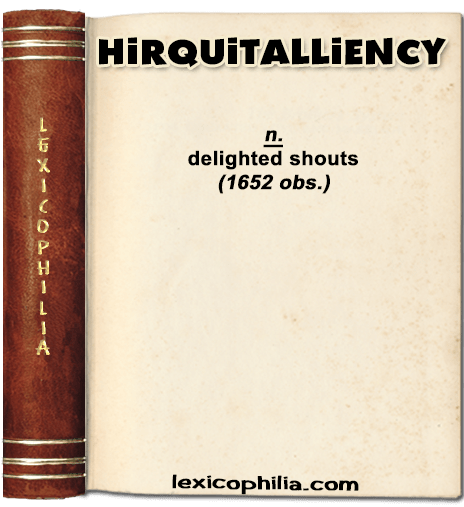
Word of the Day: HIRQUITALLIENCY


ETYMOLOGY
from Latin hirquitallire (of infants: to acquire a strong voice) [from hircus (he-goat)] + -ency


EXAMPLE
“…Here it was that passion was active, and action passive, they both being overcome by other, and each the conquerour. To speak of her hirquitalliency at the elevation of the pole of his microcosme, or of his luxuriousness to erect a gnomon on her horizontal dyal, will perhaps be held by some to be expressions full of obscoeness, and offensive to the purity of chaste ears; yet seeing she was to be his wife, and that she could not be such without consummation of marriage, which signifieth the same thing in effect, it may be thought, as definitiones logicae verificantur in rebus, if the exerced act be lawful, that the diction which suppones it, can be of no greater transgression, unless you would call it a solaecisme, or that vice in grammar which imports the copulating of the masculine with the feminine gender…”

From: Εκσκυβαλαυρον (Ekskybalauron – The Jewel )
By Sir Thomas Urquhart, 1652

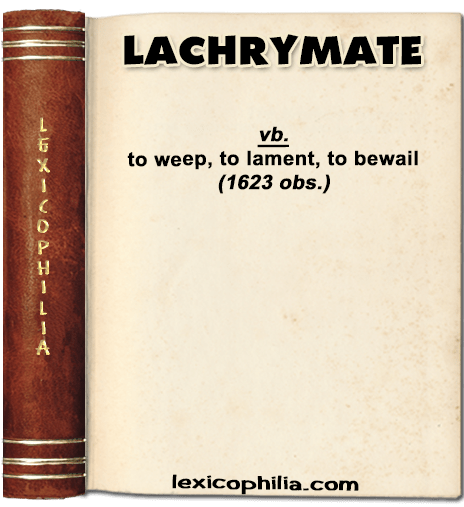
Word of the Day: LACHRYMATE


ETYMOLOGY
from Latin lacrimat-, past participial stem of lacrimare (to weep),  from lacrima (tear)


EXAMPLE
“…Whose cruell tortures did infest her heart:
For ev’ry one did taxe this Virgins Fate,
And her sad sorrowes caus’d them Lachrymate:
Since in her passions she was so extreame,
For to her griefe she limited no meane;
Which so surprest her, that she seem’d ro bee
The very abstract of calamity
…”

From: A small treatise betwixt Arnalte and Lucenda
entituled The Evill-Intreated Lover, or The Mmelancholy Knight
By San Pedro de Diego
Translation by L. Lawrence, 1639


PRONUNCIATION
LACK-ruh-mayt

Word of the Day: MIMPETTY MIMP


ETYMOLOGY
from mimp (prim, precise, affected; also, n. a prim or affectedly modest woman)


EXAMPLE
“…It is not many people indeed I should praise so warmly; but as to all squeamish prudery in not speaking what one thinks, I’ve no notion of it, though I am so teased and so lectured by the old folks that I sit mimpetty mimp before them merely for peace sake; but I don’t see why one may not admire an handsome man as well as an handsome stature, or an handsome animal, or any thing else that is beautiful…”

From: The Young Philosopher: 
A Novel in Four Volumes
By Charlotte Smith, 1798