Word of the Day

Word of the Day: CLIP-SHEARS


ETYMOLOGY
formed by compounding clip (that which is clipped or cut);
apparently from the form of its feelers, as having some resemblance to a pair of shears, 
or scissors


EXAMPLE
“…turned out their russet recesses to the birsling sun, and the foggie-toddlers hirpled about their business in the warm sod, among golacks and clip-shears, while the grasshoppers chirped in merry concert…”

From: Proceedings of the Philosophical Society of Glasgow
Edited by Agnes McLean, Vol. XXX. 1898
V. Dr. James Colville on the Scottish Vernacular.
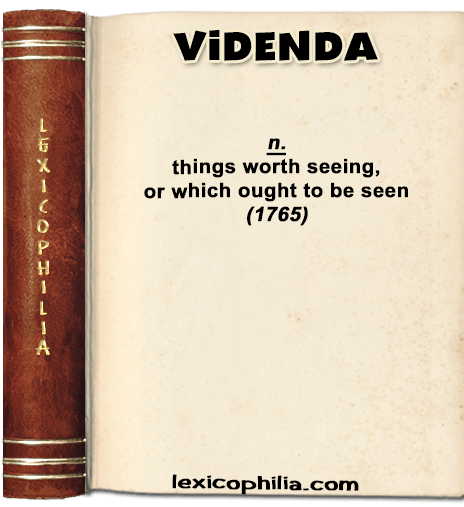
Word of the Day: VIDENDA


ETYMOLOGY
Latin, plural of videndum, from videre (to see)


EXAMPLE
“…In my list, therefore, of Videnda at Lyons, this, tho’ last, – was not, you see, least; so taking a dozen or two of longer strides than usual cross my room, just whilst it passed my brain, I walked down calmly into the basse cour, in order to sally forth; and having called for my bill – as it was uncertain whether I should return to my inn, I had paid it – had moreover given the maid ten sous, and was just receiving the dernier compliments of Monsieur Le Blanc, for a pleasant voyage down the Rhône – when I was stopped at the gate…”

From: The Life and Opinions of Tristram Shandy, Gentleman
by Laurence Sterne, 1765

Word of the Day: FADOODLE


ETYMOLOGY
apparently a random formation, possibly influenced by doodle (n.) and perhaps also fopdoodle (n.)


EXAMPLE
“…But to look for such things from a revengful mind, is as unlikely as to make the bristly skin of a Hedghog smooth. And when all the Stuff in the Letters are scann’d, what Fadoodles are brought to light?…”

From: Scrinia Reserata a Memorial Offer’d to the Great Deservings of John Williams
By John Hacket, 1693

Word of the Day: TALLYDIDDLE


ETYMOLOGY
variant of taradiddle (a trifling falsehood, a petty lie)


EXAMPLE
“…Oh, don’t call them lies, sister; it’s such a strong, ugly word. Please call them tallydiddles, for I don’t believe she meant any harm. Besides – besides – if they should turn out to be truth? Really, sister, that’s the weight on my mind; so many things sounded as if they might be true…”

From: Wives & Daughters
By Elizabeth Gaskell, 1866

Word of the Day: DOWSABEL


ETYMOLOGY
from the female forename Dowsabel (also DowsabellDousabella);
probably from Anglo-Norman and Old French douce (quiet, sedate, prudent) + ‑abel (in the female forenames AmabelIsabelMirabel);
perhaps originally used as the name of a character in a lost romance


EXAMPLE
“…With thinking on the booties, Dol., brought in
Daily, by their small parties. This deare houre,
A doughtie Don is taken, with my Dol.;
And thou maist make his ransome, what thou wilt,
My Dousabell: He shall be brought here, fetter’d
With my faire lookes, before he sees thee; and throwne
In a downe-bed, as darke as any dungeon
…”

From: The Alchemist
By Ben Jonson, 1612

Word of the Day: SACRIPANT


ETYMOLOGY
from French Sacripant, from Italian Sacripante, a character in Boiardo’s Orlando innamorato


EXAMPLE
“…He is surprised by a nymph of exquisite loveliness, who vainly assails his constancy, and who is  at length seized by the supervening  Itifal, a Sacripant of  knighthood.  The adventures in general  are spun out and interrupted by flat conversations…”

From: Historic Survey of German Poetry
By William Taylor, 1829

Word of the Day: ZOOPHILIST


ETYMOLOGY
from  zoo + -philist; from Greek ϕίλος (loving, dear) + ‑ist


EXAMPLE
“…A foreigner in America has recently discovered a species of animal which is likely to become as great a favourite among our female zoophilists, and may, perhaps, in future, banish the lap-dog from the drawing-room and the bed-chamber…”

From: The London and Paris Observer:
Or Weekly Chronicle of News, Science, Literature, and the Fine Arts
Volume 5, 1829

Word of the Day: HIRPLE


ETYMOLOGY
of unknown origin;
the coincidence in sound and sense with Greek ἕρπειν from ἕρπω (hérpō) (to move slowly),
is noticeable.


EXAMPLE
“…The bull: the beir: the bugill: and the bair:
The wodwys: vildcat: and the wild wolfyne:
The hardbakkit hurcheoun: and the hirpland hair:
Baith otter and aip: and pennit porcupyne.
The gukit gait: the selie scheip the swyne:
The bauer bakon and the balterand brok:
The fowmart, with the fyber furth can flok
…”

From: The Morall Fabillis of Esope the Phrygian
“The taill of the sone & air of the forsaid foxe”
Robert Henryson, a1500

Word of the Day: GARBOIL


ETYMOLOGY
apparently from Old French garbouille (confused mess, confusion, disorder), of uncertain and disputed origin;
From the O.E.D.: “it is likely that this word and the related garboil v. have been associated with garble v. and garble n., and probably regarded as variants of these”


EXAMPLE
“…and after long and mature debating off the mattar, forasmuch as itt appeared the Mayor to have ben a great sturrer of this garboyle, and to be a man that att sondry tymes hadde deluded wyth delayes the sayde commissioners whereby the matter cowlde grow to none ende…”

From: Selections from the Records of the City of Oxford
Edited by Willilam H, Turner, 1880
1543, May 22. Decree of the Privy Councell in the matters of Difference between the University and City.