Word of the Day

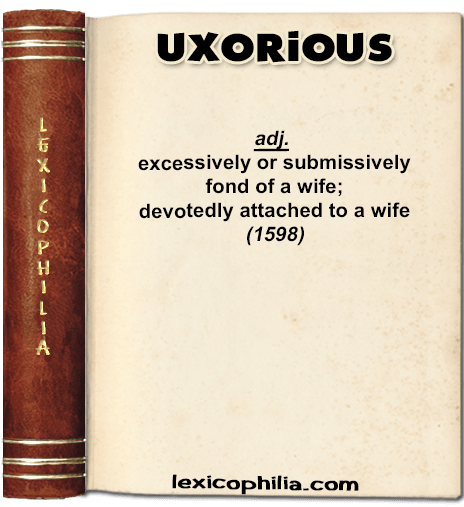
Word of the Day: UXORIOUS


ETYMOLOGY
from Latin uxorius (from uxor (wife))


EXAMPLE
“…And gripe their wast within a narrow span:
Fond Caenis that would’dst wish to be a man;
Whose mannish Hus-wiues like their refuse state,
And make a drudge of their vxorius mate,
Who like a Cot-queene freezeth at the rocke,
Whiles his breach’t dame doth man the forren stock
…”

From: Virgidemiarum. The three last bookes
By Joseph Hall, 1598


PRONUNCIATION
uk-SOR-ee-uhss

Word of the Day: REFICIATE


ETYMOLOGY
irregular from Latin reficere (to rebuild, repair, restore) + -ate


EXAMPLE
“…Bay-berryes calefye much, siccate, attenuate, and discusse flatuosity: they are mixed with medicaments that reficiate the lassitude of the nerves; and with unguents, which calefye and resolve; their oyle expressed or elicited by decoction, deleats and cures scabs, blew places, wheales, and many faedityes of the skin, and discusses effused humours…”

From: A Medical Dispensatory; Containing the Whole Body of Physick
By Jean de Renou, 1657

Word of the Day: NUM-CUMPUS


ETYMOLOGY
dialect corruption of non compos mentis (not of sound mind)


EXAMPLE
“…Sa like a graät num-cumpus I blubber’d awaäy o ‘ the bed-
” Weänt niver do it naw moor; an ‘ Sally loookt up an ‘ she said ,
” I’ll upowd it tha weänt ; thou’rt laike the rest o ‘ the men,
Thou’ll goä sniffin ‘ about the tap till tha does it agëan.
Theer’s thy hennemy, man, an’ I knaws, as knaws tha sa well,
That, if tha seeäs ’im an’ smells ’im tha’ll foller ’im slick into Hell
…”

From: The Complete Poetical Works of Alfred Tennyson, 1882
Ballads and Other Poems
‘The Northern Cobbler’

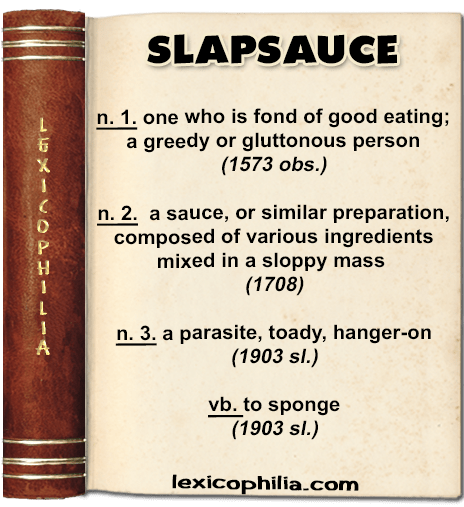
Word of the Day: SLAPSAUCE


ETYMOLOGY
from slap (to lap → Eng. dial.) + sauce


EXAMPLE
“…At dinner and supper the table doth craue
good fellowly neighbour good manner to haue.
Aduise thee well therefore, ere tongue be too free,
or slapsauce be noted too saucie to bee…”

From: Points of Huswifrie
In Fiue Hundreth Points of Good Husbandry
By Thomas Tusser, 1573

Word of the Day: UNFORTUNABLE


ETYMOLOGY
from un- + fortunable (favoured by fortune, fortunate → obs.)


EXAMPLE
“…Is not the Realme of Scotland rich ynough to nourish and to bring hir vp? by God, this manner of doing of king Lisuard is so vnfortunable and so farre out of reason, that I had rather die a hudreth fold (if it were possible) than not to be reuenged: and already I haue sent to my father to prouide therefore…”

From: Amadis de Gaula 
Translated out of French into English by Thomas Paynell, 1567

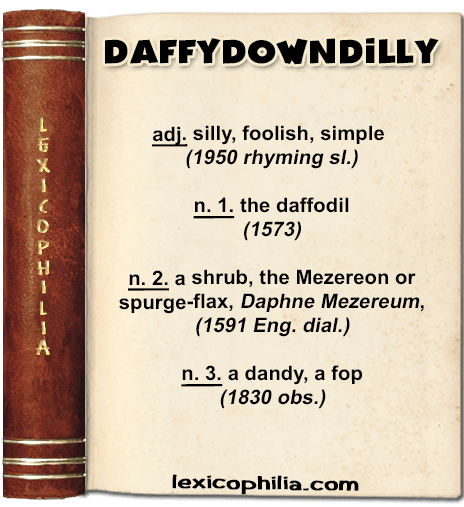
Word of the Day: DAFFYDOWNDILLY


ETYMOLOGY
n. 1. a playful expansion of daffodilly. (from daffodil + -y);
n. 2: so called in Yorkshire from the slight similarity of the Greek name Daphne with Daffodil


EXAMPLE

“…Herbes, branchis & flowers for windowes & potts
• 1 Bayes, sowe or set in plants in Ianuarie.
2 Batchelers buttens,
3 Botles, blewe, red & tauney,
4 Collembines.
5 Campions.
6 Daffadondillies.
7 Eglantine, or swete bryer.
8 Fetherfewe.
9 Flower armour, sowe in Maye.
10 Flower deluce,
11 Flower gentil, whight & red.
12 Flower nyce.
13 Gelyflowers, red, whight & carnacions, set in Spring, & Heruest in potts, payles or tubs, or for sommer in bedds.
14 Holiokes, red, whight & carnacions.
15 Indian eye, sowe in Maye, or set in slips in March.
16 Lauender, of al sorts
…”

From: Fiue Hundreth Points of Good Husbandry
By Thomas Tusser, 1573

Word of the Day: REBARBATIVE


ETYMOLOGY
from French rebarbatif (repellent, disagreeable),
from rebarber (to oppose, to stand up to; referring to two men squaring up face to face, beard to beard, aggressively) + -atif


EXAMPLE
“…It is not very clear why Sir Robert Coke (for that is his name) bestows so much trouble and time on this very rebarbative lady; it certainly is not for her undisguised admiration of him, as his own fascinations as well as his position enable him to command as much admiration as he cares for, and, besides, he seems to find it embarrassing; and it is not for the sake of her personal beauty, for she has none…”

From: The Saturday Review of Politics, Literature, Science and Art
Volume 74, November 12, 1892
‘Mrs Bligh’


PRONUNCIATION
ruh-BAR-buh-tiv