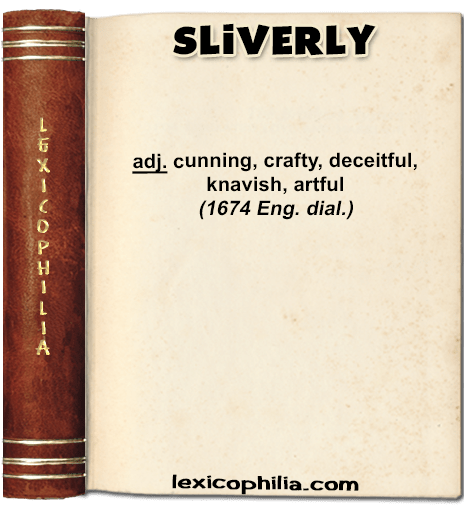
ETYMOLOGY
of unknown origin
EXAMPLE
“…He’s a a real down sliverly chap , I wouldn’t hev nowt to do wi ‘ him if I was you…”
From: Glossary of Words Used in the Wapentakes of Manley and Corringham,
Edward Peacock, 1877
ETYMOLOGY
of unknown origin
EXAMPLE
“…He’s a a real down sliverly chap , I wouldn’t hev nowt to do wi ‘ him if I was you…”
From: Glossary of Words Used in the Wapentakes of Manley and Corringham,
Edward Peacock, 1877

ETYMOLOGY
from Latin aromata or French aromat, as if adapted from Latin aromatosus or French aromateux
EXAMPLE
“…And thenne it hath vertue tascende by the lightnes of the fume and to comforte by his qualite and to conioyne by the gumme and to conferme by that it is aromatous or wel smellyng. And all in lyke wyse i the orison or prayer whiche ascendeth to the mynde of god. It conforteth the soule as to the synne passed in axyng medecyne…”
From: Legenda Aurea/The Golden Legend
By Jacobus de Voragine
Translated by William Caxton, 1483
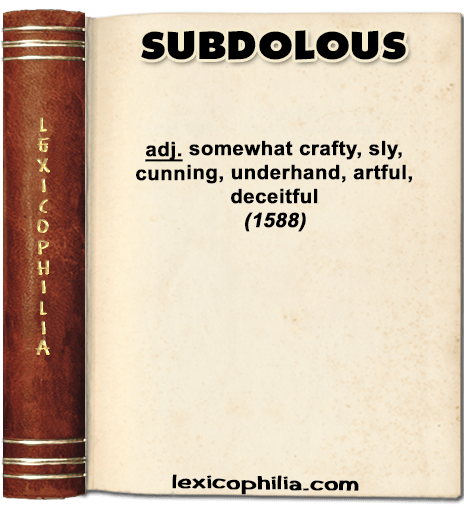
ETYMOLOGY
either from late Latin subdolosus (rather cunning), from classical Latin subdolus (sly, deceitful, treacherous) + -osus (-ous),
or from classical Latin subdolus (sly, deceitful, treacherous) (from sub- (sub-) + dolus (dole – the corrupt, malicious, or evil intention essential to the guilt of a crime)) + -ous
PRONUNCIATION
SUB-duh-luhss
EXAMPLE
“…The subdolous crafte and deceate of Satan…”
From: Ane Cathechisme or Schort Instrvction of Christian Religion
By Peter Canisius
Translated by Adam King, 1588

ETYMOLOGY
from medieval Latin accidiosus (listless, slothful),
from accidia (slothfulness, apathy, lethargy) + Latin -osus (-ous)
PRONUNCIATION
uhk-SID-ee-uhss
EXAMPLE
“…Þe accidious man haþ ydilnesse, sleuþe, & sleep for his god…”
From: The Pore Caitif, edited from MS. Harley, a1400
(a late fourteenth-century Middle English manual of religious instruction intended for the use of the laity)
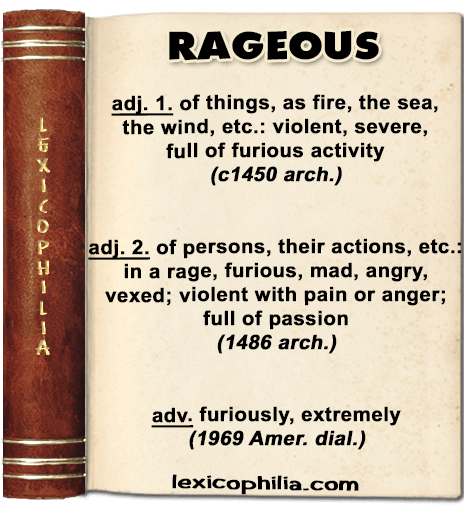
ETYMOLOGY
partly from Anglo-Norman ragous (raging), from rage (rage) + -ous,
and partly directly from rage (n.) + -ous
EXAMPLE (for adj. 1)
“…What nede y spende more enke or parchement,
That fele the crampe of deth myn hert so nyghe
As thorugh this rageous fyre which hath me hent?
Thus calle y for yowre socoure pitously…”
From: The English Poems of Charles of Orleans
Edited by R. Steele, 1941
Fortunes Stabilnes, c1450
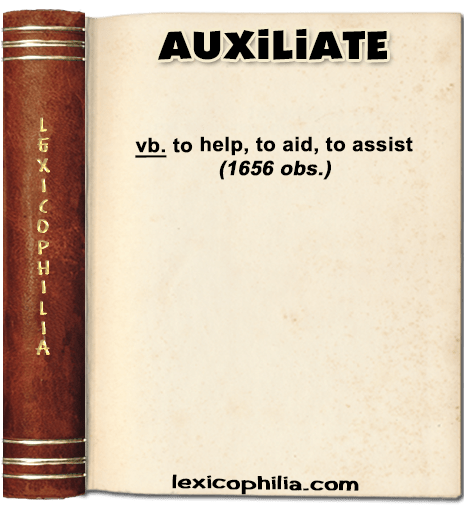
ETYMOLOGY
from Latin auxiliat- ppl. stem of auxiliari (to help, to assist)
EXAMPLE
“…of which are some Plants, or parts thereof, and some Minerals, which being absolutely described, put the Apothecary upon doubts, who is ignorant of the genuine dilucidation: whose tenuity, that we may auxiliate, we will give him the names of the five opening roots; and they are the roots of Smallage, Sperage, Parsley, Fennel, and Butchers-broom. Besides which, other five are much celebrated, to wit, the roots of Grass, the greater Madder, Oenone, Ca∣pers, and Eryngium…”
From: A Medical Dispensatory
Containing the Whole Body of Physick
Composed by the Illustrious Renodaeus,
Englished and Revised by Richard Tomlinson, 1657
The Fourth Book Of Roots
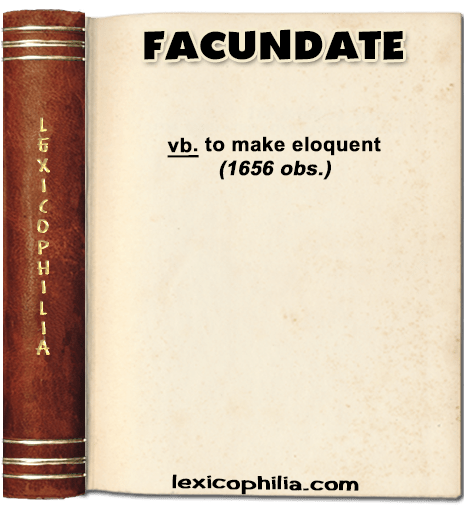
ETYMOLOGY
from facund (eloquent) + -ate
EXAMPLE
To facundate your writing , you need to understand the subtleties and nuances of language.

ETYMOLOGY
from wight (strong and courageous, esp. in warfare) + -ling (with the sense a person belonging to or concerned with)
EXAMPLE
“…Now, wiþ outen more dueling,
Galathin com swiþe flinge
Wiþ þre þousand wiȝtling
& smot oȝain þat heþen king…”
From: Arthour and Merlin;
an anonymous Middle English verse romance giving an account of the reigns of Vortigern and Uther Pendragon and the early years of King Arthur’s reign, c1330
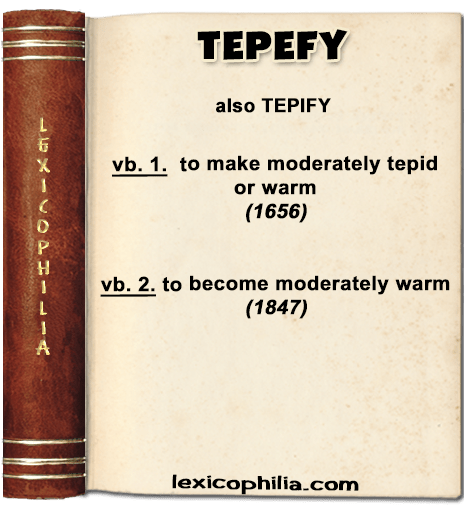
ETYMOLOGY
from Latin tepefacere (to make tepid),
from tepere (to be lukewarm)
EXAMPLE (for vb. 1)
“…Sonorous, thro’ the patient’s bosom pours
Its antidotal notes, the flood of life,
Loos’d at its source by tepefying strains,
Flows like some frozen silver stream unthaw’d
At a warm zephyr of the genial spring…”
From: The Power of Harmony
By John Gilbert Cooper, 1745
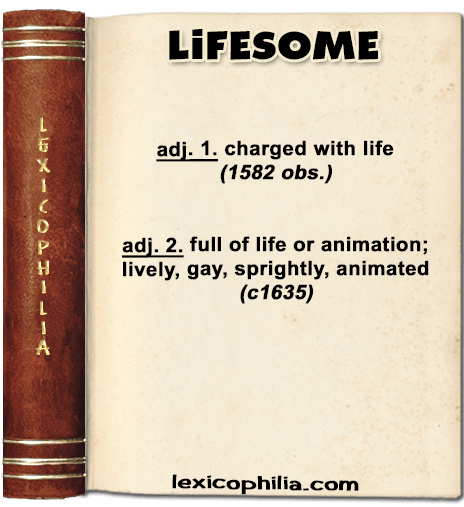
ETYMOLOGY
from life (n.) + -some
EXAMPLE (for adj. 1)
“…If badd, how happ’s that none his hurtes disproue?
If willingly I burne, how chance I waile?
If gainst my will, what sorrow will auaile?
O liuesome death, O sweete and pleasant ill,
Against my minde how can thy might preuaile?
If I bend backe, and but refraine my will,
If I consent, I doe not well to waile…”
From: ἐκατομπαθία: The Hekatompathia or Passionate Centurie of Loue
By Thomas Watson, 1582
 Lexicophilia