Word of the Day

Word of the Day: BUMFEG


ETYMOLOGY
of uncertain origin;
possibly from bum (to give a beating to, especially as a punishment) + feague (to beat, to whip)


EXAMPLE
“…I wil presently proue both maior and minor of this sillogisme. And hold my cloake there sombody, that I may go roundly to worke. For ise so bumfeg the Cooper, as he had bin better to haue hooped halfe the tubbes in Winchester, then write against my worships pistles…”

From: The Marprelate Tracts
‘Penned and compiled by Martin the Metropolitane’
Hay Any Worke for Cooper, 1523

Word of the Day: SPARROW-FART


ETYMOLOGY
from sparrow + fart


EXAMPLE (for n. 2.)
“…Miss This Miss That Miss Theother lot of sparrowfarts skitting around talking about politics they know as much about as my backside anything in the world to make themselves someway interesting Irish homemade beauties soldiers daughter am I ay and whose are you bootmakers and publicans I beg your pardon coach I thought you were a wheelbarrow…”

From: Ulysses
By James Joyce, 1922

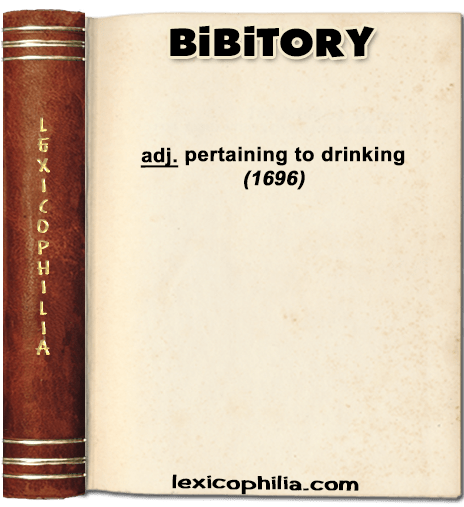
Word of the Day: BIBITORY


ETYMOLOGY
from modern Latin bibitorius, from  bibit- ppl. stem of bibere (to drink)


EXAMPLE
“…The verdict does not favour total abstinence, though it is decidedly against bibitory indulgence. It was clear from the close study of the patient – who was so well-formed and healthy that hey may be regarded corporeally as a typical man – that alcohol was not necessary to him…”

From: The Gentleman’s Magazine and Historical Chronicle
Volume 229, 1870
Notes and Incidents

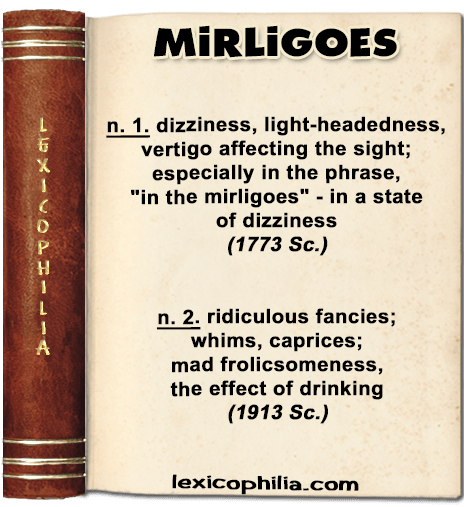
Word of the Day: MIRLIGOES


ETYMOLOGY
of uncertain origin;
perhaps from Scots mirl (to speckle, to spot),
with reference to the pattern seen before the eyes when in a state of dizziness + -igo 


PRONUNCIATION
MUR-luh-gohz


EXAMPLE
“…Sure Major Weir, or some sic warlock wight,
Has flung beguilin’ glamer o’er your sight;
Or else some kittle cantrup thrown, I ween,
Has bound in mirlygoes my ain twa ein,
If ever aught frae sense cou’d be believ’d
(And seenil hae my senses been deceiv’d),
This moment, o’er the tap of Adam’s tomb,
Fu’ easy can I see your chiefest dome:
Nae corbie fleein’ there, nor croupin’ craws,
Seem to forspeak the ruin of thy haws,
But a’ your tow’rs in wonted order stand,
Steeve as the rocks that hem our native land
….”

From: The Poems of Robert Fergusson
By Robert Fergusson, 1785
The Ghaists: A Kirk-yard Eclogue

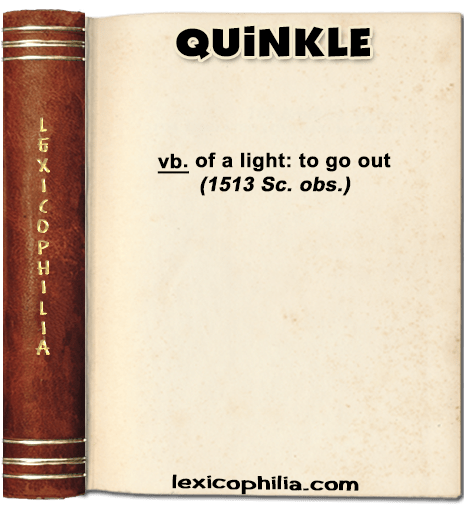
Word of the Day: QUINKLE


ETYMOLOGY
of uncertain origin;
apparently formed on quink = Old English cwincan (to go out, be extinguished)


EXAMPLE
“…The lycht begouth to quynkill owt and faill,
The day to dyrkyn, decline, and devaill;
The gummys rysis, doun fallis the donk rym,
Baith heyr and thair scuggis and schaddois dym
…”

From: Translation of Virgil, Æneid
By Gawin Douglas, 1513

Word of the Day: VOUTER


ETYMOLOGY
aphetic formed on avouter (an adulterer, esp. a male one);
in its oldest form from Old French avoutre, aoutre


EXAMPLE
“…For in þis werlde is no doge for þe bowe
þat knowe an hurt dere fro an holde bet cowe
þan þis Somenour knewe a licour
Or a vouter or elles a paramour
And for þat was þe fruyte of al þe rente
Ther-for on it he set al his entente
…”

From: The Lansdowne Manuscript of Chaucer’s Canterbury Tales,
Geoffrey Chaucer, c1386

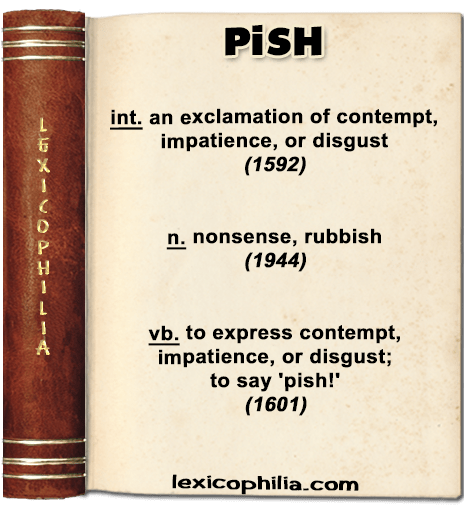
Word of the Day: PISH


ETYMOLOGY
an imitative or expressive formation


EXAMPLE
“…Hoe! God, be here! on their bald, burnt, parchment pates. Pish, pish! what talke you of olde age or balde pates? Men and women that haue gone vnder the south pole, must lay of theyr furre night-caps in spyght of their teeth, and become yeomen of the vineger bottle…”

From: Pierce Penilesse, His Supplication to the Diuell
By Thomas Nashe, 1592

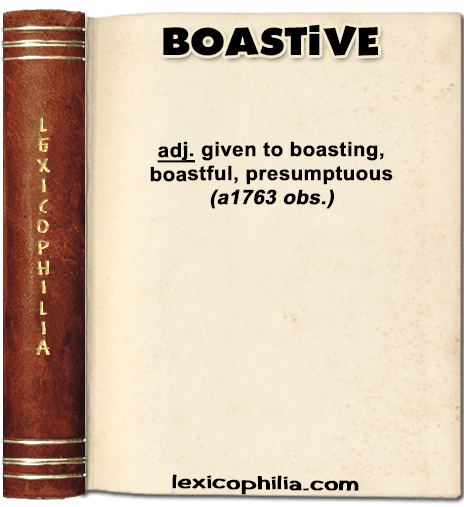
Word of the Day: BOASTIVE


ETYMOLOGY
from boast (vb.) + -ive


EXAMPLE
“…Of acid blood, proclaiming Want’s disease
Amidst the bloom of shew. The scanty stream,
Slow-loit’ring in its channel, seems to vie
With Vaga’s depth; but should the sedgy pow’r,
Vain-glorious, empty his penurious urn
O’er the rough rock, how must his fellow streams
Deride the tinklings of the boastive rill
…”

From: The Poetical Works of William Shenstone, 1768
By William Shenstone, a1763