
ETYMOLOGY
from Latin parciloquium (speaking sparingly),
from parcus (sparing) + loqui (to speak)
EXAMPLE
She delivered a parciloquy to officially open the refurbished building.
ETYMOLOGY
from Latin parciloquium (speaking sparingly),
from parcus (sparing) + loqui (to speak)
EXAMPLE
She delivered a parciloquy to officially open the refurbished building.
ETYMOLOGY
from Latin sesquihora (an hour and a half)
EXAMPLE
“…but the greater part of those that were commissionated with the Scot-Ecclesiastical approbation) their rancour and spleen being still more and more sharpned against the English Nation, they in their tedious pharisaical prayers before Supper, and Sesquihoral Graces upon a dish of Skink, and leg of Mutton, would so imbue the mindes of the poor swains (on whose charge they were) with vaticinations of help from heaven…”
From: Εκσκυβαλαυρον (Ekskybalauron) (The Jewel)
By Thomas Urquhart, 1652

ETYMOLOGY
from Latin mentition-, mentitio (lying, falsehood),
from mentit-, past participial stem of mentiri (to lie)+ -iō (-ion)
EXAMPLE
From childhood, she has never been good at mentition. Her face always turned bright red when she tried.
ETYMOLOGY
from French gobe-mouches
(from gober (to swallow) + mouche (fly))
PRONUNCIATION
GOB-moosh
EXAMPLE
“…Such a representation the gobes mouches of Florence might have readily magnified into a change of religion.…”
From: Narrative Of A Residence In Algiers
By Edward Blaquière, translation of Filippo Pananti, 1818

ETYMOLOGY
badly formed on edibilis (edible),
after adjs. in –atory
EXAMPLE
“…“Amen to your creed!” said I: “edibilatory Epicurism holds the key to all morality: for do we not see now how sinful it is to yield to an obscene and exaggerated intemperance?…”
From: Pelham, Or, Adventures of a Gentleman
By Edward Bulwer Lytton, 1828
ETYMOLOGY
from Latin tonitruare (to thunder)
EXAMPLE
“…I cannot fulminate or tonitruate words,
To puzzle intellects; my ninth lassaffords
No Lycophronian buskins, nor can strain
Garagantuan lines to gigantize thy vein;
Nor make a jusjurand, that thy great plays
Are tierra-del-fuegos or incognitas;
Thy Pegasus, in his admir’d career,
Curvets no caprioles of nonsense here…”
From: Panegyric to James Shirley’s Grateful Servant, (preface verses)
By Thomas Randolph, 1630

ETYMOLOGY
from Latin nimius (excessive),
from nimis (too much) + -ous
EXAMPLE
“…That is trew, and be possybilyte;
therfor of my deth shew yow I wyll.
My fathyr, of nemyows charyte,
sent me, his son), to make redemcyon),
wyche was conseyvyd be puer verginyte…”
From: The Digby Mysteries
Mary Magdalene. c1500
ETYMOLOGY
from writing (vbl. n.) + -er
EXAMPLE
“…and that of the shape of the x from a form like theMS. & to the modern one, which occurs towards the end of the volume, may help some future and more learned writinger to settle the date more closely than I can…”
From: Bishop Percy’s Folio Manuscript
By F. J. Furnivall (Forewords)
J.W. Hales, 1867

ETYMOLOGY
from Latin poculentus (drinkable, suitable for drinking),
from poculum (a cup, a drinking vessel) + -lentus (-lent), after vinolentus (addicted to drinking wine)
EXAMPLE
“…As for radish and tarragon, and the like, they are for condiments, and not for nourishment. And even some of those herbs which are not esculent, are notwithstanding poculent; as hops, broom, &c…”
From: Sylva Sylvarum
By Francis Bacon, 1626
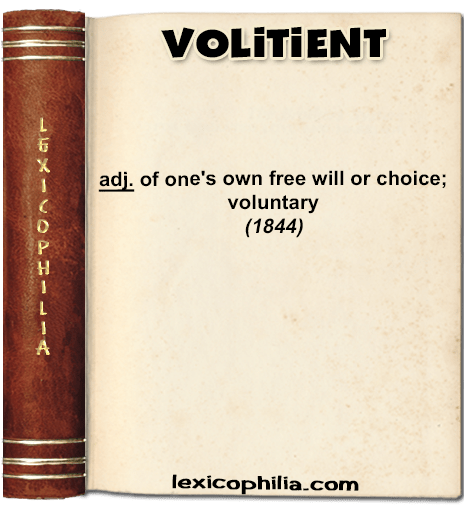
ETYMOLOGY
irregularly from voliti-,
from French volition,
from medieval Latin volition-, volitio (noun of action),
from Latin volo (I wish, will) + -ent
EXAMPLE
“…I chose this ruin: I elected it
Of my will, not of service, What I do, I do volitient, not obedient,
And overtop thy crown with my despair…”
From: A Drama of Exile
By Elizabeth Barrett Browning, 1844
 Lexicophilia