Word of the Day

Word of the Day: MINACIOUS


ETYMOLOGY
from Latin minac-minax (threatening), from minae (threats) + -ax + -ous


EXAMPLE
“…or with a pleasant horrour and chilness look upon some silent Wood, or solemn shady Grove; whether the face of Heaven smile upon us with a chearfull bright azure, or look upon us with a more sad and minacious countenance, dark pitchy Clouds being charged with Thunder and Lightning to let fly against the Earth; whether the Aire be cool, fresh and healthful, or whether it be soultry, contagious and pestilential, so that while we gasp for life we are forc’d to draw in a sudden and inevitable Death…”

From: An Explanation of the Grand Mystery of Godliness
By Henry More, 1660
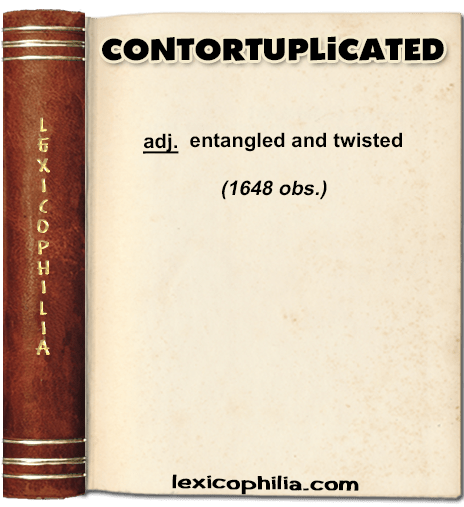
Word of the Day: CONTORTUPLICATED


ETYMOLOGY
from Latin contortuplicatus, from contortus (twisted together) + plicatus (folded)


EXAMPLE
“…Cruspini, who, in spite of his selfishness, is a shrewd dog, for a foreigner, says it is allowing to his violin; and he takes care that its influence shall not be wanting, for he eviscerates as much noise from its contortuplicated bowels, every day, as would disconcert a herd of swing remonstrating against a high wind…”

From: Thurlston Tales
“Grey Joan”
Robert Pierce Gillies, 1835

Word of the Day: INDEXTROUS


ETYMOLOGY
from in- + dexterous


EXAMPLE
“…An Issue must also be made with the hand of a skilfull Artist, for I have often observed from an indextrous way of making an Issue in the occiput a thousand mischiefs and death has followed: for if the Chirurgeon try to burn all the Skin with the Iron, I have often seen a Convulsion follow, and the child die of a most cruel death…”

From: Mercurius compitalitius;
Or, A Guide to the Practical Physician
By Theophill Bonet, 1684

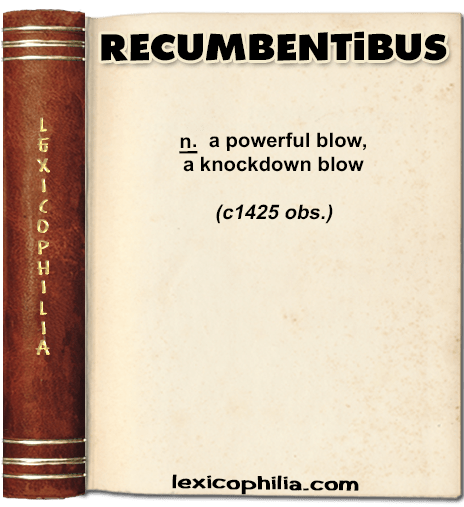
Word of the Day: RECUMBENTIBUS


ETYMOLOGY
a humorous use of Latin recumbentibus, ablative plural of recumbens, present participle of recumbere (recumb – to lean, recline, rest)


EXAMPLE
“…Ector sone to him gan take,
He thoght him venge of that wrake;
Ector bare his sword on hye,—
For he hadde no spere him bye,—
He ȝaff the kyng Episcropus
Suche a recumbentibus,
He smot In-two bothe helme & mayle,
Coleret and the ventayle…”

From: The Laud Troy Book;
an anonymous Middle English poem dealing with the background and events of the Trojan War, dating from around 1400

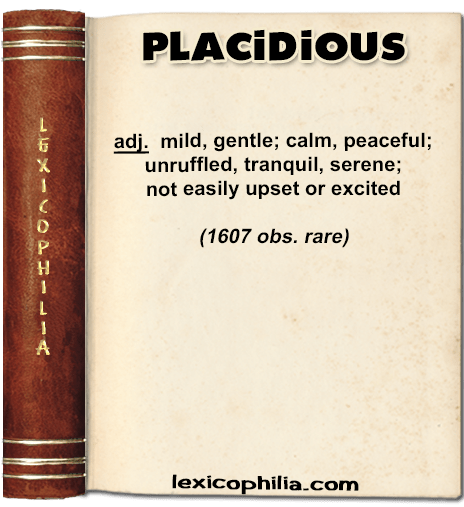
Word of the Day: PLACIDIOUS


ETYMOLOGY
from Latin placidus (pleasing, favourable, gentle, mild, calm),
from root of placēre (to please)


EXAMPLE
“…There was never any thing more strange in the nature of Dogs, then that which happened at *Rhodes besieged by the Turk, for the Dogs did there discern betwixt Christians and Turks; for towards the Turks they were most eager, furious, and unappeaseable but towards Christians, although unknown, most easie, peaceable and placidious, which thing caused a certain Poet to write thus…”

From: The History of Four-footed Beasts, and Serpents
By Edward Topsell, 1607

Word of the Day: HONEY-DROP


ETYMOLOGY
from honey + drop


EXAMPLE
“…The younges brother he stepped in,
            Took’s sister by the hand;
            Said, Here she is, my sister Maisry,
            Wi the hinny-draps on her chin.
             ‘O if I were in some bonny ship,
            And in some strange countrie,
            For to find out some conjurer,
            To gar Maisry speak to me!’…”

From: Bondsey and Maisry
in English and Scottish Popular Ballads
By Francis Child, 1886

Word of the Day: RECRAYED


ETYMOLOGY
from recray (to tire or wear out), from Anglo-Norman recreirerecreere and Middle French recroire (to desist, give up, to acknowledge oneself defeated, to yield in battle, to fail to go back on what one has said, to tire (something) out, to become tired out (especially of a horse), to confess (something), to go back on one’s sentiments or beliefs)


EXAMPLE
“…The toke[n]s ar not good
To be true Englysh blood
For if they vnderstood
  His traytourly dispyght
He was a recrayed knyght
A subtyll sysmatyke
Ryght nere an heretyke
Of grace out of the state
And dyed excomunycate…”

From: Agaynst the Scottes
By John Skelton, a1529

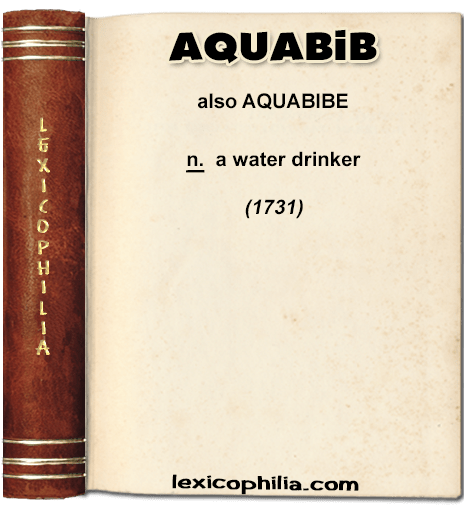
Word of the Day: AQUABIB


ETYMOLOGY
from Latin aqua (water) + bibere (to drink)


EXAMPLE
“…To call a man a total abstainer would imply that he abstained from everything; to call him a temperance man is absurd, because from time immemorial men have drunk, as they still drink, wine temperately. Aquabib and hydropot may mean one who drinks water, but most men do that. I drink it always to quench thirst, but then I drink also a moderate quantity of wine…”

From: The Medical Times and Gazette,
A Journal of Medical Science, Literature, Criticism, and News
Volume I for 1883
“Temperance Appellations”