Word of the Day

Word of the Day: INCOLIST


ETYMOLOGY
from Latin incolere (to inhabit) + -ist


EXAMPLE
“…which maladyes much molest the Germanes, and Septentrionall incolists; the like whereof hapned upon Caesars Souldiers when they came beyond Rhene, who there finding a River, drunk of the water, which within two dayes caused their teeth to fall out, and resolved the joynts of their knees, but the herb Britannica will help such as are thus infested…”

From: A Medicinal Dispensatory
Composed by the Illustrious Renodaeus,
Englished and Revised by Richard Tomlinson, 1657
Section 6. Of Fruits. Chapter XVII.

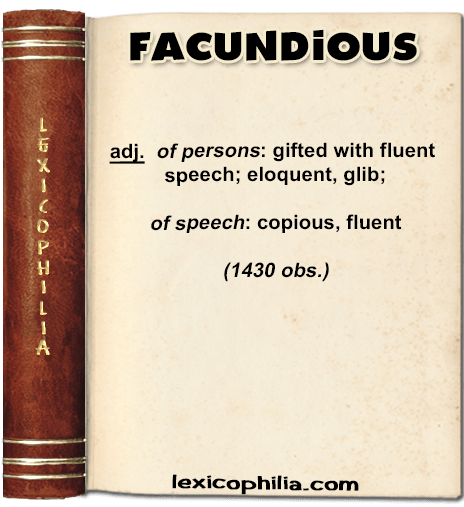
Word of the Day: FACUNDIOUS


ETYMOLOGY
from Latin fācundia (eloquence) + -ous


EXAMPLE
“…Discrete and hardy and wonder vertuous,
And of speche ryght facundious.
And coud him wel in euery thinge demene,
But Menelay of stature was but meane…”

From: The Auncient Historie and Onely Trewe and Syncere Cronicle of the Warres Betwixte the Grecians and the Troyans 
By John Lydgate, 1430

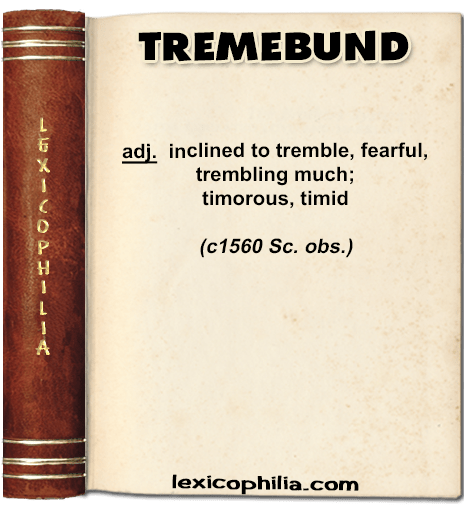
Word of the Day: TREMEBUND


ETYMOLOGY
from Latin tremebundus (trembling), from tremere (to tremble)


EXAMPLE
“…Thay tak delyt in martiall deidis,
And are of nature tremebund,
Thay wald men nurist all thair neidis,
Syne confortles lattis thame cnfound:
So find I thair affectioun
Contrair thair awin complexioun…”

From: Chronicle of Scottish Poetry,
From the Thirteen Century to the
By James Sibbald, 1802
Of Wemen-kind, By Alexander Scott, c1560

Word of the Day: VAFROUS


ETYMOLOGY
from Latin vafervafr- (sly, cunning, crafty) + -ous


EXAMPLE
“…thinkyng surely that they for the most part, would neuer cosent & longe agree with the Englishmen, accordyng to their olde vaffrous varietie: wherfore least ye he should offend or ministre cause of occasio to them (as in dede all me were not his frendes in Scotlad at that tyme) he desired y Ambassadours to cosent w truce & abstinece of warre for suen yeres…”

From: The Vnion of the Two Noble and Illustre Famelies of Lancastre [and] Yorke
By Edward Hall, 1548

Word of the Day: SMARTFUL


ETYMOLOGY
from smart (sharp physical pain) + -ful


EXAMPLE
“…What kind harted husband: can se his kind wife,
In like carefull case, without wo at his hart.
What naturall father can se: for his life,
His naturall childerne, in dread quake and start.
Without his hart smarting, in most smartfull smart.
I thinke, ye thinke none: and euin so thinke I.
Meruell not then: though the spider be toucht nie…”

From: The Spider and the Flie 
By John Heywood, 1556

Word of the Day: PERIPATICIAN


ETYMOLOGY
shortened from Middle French peripateticien, from peripateticus (a person who walks about, a traveller; also, moving about from place to place) + French -ien (-ian)


EXAMPLE
“…Yet certes Moecha is a Platonist,
To all, they say, but whoso do not list;
Because her husband, a far traffick’d man,
Is a profest Peripatecian…”

From: Virgidemiarum. The Three Last Bookes
By Joseph Hall, 1598

Word of the Day: MULTISCIOUS


ETYMOLOGY
from Latin multisciusmultus (much) + scius (knowing), from scire (to know)


EXAMPLE
“…His somatic structure was procere and feateous; and his ostent, debonair. Multiscious in vitilitigation, omnipercipient, pansophical, emissitious, and obversant with anthroposophy, he was without dubitancy, a dabster…”

From: Letters to Squire Pedant, in The East
By Lorenzo Altisonant, an Emigrant to the West 
By Samuel Klinefelter Hoshou. 1870
No. IX. Rixationville, July 7, 1843