Word of the Day: STALWORTH

ETYMOLOGY
from Old English stǽlwierðe, from stǽl (place) + wierðe (worth – adj.);

From OED: “The length of the vowel in the first syllable seems to be authenticated by some of the early Middle English forms; the shortening of ǽ to ă in the first element of a compound is normal. The Old English stǽl(the quantity of which is certain from the three occurrences in poetry) appears not to be immediately connected with the synonymous stæl with short vowel (dat. stale); according to some scholars it represents a contraction of Old Teutonic *staþl- or *stađl-, the relation of Old English stǽl to staðol foundation being considered parallel with that of mǽl speech to the synonymous mæðel. The 13th century form staðelwurðe, occurring only once strongly confirms this view.
The early Middle English forms with medial e, stele-, steale-, stalewurðe are difficult to account for.

EXAMPLE (for n.)
“… Such semblaunt to þat segge semly ho made
Wyth stille stollen countenaunce, þat
stalworth to plese,
Þat al forwondered watz þe wyȝe, and wroth with hymseluen,
Bot he nolde not for his nurture nurne hir aȝaynez,
Bot dalt with hir al in daynté, how-se-euer þe dede turned
towrast.
…”

From: Sir Gawain and the Green Knight
Author unknown; a late 14th-century chivalric romance in Middle English alliterative verse;
Edited by Sir Israel Gollancz through the Early English Text Society, 1940

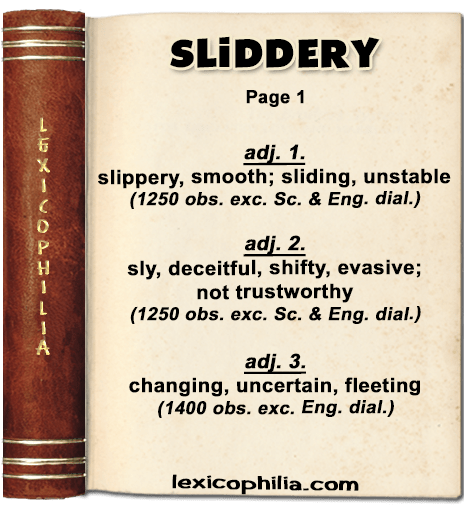
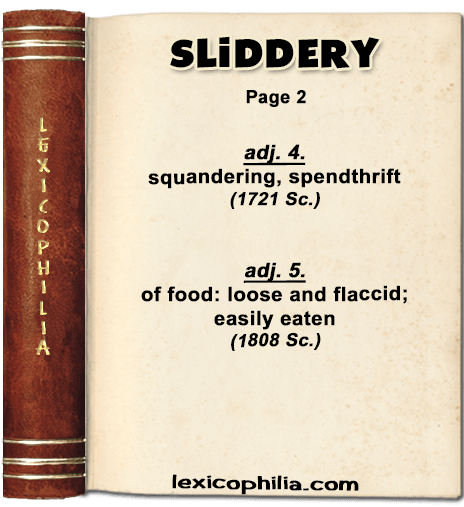
Word of the Day: SLIDDERY

ETYMOLOGY
from slidder (to slide, to slip) + -y

EXAMPLE (for adj. 3)
“… Full slyddrie is the sait that thay on sit,
And for thair fault till Hell sune sall thay flit,
For suddanlie thay sall die with mischeif,
Thair distructioun salbe without releif.
…”

From: A compendious book of godly and spiritual songs : commonly known as ‘The gude and godlie ballatis’
By John Wedderburn , Robert Wedderburn
Reprinted from the edition of 1567
Edited by Alexander Ferrier Mitchell, 1897
Quam bonus Deus Israell. Psal. lxxiij

Word of the Day: ORGULOUS

ETYMOLOGY
from Anglo-Norman orguillous, orgeillus, orgoilous, orgullous,
orgulous, orgulus, orgilousorgillus and Old French orguillus,
orgoillus, orguilleus, orgueilleux;
from  orgueil (pride, haughtiness) + ‑ous 

EXAMPLE 1 (for adj. 1.)
“… yet habbeþ manitime maked of watere wyn; gostliche. wanne þurch his grace maked of þo euele manne good man. of þe orgeilus umble. of þe lechur chaste. of þe niþinge large. and of alle oþre folies; so ha maket of þo watere wyn. þis his si signefiance of þe miracle. …”

From: An Old English miscellany containing a bestiary, Kentish sermons, Proverbs of Alfred, religious poems of the thirteenth century
Edited by Richard Morris, 1872


EXAMPLE 2 (for adj. 1)
”…I was banished from my own country, and was dishonoured, and with hard labour gained I what I have got ; and now I stand in the King’s favour, and he asketh of me my daughters for the Infantes of Carrion. They are of high blood and full orgullous, and I have no liking to this match ; but if our Lord the King adviseth it we can do no other-wise: …”

From: Chronicle of the Cid
By Robert Southey, 1808

Word of the Day: MOSTWHAT

ETYMOLOGY
from most (greatest in size, bulk, etc.) + what (pronoun); probably after somewhat (adv.)

EXAMPLE (for adv. 2.)
“…  The parentes and freindes with whom I haue to deale, be mostwhat no latinistes: and if they were, yet we vnderstand that tounge best, whervnto we are first borne, as our first impression is alwaie in English, before we do deliuer it in Latin. …”

From: Positions vvherin those primitiue circumstances be examined, which are necessarie for the training vp of children, either for skill in their booke, or health in their bodie,
By Richard Mulcaster, 1581

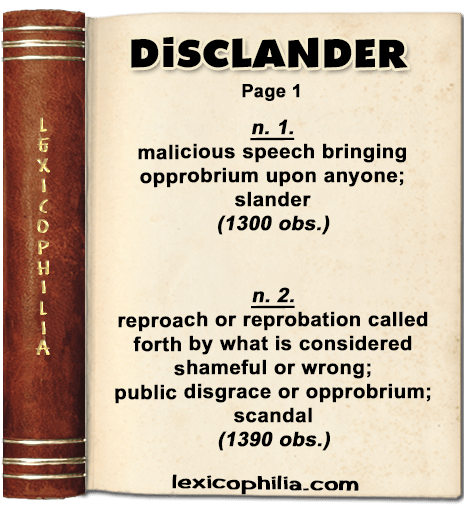
Word of the Day: DISCLANDER

ETYMOLOGY
noun: from Anglo-Norman desclandredesclaundredisclaunderdisclaundre (slander, slanderous statement, scandal, public outrage)
verb: from disclander (noun)

EXAMPLE (for vb. 1.)
“… Þis gode men with ioie inov : heore leue of him heo nome,
And þannes heo wenden sone i-nouȝ : to þe court of rome.
Þare neren heo nouȝt faire onder-fonge : for þe bischopes comen bi-fore
And desclaundreden seint thomas : þat he was fals and for-suore.
Ake naþeles þe grace heo hadden : þat to þe pope heo miȝten go.
him-sulue heo tolden in priuete : al seint thomases wo: …”

From: Laud Manuscript, c1300
In The Early South-English Legendary ; or, Lives of Saints
Edited by Carl Horstmann, 1887

Word of the Day: OFTLY


ETYMOLOGY
from oft (adv.) + -ly


EXAMPLE
“…And faste approcht: which newes when so I knew
I placed me where comming I behold
A seemely band, as eie di euer vewe,
And goodly dight as hart defier cold,
Oftlie returning vnto freends I told,
That I had seene of noblenes the flower
For discipline in ordring of a power
…”

From: The True Vse of Armorie
By William Wyrley, 1592

Word of the Day: GLOPPEN


ETYMOLOGY
from Old Norse glupna (to be downcast);
a root of identical form appears in Old Frisian glûpa, Middle Low German glûpen (to lie in wait for), Dutch gluipen (to watch slily, to sneak), Old Swedish glupa (to gape, swallow), Swedish glupande, Danish glubende (ravenous, fierce);
whether there is any etymological connection is uncertain


EXAMPLE (for vb. 1)
“…Quen [he] þar-of son had a sight,
Al was he gloppend for þat light
…”

From: Cursor Mundi
(The Cursur of the World)
A Northumbrian Poem of the XIVth Century