Word of the Day: RIGENT

ETYMOLOGY
from Latin rigent-rigens (stiff, rigid), present participle of rigere (to be stiff)

EXAMPLE
“… An hous [y]maad of aller is but shent; 
Yet ther the ground is myre, weet, vnsure,
Pile in aller as for the fundament.
Ek elm & asshe ydried beth rigent,
And while they beth vndried, so curuable,
ffor shippis that they beth right profitable. …”

From: Middle-English translation of Palladius De Re Rustica. ?1440
Edited by Mark Liddell, 1896

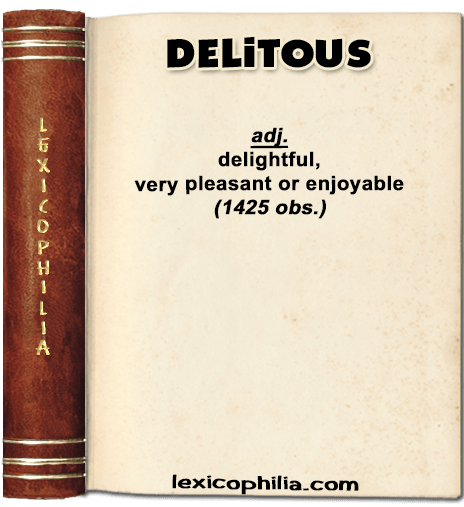
Word of the Day: DELITOUS

ETYMOLOGY
from Anglo-Norman delitous, Middle French deliteux;
from delit (delight) + ‑ous 

EXAMPLE
“… For sich solace sich ioie and play
I trowe that neuere man ne say 
As was in that place delytous
The gardeyn was not daungerous
To herberwe briddes many oon
So riche a yeer was neuer noon …”

From: The Romaunt of the Rose
By Guillaume de Lorris and Jean de Meun
Translated by Geoffrey Chaucer, a1425

Word of the Day: DUPLE

Note: the obsolete adjective definition is a general sense.
In mathematics, it is applied to the proportion of two quantities one of which is double of the other; 
in music, it is applied to ‘time’ or rhythm having two beats in the bar.

ETYMOLOGY
Adj. and n.:  from Latin duplus (double), from duo (two) + -plus, from root ple- (to fill);
Vb.:  from Latin duplare (to double), from dupl-us (duple)

EXAMPLE (for vb.)
“… She mixd of Quick-silver a deadly weight,
That dupled force his murder hasten might.
Then while those baneful pots betwixt them strov,
The helpful swaying the hurtfuls bane out drov. …”

From: Enchiridium epigrammatum Latino-Anglicum:
An epitome of essais,
Englished out of Latin by Robert Vilvain, 1654

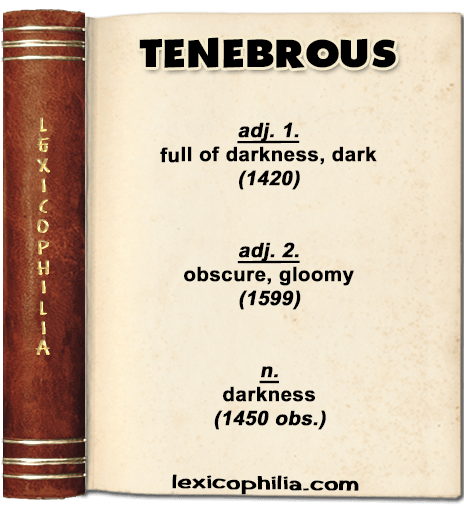
Word of the Day: TENEBROUS

ETYMOLOGY
from Old French tenebrus, modern French tenebreux, Provencal tenebros
Spanish, Italian tenebroso, from Latin tenebrosus (dark, gloomy)

EXAMPLE
“… The name of thys lady was callyd Prescience.
She neuer left Vyce, ne noon that wold hym folow,
Tyll they wer commyttyd by the diuine sentence
All to peyne perpetuell and infynyte sorow.
Ryghtwysnes went to see that no man shuld hem borow.
Thus all entretyd sharpely were they, tyll Cerberus
Had hem beshut withyn hys gates
tenebrus. …”

From: The Assembly of Gods:
or, The Accord of Reason and Sensuality in the Fear of Death
By John Lydgate, c1420

PRONUNCIATION
TEN-uh-bruhss

Word of the Day: BROTHELY

ETYMOLOGY
Middle English: in sense adj. 1, from broth (impetuous, violent, wrathful) + -ly;
sense adj. 2, possibly a derivative of brothel

EXAMPLE (for adj. 1)
“… þan said Isaac tille him, “ert þou his mayntenour?
Fulle
broþely & brim he kept vp a trencheour,
& kast it at Statin, did him a schamfulle schoure.
His nese & his ine he carfe at misauentoure.
…”

From: Peter Langtoft’s Chronicle, (as illustrated and improv’d by Robert of Brunne), 1330

Word of the Day: REPENTINE

ETYMOLOGY
from obsolete French repentin-ine, or from Latin repentinus
from repent-, repens (sudden) + ‑inus (ine)

EXAMPLE
“… Whan thou shalte ought do, of vnexpert or newe
Fyrste ponder in thy mynde, reuoluynge busely
What maner, and how great thynge, may therof ensue
Attempt nothynge weyghty, in haste nor sodaynly
If thynges may byde, tary, begyn thou nat rasshely
For enterpryses rasshe, hasty and
repentyne
Ar chefe thynges bryngynge, great warkes to ruyne
…”

From: Here begynneth a ryght frutefull treatyse, intituled The Myrrour of Good Maners,
By Dominicus Mancinus
Translated by Alexander Barclay, ?1518

PRONUNCIATION
ruh-PEN-tighn

Word of the Day: MOSTWHAT

ETYMOLOGY
from most (greatest in size, bulk, etc.) + what (pronoun); probably after somewhat (adv.)

EXAMPLE (for adv. 2.)
“…  The parentes and freindes with whom I haue to deale, be mostwhat no latinistes: and if they were, yet we vnderstand that tounge best, whervnto we are first borne, as our first impression is alwaie in English, before we do deliuer it in Latin. …”

From: Positions vvherin those primitiue circumstances be examined, which are necessarie for the training vp of children, either for skill in their booke, or health in their bodie,
By Richard Mulcaster, 1581

Word of the Day: PLEASURANCE

ETYMOLOGY
from pleasure (vb.) + -ance

EXAMPLE
“… With a mighty noise, noye for to here,
Playnond with pytie, no
pleasurance at all,
With sykyng & sorow said on this wise:—
“A! fonnet folke, why fare ye thus now,
With solas full sore, and sanges of myrthe,
At the weddyng of the weghes, þat shall to wo turne.
…”

From: The “Gest Hystoriale” of the Destruction of Troy
from Guido de Colonna’s “Hystoria troiana.”, a1400

PRONUNCIATION
PLEZH-uh-ruhns