Word of the Day: STRIVABLE


ETYMOLOGY
from Old French estrivable, from estriver (to quarrel, contend) + -able


EXAMPLE
“…that eke the lay peple of the newe lawe is bounde, undir perel of greet synne, forto receyve her feith and al the leernyng of Goddis lawe, now beyng, in ech doutable and strivable poynt therof, fro and of the preestis of the newe lawe, and forto obeie to hem therynne, in lasse thanne the case of the seid excepcioun kan be executid …”

From: Book of Faith; a fifteenth century theological tractate
From the manuscript in the library of Trinity college, Cambridge
By Reginald Pecock, c1456

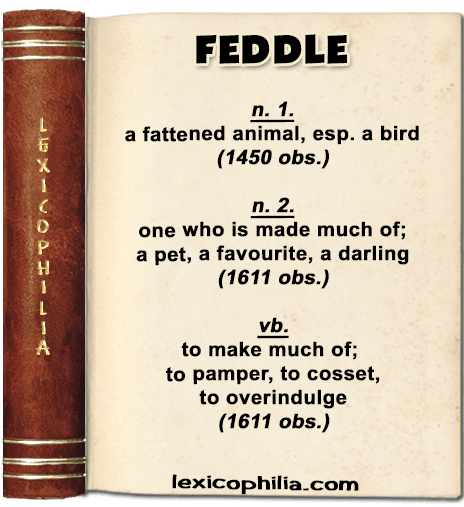
Word of the Day: FEDDLE


ETYMOLOGY
perhaps representative (with some change of sense) Old English  fedels (fatted bird),
the Germanic base of feed (vb.) + the Germanic base of ‑els


EXAMPLE
(for n. 2)
“…It will be of a pretty little Infant: O how heartily I shall love it! I do
already dote upon it; for it will be my dainty Fedle-darling, my genteel Dilli-minion
…”

From: The third book of the Works of Mr. Francis Rabelais
Translation by Thomas Urquhart. 1693

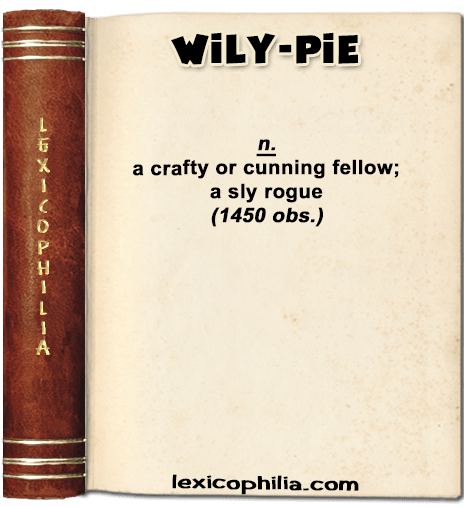
Word of the Day: WILY-PIE


ETYMOLOGY
from wily (crafty, cunning, sly) + pie (a cunning, sly, or wily person, obs.)


EXAMPLE
“…So fiercely he fighteth, his mind is so fell,
That he driveth them down with dints on their day-watch;
He bruiseth their brainpans and maketh them to swell,
Their brows all to-broken, such claps they catch;
Whose jealousy malicious maketh them to leap the hatch;
By their cognizance knowing how they serve a wily pie
Ask all your neighbours whether that I lie
…”

From: Divers Ballads and Ditties Solacious
The Ancient Acquaintance, Madam, Between us Twain
John Skelton, (1460? – 1529)

Word of the Day: DEBATOUS


ETYMOLOGY
from debat (debate, a controversy or discussion + -ous


EXAMPLE
“…Appetytes of auaryce be to them so amerous
Abusyon and arrogaunce ben of one affynyte
Aduenture and angre ben aye so debatous.
Faynynge estate of counterfet auctoryte
Adulacyon of aduenture mayst thou not auaunt the
As a lyer in goodnes in thyne araye doest appere
Englande may wayle that euer it came here
…”

From: Here Begynneth a Treatyse of this Galaunt
By John Lydgate (attributed name), ?1510

Word of the Day: TOILOUS


ETYMOLOGY
from toil (strife, turmoil, dispute) + -ous


EXAMPLE
“….R
to riotus, to reueling, ne rage not to rudeli.
S
to straunge, ne to stirynge, ne straungeli to stare.
T
to toilose, ne to talewijs, for temperaunce is beest.
V
to venemose, ne to veniable, & voide al vilonye.
W
to wielde, ne to wraþful, neiþer waaste, ne waade not to depe
..”

From: Aristotle’s A B C
in The Babees Book,
Lambeth Manuscript. a1430

Word of the Day: PERQUIRE


ETYMOLOGY
adj. & adv.: from French par cœur (by heart, by memory, perfectly, exactly)
vb.: from Latin perquirere (to make diligent search for), formed on  per-  + quærere (to seek)


EXAMPLE (for vb.)
“…Sweetly disposed soul (for so I hope)
Though most deluded by thy self, and Pope;
Perquire Zoographers, and none recite,
A Romane Pope turn’d willing Anchorite.
Now they so much abhor such doubtful ways,
They’ll not to Heaven go, without false ayes.
…”

From: Divine Glimpses of a Maiden Muse
By Christopher Clobery, 1659

Word of the Day: AROMATOUS


ETYMOLOGY
from Latin aromata or French aromat, as if adapted from Latin aromatosus or French aromateux


EXAMPLE
“…And thenne it hath vertue tascende by the lightnes of the fume and to comforte by his qualite and to conioyne by the gumme and to conferme by that it is aromatous or wel smellyng. And all in lyke wyse i the orison or prayer whiche ascendeth to the mynde of god. It conforteth the soule as to the synne passed in axyng medecyne…”

From: Legenda Aurea/The Golden Legend
By Jacobus de Voragine
Translated by William Caxton, 1483