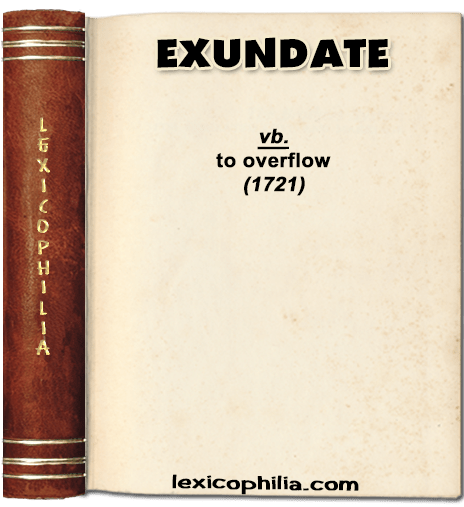
Word of the Day: EXUNDATE

ETYMOLOGY
from Latin exundat- participial stem of exundare,
from ex- (out) + undare (to rise in waves), from unda (wave)

EXAMPLE
“… Thus armed, he advanced to the well. The yew-twig struck the bright motionless water, and strongly agitated it. The stream exundated on every side, kindled as it mounted, and, tumbling and commingling, in a few seconds, like an enormous flame of fire, rolled forwards and backwards round the margin of the fountain. …”

From: Blackwood’s Edinburgh Magazine
Volume LVI. July-December 1844
Traditions and Tales of Upper Lusatia
No. III. The Dwarf’s Well

Word of the Day: MALIFEROUS

ETYMOLOGY
from Latin malus (bad) + -ferous (bearing, producing)

EXAMPLE
“… I had really forgotten to mention that gallant, fine-hearted soldier, who – as I heard to my infinite regret, shared by every one who knew his kindly, honest, genial nature – fell a victim to the maliferous climate of China! …”

From: From: My Diary in India,  In the Year 1858-9,
By William Howard Russell, Volume I, 1860
Cowasjee’s Shop

Word of the Day: EPISTOLIST

ETYMOLOGY
from Latin epistola (epistle) + -ist

EXAMPLE
Mrs. Carter to Miss Talbot, Deal, April 16, 1743.
“… I am extremely obliged to you, my dear Miss Talbot, for your account of the Italian epistolists. I find I am not likely to be much edified by their sense, but they may perhaps be of use to me in gaining the improvement I wish for in the language. …”

From: A Series of Letters Between Mrs. Elizabeth Carter and Miss Catherine Talbot, from the year 1741 to 1770
By Elizabeth Carter, 1743

Word of the Day: NECATION

ETYMOLOGY
from Latin necation-necatio (killing); from Latin necat-, past participial stem of necare (to kill); (from nec-nex (death, violent death)) + ‑iō (ion)

EXAMPLE
“… Yet such an inveterate poacher was he that at the next sessions he was “up” again for a like offence at the same place, save that on this second charge the evidence seems to have extended to “exagitation” only, and not to “necation.”…”

From: The Wiltshire Archaeological and Natural History Magazine
Volume XIX, 1881
Extracts from the Records of the Wiltshire Quarter Sessions.
‘Trespass in Pursuit of Game. Licence to Shoot’

Word of the Day: SCRIPTITATION

ETYMOLOGY
from Latin scriptitation-scriptitatio (act of writing down, act of writing or composing, that which is written, text) from scriptitat-, past participial stem of scriptitare (to be in the habit of writing, to write regular or repeated letters), (frequentative formation from scribere (to write))

EXAMPLE
“… There is something in this Amory’s manner of scriptitation which is..utterly void of all pretensions to the business of argument. …”

From: The Church of England Vindicated, 1779

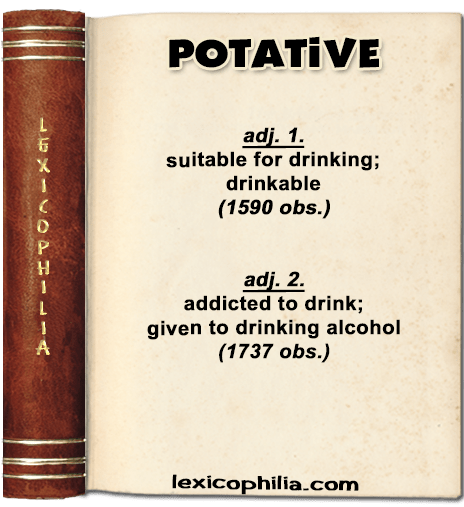
Word of the Day: POTATIVE

ETYMOLOGY
from Latin potat-, past participial stem of potare (to drink) + ‑ive

EXAMPLE
“… desireth to cure these or such like infectious diseases, must chiefly prepare and season the body with waters of cold and naturall hearbes, in the first and second degree, be­fore the disease be possessed: then foorthwith flux the body, by some gentle and potatiue electuarie, in equall and artificial de­gree, fauourably casting out the infected humours. …”

From: The Flower of Phisicke
VVherein is perfectlie comprehended a true introduction and method for mans assured health
By William Clever, 1590

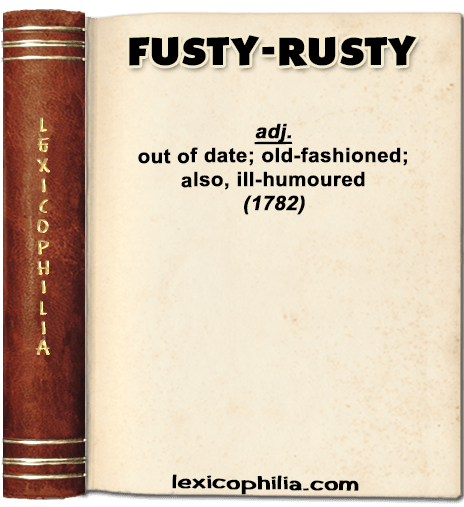
Word of the Day: FUSTY-RUSTY

ETYMOLOGY
from fusty (adj.)

EXAMPLE
“…There is a fashion in these things, which the Doctor seems to have forgot. But what shall we say of his fusty-rusty remarks upon Henry and Emma? I agree with him, that morally considered both the knight and his lady, are bad characters, and that each exhibits an example which ought not to be followed. …”

From: The Life and Posthumous Writings of William Cowper
By William Hayley, Volume III, 1804
Letter XLVII. To the Rev. William Unwin, January, 5, 1782