Word of the Day: EBRIETATING


ETYMOLOGY
from ebriety (a being intoxicated, drunkenness) + ‑ate 


EXAMPLE
“…But what we suppose conduces most to this seeming Magnanimity, is some things their Priests give them before, of an ebrietating Quality, which intoxicates their Spirits, and renders them insensible of what they are going to endure…”

From: The British Apollo, or, Curious Amusements for the Ingenious
May, 1711
Word of the Day: PODGER


ETYMOLOGY
for n. 1. – a variant of pottinger
for n. 2, 3, 4 – from podge (anything short or thick)  + ‑er 


EXAMPLE
“…He cannot deal the knock-me-down blows of Old Brough, and if you watch your opportunity you may give him a podger. I am seldom in a cause of any consequence before him without getting into some squabble with him…”

From: Life of John, Lord Campbell, 1881,
Letter dated 9 March, 1816

Word of the Day: MICACIOUS


ETYMOLOGY
from Latin micare (to shine, sparkle, dart, move swiftly) + -acious 


PRONUNCIATION
migh-KAY-shuhss


EXAMPLE
“…Others little inferior in splendour followed in procession; and what added much to their gorgeous appearance was, that as the oars were lifted, the water was perfectly micacious, and they appeared to glide over a sea of liquid gold…”

From: Constantinople Ancient and Modern:
With Excursions to the Shores and Islands of the Archipelago and to the Troad
By James Dallaway, 1797

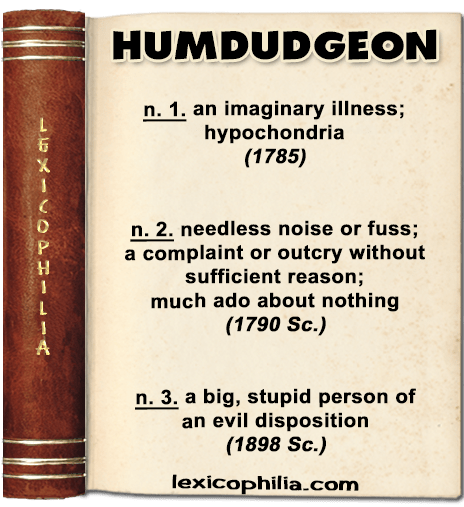
Word of the Day: HUMDUDGEON


ETYMOLOGY
from hum (a piece of humbug, an imposition, a hoax) + dudgeon (a feeling of anger, resentment, offense)


EXAMPLE (for n. 1)
“…”Hout tout, man – I would never be making a hum-dudgeon about a scart on the pow – but we’ll be in Scotland in five minutes now, and ye maun gang up to Charlies-hope wi’ me, that’s a clear case…”

From: Guy Mannering
By Walter Scott, 1815

Word of the Day: RURICOLIST


ETYMOLOGY
from Latin ruricola (a person who tills the land, husbandman, country dweller, rustic)
(from ruri-, combining form of rur-rus (country) + -cola) + -ist


EXAMPLE
“…His hood was half blue and half green, and, over his left ear, was set off with an artificial rose. His appearance did not bespeak the ruricolist, and Dick, who at once detected this, set him down for a burgess of London…”

From: The Life and Times of Dick Whittington
An Historical Romance.
By Richard Whittington, 1841

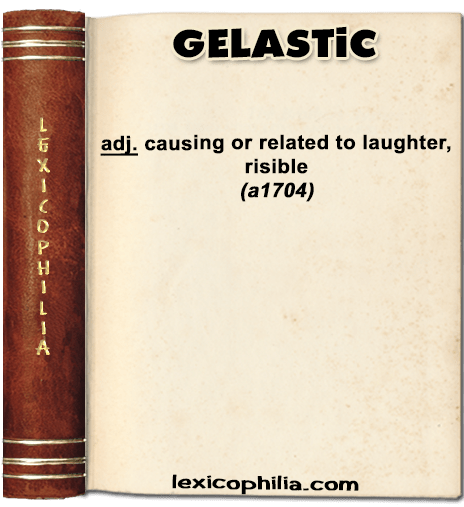
Word of the Day: GELASTIC


ETYMOLOGY
from Greek γελαστικός (gelastikos), from γελᾶν (to laugh)


EXAMPLE
“…or even exempt it from his unexcepting Censure and Undutiful Reflection against that Right Reverend Father of our Church, not without a Gelastick deference to so great a name, no more than without as high a Conception as possibly conceivable of the unappearing performances of so learned a Prelate…”

From: Athenae Britannicae:
Or, A Critical History of the Oxford and Cambridge Writers and Writings
By Myles Davies, 1716

Word of the Day: UBIQUARIAN


ETYMOLOGY
from Latin ubique (wherever, anywhere, everywhere) + -arian


PRONUNCIATION
yoo-buh-KWAIR-ee-uhn


EXAMPLE (for adj. 1)
“…Tho’ detestable the place,
Mean the lodgings, small and base,
Tho’ the crowded hoy pours forth
Company of little worth,
Coach or chariot, tho’ there’s none,
Rattling thro’ the fishing town,
Yet, Maria, yet, my fair,
Happiness shalt find us here:
Happiness our friend shall be,
Ubiquerian deity!
…”

From: The Gentleman’s Magazine and Historical Chronicle
Volume XXXII, 1762
Happiness Every Where
Occasioned by a fair Lady’s condemning the Author’s choice of Margate, for a Place of Entertainment

Word of the Day: SNUFFY


ETYMOLOGY
from snuff + -y


EXAMPLE
“…I’m sure she makes a very Tarquinius Sextus of me, and all about this Serenade,—I protest and vow, incomparable Lady, I had begun the sweetest Speech to her—though I say’t, such Flowers of Rhetorick—’twou’d have been the very Nosegay of Eloquence, so it wou’d; and like an ungrateful illiterate Woman as she is, she left me in the very middle on’t, so snuffy I’ll warrant…”

From: Sir Patient Fancy
By Aphra Behn, 1678