Word of the Day: PEEPY


ETYMOLOGY
from peep + -y


EXAMPLE (for adj. 1)
“…An individual of the latter kind is distinguished in his earliest petticoats – even before he has well left the nursery. He is then a poor, peepy wretch, with blear eyes, and one everlasting dingy night-cap. constantly sitting by the fire, to the great annoyance of the nurse, who frequently declares him to be more of an infant than even his younger brother the baby…”

From: Chambers Edinburgh Journal
Conducted by William Chambers, and Robert Chambers,
Volume I No. 49, Saturday, January 5, 1833,
‘The Domestic Man’

Word of the Day: EXFLUNCTICATE


ETYMOLOGY
quasi-Latin elaboration of flunk (to fail)


EXAMPLE
“…Though at my old Kenawa home,
They named me there afore I come,
For short, and caze it was my natur,
‘Half hoss and half an alligator’;
But that is nuther here nor there;
But I’m resolved, and now declare,
I’ll go along with you and fight,
As long as I can see the light;
If not, may I be regulated, —
Tee-totally exfluncticated
…”

From: The Forest Rangers:
A Poetic Tale of the Western Wilderness in 1794
By Andrew Coffinberry, 1842

Word of the Day: STULTITIOUS


ETYMOLOGY
for adj. 1: from Latin stultitia (folly),
from stultus (foolish)


EXAMPLE
“…In Wales in diuers places is vsed these two stulticious matters, the fyrste is, that they wyl sell their lams, and theyr calues, and theyr corne the whyche is not sowen, and all other newynges, a yere before that they be sure of any newynge; and men wyl bye it, trustynge vppon hope of suche thynges that wyl come…”

From:
The Fyrst Boke of the Introduction of Knowledge
By Andrew Boorde, 1549

Word of the Day: SNATTER


ETYMOLOGY
vb.: from Dutch snateren or Low German snat(t)ern (Greek schnattern, Swedish snattra),
of imitative origin


EXAMPLE (for vb.)
“…for if thou considerest the things are easie attained, every ditch offering the some of them, and the preparation so trinial, that there is as much art to make a mess of pottage; in this above all other I have deserved well at thy hand, if thou hast a heart to improve it, neither do I doubt, although many will be angry and snatter at it, but this entrance which I have given in this receipt will stand while the world indures and get strength, and my memory held in honor, for so good service in it…”

From: The Unlearned Alchymist His Antidote
By Richard Mathews, 1662

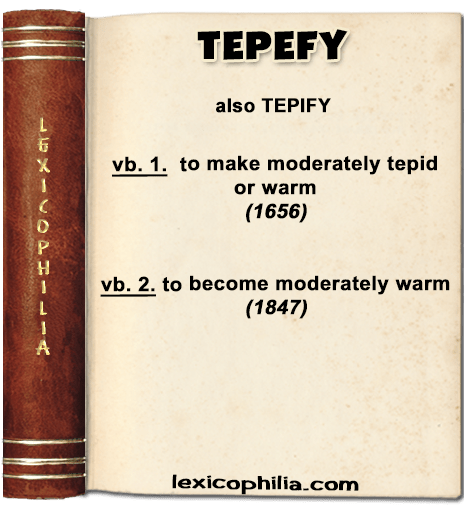
Word of the Day: TEPEFY


ETYMOLOGY
from Latin tepefacere (to make tepid),
from tepere (to be lukewarm)


EXAMPLE (for vb. 1)
“…Sonorous, thro’ the patient’s bosom pours
Its antidotal notes, the flood of life,
Loos’d at its source by tepefying strains,
Flows like some frozen silver stream unthaw’d
At a warm zephyr of the genial spring
…”

From: The Power of Harmony
By John Gilbert Cooper, 1745

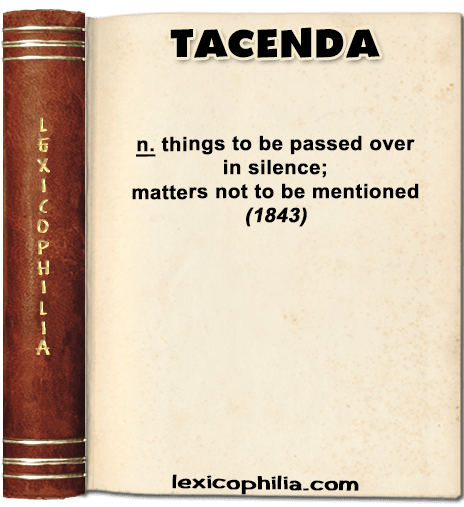
Word of the Day: TACENDA


ETYMOLOGY
Latin, gerundive neuter pl. of tacere (to be silent)


EXAMPLE
“…With due rigour, Willelmus Sacrista, and his bibations and tacenda are, at the earliest opportunity, softly, yet irrevocably put an end to. The bibations, namely, had to end; even the building where they used to be carried on was razed from the soil of St. Edmundsbury, and ‘on its place grow rows of beans:’ Willelmus himself, deposed from the Sacristry and all offices, retires into obscurity, into absolute taciturnity unbroken thenceforth to this hour…”

From: Past and Present
By Thomas Carlyle, 1843

Word of the Day: GLOPPEN


ETYMOLOGY
from Old Norse glupna (to be downcast);
a root of identical form appears in Old Frisian glûpa, Middle Low German glûpen (to lie in wait for), Dutch gluipen (to watch slily, to sneak), Old Swedish glupa (to gape, swallow), Swedish glupande, Danish glubende (ravenous, fierce);
whether there is any etymological connection is uncertain


EXAMPLE (for vb. 1)
“…Quen [he] þar-of son had a sight,
Al was he gloppend for þat light
…”

From: Cursor Mundi
(The Cursur of the World)
A Northumbrian Poem of the XIVth Century

Word of the Day: VOLITIENT


ETYMOLOGY
irregularly from voliti-,
from French volition,
from medieval Latin volition-volitio (noun of action),
from Latin volo (I wish, will) + -ent 


EXAMPLE
“…I chose this ruin: I elected it
Of my will, not of service, What I do, I do volitient, not obedient,
And overtop thy crown with my despair
…”

From: A Drama of Exile
By Elizabeth Barrett Browning, 1844