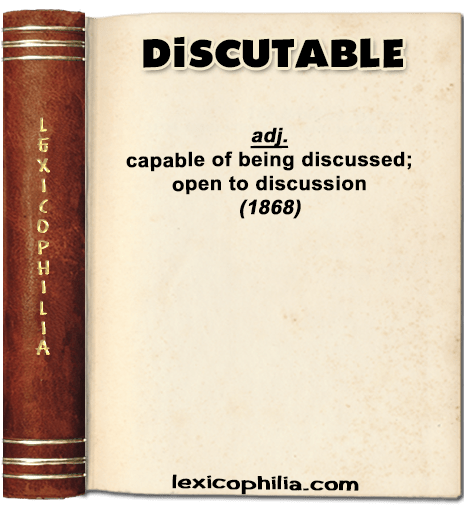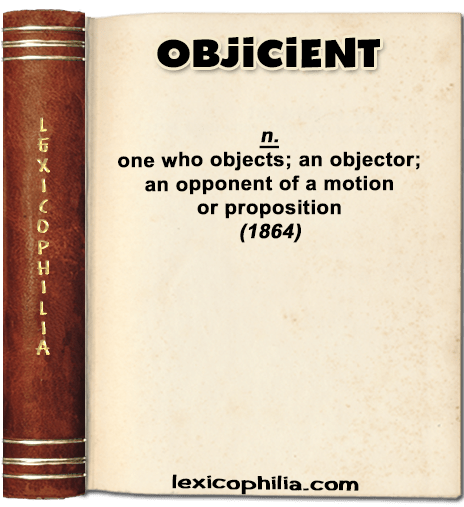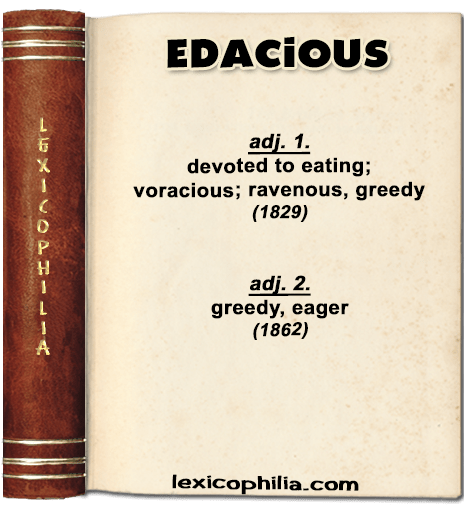
Word of the Day: OBJICIENT

ETYMOLOGY
from Latin objicientem, present participle of objicere (to object)

EXAMPLE
“… Yet, it may be observed, in passing, such is precisely the discrepancy of which St. Thomas speaks, in the two passages which have been quoted in support of the objection. But the objicient may still press his difficulty. …”

From: The Metaphysics of the School
By Thomas Harper, 1879
Book III. Attributes of Being
Chapter III. Truth 
Proposition LXXXIII. Every Being, as such, is true.

Word of the Day: BEDOOZLE

ETYMOLOGY
perhaps from  bedazzle + bamboozle 

EXAMPLE
“… O Shadrack, my Shadrack! Prissilla did speak,
While the rosy red blushes surmantled her cheek,
And the tears of affection
bedoozled her eye,
Shadrack, my Shadrack! I ‘m yourn till I die!
…”

From: The Gazette of the Union, Golden Rule, and Odd-Fellow’s Family Companion
A Saturday Family Journal of General Literature, Odd-Fellowship and Amusement.
Volume X – From January to June Inclusive, 1849
From the Scrabble Hill Luminary

Word of the Day: ALIICIDE

ETYMOLOGY
from. Latin alius (another) + -icide (the killing of), in allusion to suicide

EXAMPLE
“… Would the Lord Chief Justice be at all surprised if one of his amiable and interesting, but insane, correspondents were to take a mad freak into her head some day, and commit suicide or allicide? If, instead of adorning the Queen’s Bench, he honoured the chair of an insurance company, what would he think of the rate of payment requisite on the lives of such persons going at large? …”

From:  Punch, or The London Charivari,
December 19, 1868
Look After Lunatics

Word of the Day: CLOTTYMOLES

also CLOTTIMAULS

ETYMOLOGY
from ‘clotty‘ related to clot (vb.);
with ‘mauls‘ ‘mauley‘ (the hand, fist, sl.)

EXAMPLE
“… sich a passionate chap, I wor afreead o´ his clottymoles comin´ i´ contact wi´ my bowster: soa thowt I, I´d wesh ´em, an´ just sponge my cloas dahn at t´ same toime. …”

From: The Salamanca Corpus
Wadsley Jack; or, The Humours & Adventures of a Travelling Cutler
By Reuben Hallam, 1866

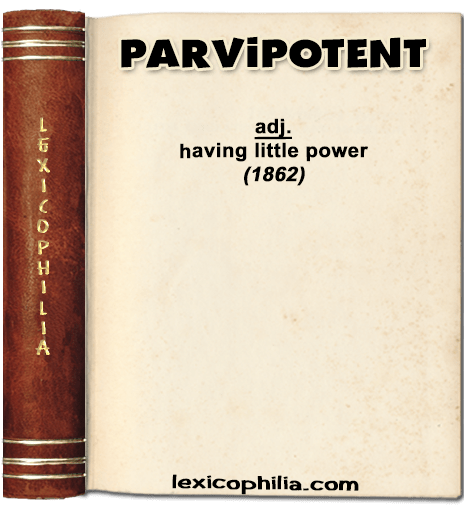
Word of the Day: PARVIPOTENT

ETYMOLOGY
from parvi- comb. form + potent (powerful, having great authority or influence)

EXAMPLE
“…It is called his causal body. Neither can do anything without one. The aggregate of the causal bodies of all souls, that is to say, distributive ignorances, make up I’s’wara’s causal body, which is illusion. Strange to say, the ignorance of a single soul renders that soul subject to misapprehension, and keeps it parviscient, parvipotent, &c; but the aggregation of these individual ignorances, or illusion, allows I’s’wara to be exempt from misapprehension, and communicate to him such attributes as omniscience and omnipotence …”

From: A Rational Refutation of the Hindu Philosophical Systems
By Nehemiah Nilakantha S’Astri’ Gore
Translation by Fitz-Edward Hall, 1862

Word of the Day: SNOOZLEDOM

ETYMOLOGY
from snoozle (to nestle and sleep or doze) + -dom

EXAMPLE
“…There are times with us all, when in a concave mirror we see a minute distorted into long hours; and, again, in the convex glass the long hours dwindle to a point. When summoned by peremptory duty from a warm bed upon a keen, frosty morning, how precious are the last five minutes of snoozledom! You live introspectively all through them; you chew the cud of your own cosiness. …”

From: The Casquet of Literature, a Selection in Poetry and Prose
Edited by C. Gibbon, 1873
‘The Philosophy of Sorrow’
By D’Arcy Wentworth Thompson

Word of the Day: PARVISCIENT


ETYMOLOGY
from parvi- comb. form of Latin parvus (small) + scient (knowledgeable, skilled);
probably after omniscient (having infinite knowledge)


EXAMPLE
“…It is called his causal body. Neither can do anything without one. The aggregate of the causal bodies of all souls, that is to say, distributive ignorances, make up I’s’wara’s causal body, which is illusion. Strange to say, the ignorance of a single soul renders that soul subject to misapprehension, and keeps it parviscient, parvipotent, &c; but the aggregation of these individual ignorances, or illusion, allows I’s’wara to be exempt from misapprehension, and communicate to him such attributes as omniscience and omnipotence…”

From: A Rational Refutation of the Hindu Philosophical Systems
By Nehemiah Nilakantha S’Astri’ Gore
Translation by Fitz-Edward Hall, 1862


PRONUNCIATION
par-VISS-ee-uhnt

Word of the Day: BATRACHOPHOBIA


ETYMOLOGY
from batracho- (comb. form) [from Greek βάτραχος (bátrakhos, frog)] + ‑phobia 


EXAMPLE
“…The world looks down upon them, gives them ill names, affects a sort of horror of them, and does its best to kick them out of sight; and the consequence is that the world knows next to nothing about them, and thus misses one of the most marvellous chapters in the whole range of zoological science. The Batrachophobia is at length giving way in one direction, it is true; for the Aquarium, has made it manifest that the Water-Newts, spite of a long-cherished belief to the contrary, are perfectly harmless little creatures…”

From: Links In The Chain;
Or, Popular Chapters On the Curiosities of Animal Life
By George Kearley, 1863
‘The Ancient Order of Batrachians’


PRONUNCIATION
bat-ruh-koh-FOH-bee-uh

Word of the Day: AURICOMOUS


ETYMOLOGY
from Latin auricomus, from auri-, comb. form of aurum (gold) + coma (hair) + -ous


EXAMPLE
“…Mrs. Poignarde, who was walking beside Saltasche, raised her eyelashes, and timidly looked for a recognition. Mrs. Hepenstall, a very frisky matron, and her friend of the auricomous hair, looked blankest forgetfulness…”

From: Hogan, M.P.: A Novel
By May Laffan Hartley, 1881