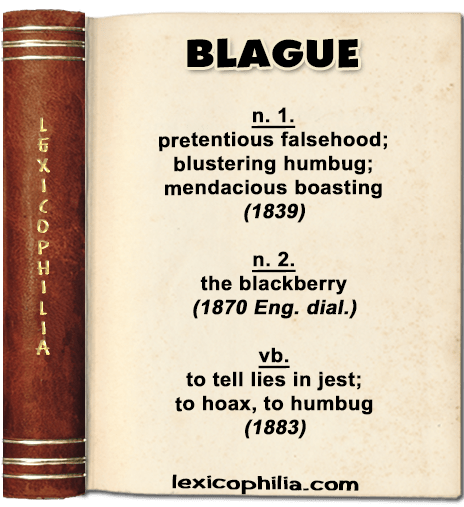
Word of the Day: BLAGUE

ETYMOLOGY
noun: from the French
verb: French blaguer, from the noun

EXAMPLE
“…In later editions of The French Revolution Carlyle did not alter a word of his original account. Instead, he added directly to the main text a new concluding paragraph correcting Barere’s story, which he terms a ‘masterpiece; the largest, most inspiring piece of blague manufactured, for some centuries, by any man or nation. As such, and not otherwise, be it henceforth memorable’…”

From: The French Revolution
By Thomas Carlyle, 1839

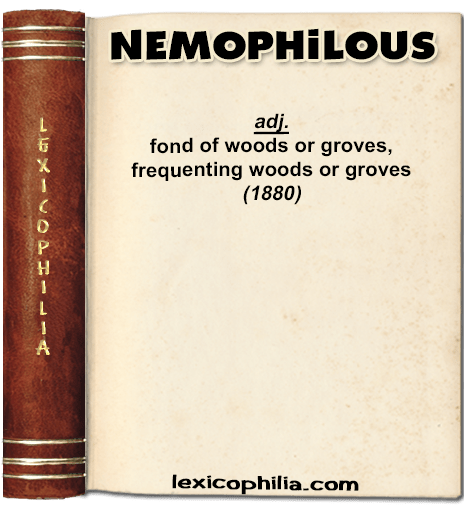
Word of the Day: NEMOPHILOUS

ETYMOLOGY
from Greek νέμος [némos] (wooded pasture, glade) + ‑philous

EXAMPLE
“…The remainder may be classed with regard to requisite moisture as Hygrophilous, Xerophilous, or Noterophilous, the former division including most shade-loving or Nemophilous plants, the Dryads of Martius, and the Xerophiles most but not all Calcophiles or lime-loving plants…”

From: Journal of Botany, British and Foreign
Edited by James Britten, Vol. IX, 1880
‘Proceedings of Societies. Geologists’ Association’

Word of the Day: DRY-FIST

ETYMOLOGY
from dry (miserly, stingy) + fist

EXAMPLE
“…Ferentes. Yet again ? nay, an if you be in that mood, shut up your fore-shop, I’ll be your journeyman no longer. Why, wise Madam Dryfist, could your mouldy brain be so addle to imagine I would marry a stale widow at six-and-forty? Marry gip! are there not varieties enough of thirteen? come, stop your clap-dish, or I’ll purchase a carting for you. By this light, I have toiled more with this tough carrion hen than with ten quails scarce grown into their first feathers …”

From: Loves Sacrifice
By John Ford, 1633

Word of the Day: BLASTFUL

ETYMOLOGY
from blast (a blowing or strong gust of wind) + -ful

EXAMPLE
“…Breezy hills and blastful mountains,
Chirp of birds, and thunder’s roll.
Tinkling rills and gushing fountains.
Powers that spurn weak man’s control.
Cradle song and chariot’s rattle.
Mighty thoughts that stir the soul,
Throng of business, roar of battle,
All make music In the whole.
…”

From: Blackwood’s Edinburgh Magazine,
July – December 1883
‘October Song’

Word of the Day: MICRONYMY


ETYMOLOGY
from Greek µῑκρός (small) + ὄνυµα (name), ὄνοµα, after synonymy, etc.


EXAMPLE
“…Astronomers have set an example in micronymy that anatomists might well fellow; the first asteroid discovered was named Ceres, and many of its successors have dissyllabic or, at most, trisyllabic names. This is the more noteworthy, because, in the first place, these bodies are not, and are hardly likely to become objects of popular discussion; and, secondly, each has its assigned numeric symbol, so that the professional astronomer need not employ the names at all. Now that the choice is offered, the anatomist who deliberately says aponeurosis for fascia, anfractuosity for fissure, and convolution for gyre, runs the risk of association, in the minds of others at least equally well-informed with the “penny-a-liner.” or the village orator who distinctly prefer conflagration to fire …”

From: A Reference Handbook of the Medical Sciences
Edited by Albert H. Buck, 1889

Word of the Day: COCKAPERT


ETYMOLOGY
seemingly an alteration of malapert (adj.) after cock (a mature male of the domestic chicken)


EXAMPLE
for adj.

“…Which is terbox to your side: for out of dout,
Your cockapert pride: and your couetous harts.
Haue brought: more than three parts of our ils about.
Your rude rebelins disobedient parts:
Much vnto our (and much more to your own) smarts:
Kicking and wincing at euery good order,
Hath distroide good order in euery border…”

From: The Spider and the Flie
By John Heywood, 1556


for n.

“… I could tell he was cross about something. I didn’t think the blisters were enough to account for it; he’d suffered them for days without complaint. We got under the quilt and I pulled the coverlet over our heads. In the dark I could watch him but he couldn’t see me. There was a strong scent of sweet balm from the foot salve. I said, “I heard about Sire … Lackadaisy, or or Lapscallion – the cockapert who insulted you. Are you still hungry at him?…”

From: Wildfire: A Novel
By Sarah Wicklem, 2009

Word of the Day: NICELING


ETYMOLOGY
from nice (adj.) + -ling


EXAMPLES
(for n.1.)
“…Whether a man loue God purely, the pleasures of this worlde dooe trye, but muche more doeth the hurly burly of affliccions. And it is in vs, that being furnyshed with the helping ayde of God, we maye nether become tendre nycelynges through vayne pleasures, ne moued with terrible turmoylinges …”

From: The seconde tome or volume of the Paraphrase of Erasmus vpon the Newe Testament
Desiderius Erasmus
Translation by Miles Coverdale et al, 1549


(for n. 2.)
“…Why, I was showing you what nicelings and delicates my father was bringing, and what I had thought to say was this: that he may have this for one, and that for the other, and many a one proud to be remembered (as I shall be if he thinks of me), but this that I know he is bringing for little Bess Hall is something worth all of these, for it is nothing less than the whole love of his heart…”

From: Judith Shakespeare: Her love affairs and Other Adventures
By William Black, 1884

Word of the Day: NUM-CUMPUS


ETYMOLOGY
dialect corruption of non compos mentis (not of sound mind)


EXAMPLE
“…Sa like a graät num-cumpus I blubber’d awaäy o ‘ the bed-
” Weänt niver do it naw moor; an ‘ Sally loookt up an ‘ she said ,
” I’ll upowd it tha weänt ; thou’rt laike the rest o ‘ the men,
Thou’ll goä sniffin ‘ about the tap till tha does it agëan.
Theer’s thy hennemy, man, an’ I knaws, as knaws tha sa well,
That, if tha seeäs ’im an’ smells ’im tha’ll foller ’im slick into Hell
…”

From: The Complete Poetical Works of Alfred Tennyson, 1882
Ballads and Other Poems
‘The Northern Cobbler’

Word of the Day: PODGER


ETYMOLOGY
for n. 1. – a variant of pottinger
for n. 2, 3, 4 – from podge (anything short or thick)  + ‑er 


EXAMPLE
“…He cannot deal the knock-me-down blows of Old Brough, and if you watch your opportunity you may give him a podger. I am seldom in a cause of any consequence before him without getting into some squabble with him…”

From: Life of John, Lord Campbell, 1881,
Letter dated 9 March, 1816