Word of the Day: NUM-CUMPUS


ETYMOLOGY
dialect corruption of non compos mentis (not of sound mind)


EXAMPLE
“…Sa like a graät num-cumpus I blubber’d awaäy o ‘ the bed-
” Weänt niver do it naw moor; an ‘ Sally loookt up an ‘ she said ,
” I’ll upowd it tha weänt ; thou’rt laike the rest o ‘ the men,
Thou’ll goä sniffin ‘ about the tap till tha does it agëan.
Theer’s thy hennemy, man, an’ I knaws, as knaws tha sa well,
That, if tha seeäs ’im an’ smells ’im tha’ll foller ’im slick into Hell
…”

From: The Complete Poetical Works of Alfred Tennyson, 1882
Ballads and Other Poems
‘The Northern Cobbler’

Word of the Day: PODGER


ETYMOLOGY
for n. 1. – a variant of pottinger
for n. 2, 3, 4 – from podge (anything short or thick)  + ‑er 


EXAMPLE
“…He cannot deal the knock-me-down blows of Old Brough, and if you watch your opportunity you may give him a podger. I am seldom in a cause of any consequence before him without getting into some squabble with him…”

From: Life of John, Lord Campbell, 1881,
Letter dated 9 March, 1816

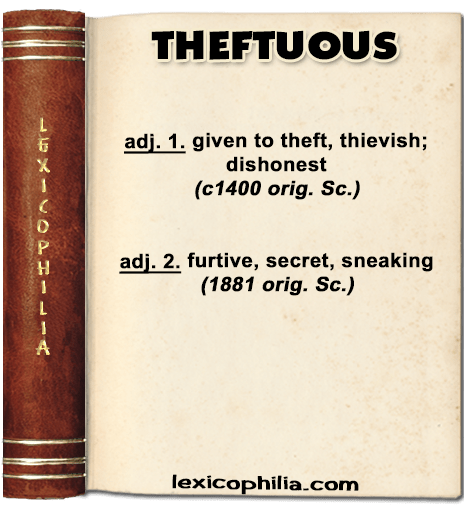
Word of the Day: THEFTUOUS


ETYMOLOGY
alteration (influenced by -uous) of Middle English thiftwis,
from thifte (theft) + wis (wise)


PRONUNCIATION
THEFF-tyoo-uhss


EXAMPLE
“…It is declared, that whosoever intercommuns with Thieves, or assists them in their theftous stealings, or deeds, either in going, or coming, or gives them meat, harbour, or assistance, or trysts with them any manner of way, they shall be pursued, either Civilly, or Criminally; but this act strikes not against such as have entertained the Thief any considerable time, after the committing of the Theft, and before Letters of Intercommuning were execute…”

From: The Laws and Customes of Scotland
By Sir George Mackenzie, 1678

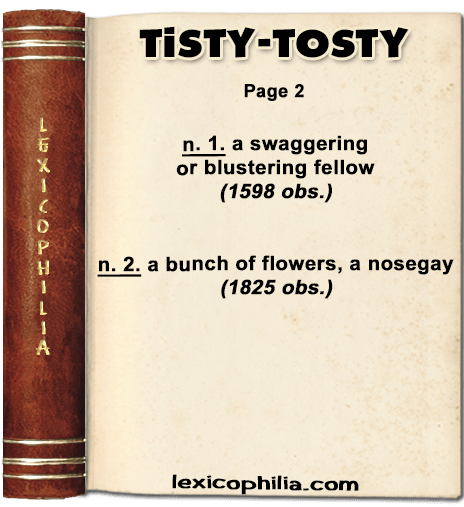
Word of the Day: TISTY-TOSTY


ETYMOLOGY
for int.: perhaps a mere ejaculation
for n. 2.: it has been compared with obsolete tyte tust(e) or obsolete tussemose (a nosegay)


EXAMPLE
“…And now I wil daunce, now wil I praunce,
For why I haue none other woork:
Snip snap Butter is no bone meat:
Knaues flesh is no Porke.
Hey tisty tosty an Ole is a bird,
Iack a napes hath an olde face:
You may beleeue me at one bare woord,
how like you this mery cace?
…”

From: A Pleasant Enterlude, Intituled, Like Will to Like Quoth the Deuill to the Collier
By Ulpian Fulwell, 1568

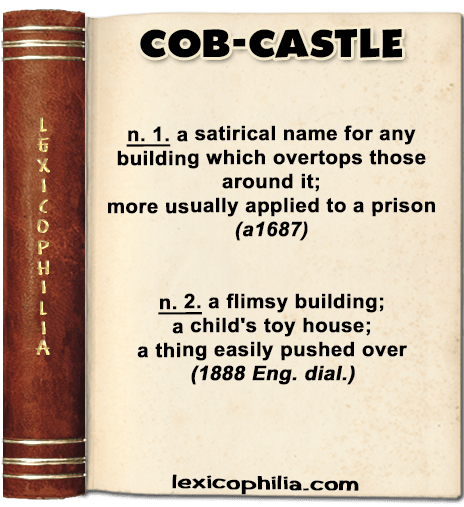
Word of the Day: COB-CASTLE


ETYMOLOGY
? from cob (a big man, a great man, a leading man) + castle


EXAMPLE
“…’Twixt the wood and the castle they see at high water
The storm, the place makes it a dangerous matter;
And besides, upon such a steep rock it is founded,
As would break a man’s neck, should he’scape being drowned:
Perhaps though in time one may make them to yield,
But ’tis prettiest Cob-castle e’er I beheld
…”

From: Poems on Several Occasions written by Charles Cotton, 1689
A Voyage to Ireland in Burlesque

Word of the Day: SNUFFY


ETYMOLOGY
from snuff + -y


EXAMPLE
“…I’m sure she makes a very Tarquinius Sextus of me, and all about this Serenade,—I protest and vow, incomparable Lady, I had begun the sweetest Speech to her—though I say’t, such Flowers of Rhetorick—’twou’d have been the very Nosegay of Eloquence, so it wou’d; and like an ungrateful illiterate Woman as she is, she left me in the very middle on’t, so snuffy I’ll warrant…”

From: Sir Patient Fancy
By Aphra Behn, 1678

Word of the Day: WHIZZER


ETYMOLOGY
from whizz (to move swiftly or with such a sound) + -er


EXAMPLE
“…The washerwoman finds her occupation almost gone through the introduction of machinery. The larger part of the city of Troy is devoted to the manufacture of engines, whizzers, starchers, and other machines of the steam laundry. The most interesting machine is the whizzer, which dries clothes in 1,000 revolutions a minute…”

From: The Pall Mall Budget, July 1887
Volume 35

Word of the Day: SPARROW-FART


ETYMOLOGY
from sparrow + fart


EXAMPLE (for n. 2.)
“…Miss This Miss That Miss Theother lot of sparrowfarts skitting around talking about politics they know as much about as my backside anything in the world to make themselves someway interesting Irish homemade beauties soldiers daughter am I ay and whose are you bootmakers and publicans I beg your pardon coach I thought you were a wheelbarrow…”

From: Ulysses
By James Joyce, 1922

Word of the Day: GORREL


ETYMOLOGY
from Old French gorelgorreau (a pig, hog);
related to Old French gore (sow): of unknown origin.


EXAMPLE (for n. 1.)
“…Crampe that comyth of replycyon fallyth ofte to fatte men and flesshly and well fedde and gorrelles…”

From: Bartholomew de Glanville’s De Proprietatibus Rerum,
Translated by John Trevisa, 1495