Word of the Day: THINKATIVE

ETYMOLOGY
from think (vb.) + -ative, chiefly after talkative

EXAMPLE
“… They have not known I say, that the knowledge of Observation, doth not introduce an understanding into the essential thingliness of a thing, but erecteth only a thinkative knowledge: For otherwise, the understanding should perceive causes that are before in essence. Then also they have been deceived by the simplicity of the Water, which simpleness they have confounded with the unity of knowledge to us unknown. …”

From: Oriatrike or, Physick Refined
By Jean Baptiste van Helmont
Translated by J. Chandler, 1662

Word of the Day: TAKY

ETYMOLOGY
from take (to catch the fancy or affection of; to excite a liking in; to captivate, delight, charm) + -y

EXAMPLE
“…Speaking thus, Mr. Blyth now proceeded to perform by one great effort those two difficult and delicate operations in art, technically described as “putting in taky touches, and bringing out bits of effect.” These arduous final processes, are, as all painters know, only to be accomplished through the medium of certain mystic bodily evolutions, …”

From: Hide and Seek,
By Wilkie Collins, Vol. I. 1854

Word of the Day: SPLENDIDIOUS

ETYMOLOGY
from Latin splendidus (bright, glittering, splendid) + -ious

EXAMPLE
“…Of whom Gregorius Naz[i]anzen spekethe, seyenge, “Suche men reprove liȝhtely straunge thinges, but vnnethe with grete difficulte thei folowe goode thynges.” Wherefore y seenge the poverte and insufficience of my connynge after so splendidious laboures dredde to proferre a raw thynge with bareyne eloquence and to purpose as a thynge bytter to so mellifluous delices….”

From: Polychronicon Ranulphi Higden maonachi Cestrensis
By Ranulf Higden 
Translated by John Trevisa, a1475

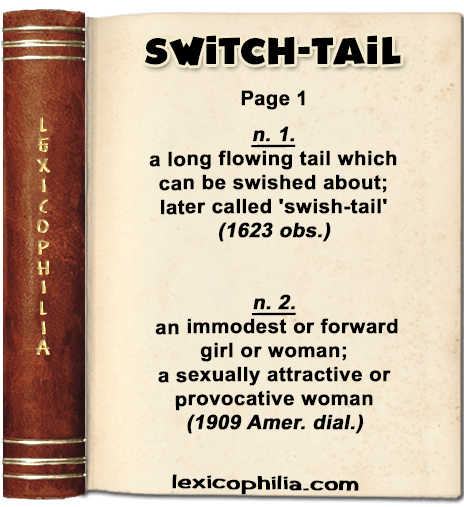
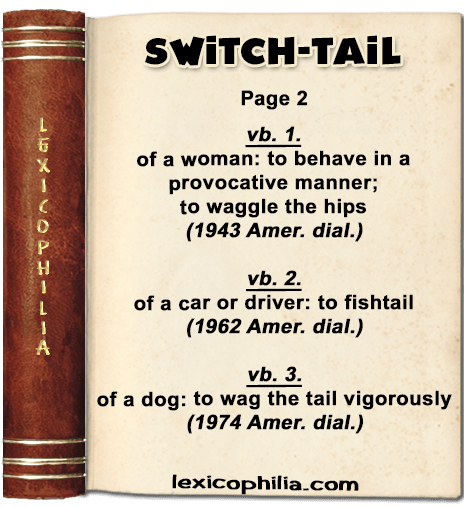
Word of the Day: SWITCH-TAIL


ETYMOLOGY
from switch + tail


EXAMPLE 1 (for n.1)
“…she was observed to ride forth in a Cavalcade somewhat extraordinary pleasant , viz. a good rich Velvet Saddle, and fashionable upon a sorry Horse with a Switch-Tail that us’d to carry Lime, and not Ladies; A gentile Surtout or riding-Suit; with her Shoulders warmly wrapt up in a good White Serge whittle: A pretty handsome Commode of the newest fashion, upon which was gracefully plac’d a good homely Straw Hat, with a long Pole like a Sugar Loaf, so that Cit and Bumpkin seem’d never better met or set off since the Creation …”

From: The Adventures of the Helvetian Hero, with the Young Countess of Albania;
Or, The Amours of Armadorus and Vicentina: a Novel
Unknown author, 1694


EXAMPLE 2 (for n. 2.)
“…I can look a gangster in the eye and make him change his mind, but I can’t do a thing with a woman no more. At one time I had nine big switch-tail women on my personal payroll, and they all stole from me, picked me clean. Buzzards!

From: McSorley’s Wonderful Saloon
By Joseph Mitchell, 1943

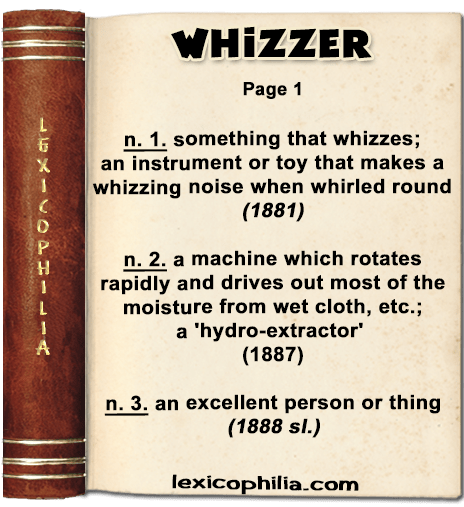
Word of the Day: WHIZZER


ETYMOLOGY
from whizz (to move swiftly or with such a sound) + -er


EXAMPLE
“…The washerwoman finds her occupation almost gone through the introduction of machinery. The larger part of the city of Troy is devoted to the manufacture of engines, whizzers, starchers, and other machines of the steam laundry. The most interesting machine is the whizzer, which dries clothes in 1,000 revolutions a minute…”

From: The Pall Mall Budget, July 1887
Volume 35

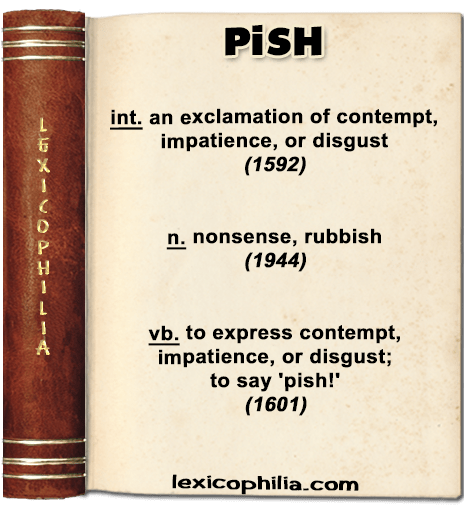
Word of the Day: PISH


ETYMOLOGY
an imitative or expressive formation


EXAMPLE
“…Hoe! God, be here! on their bald, burnt, parchment pates. Pish, pish! what talke you of olde age or balde pates? Men and women that haue gone vnder the south pole, must lay of theyr furre night-caps in spyght of their teeth, and become yeomen of the vineger bottle…”

From: Pierce Penilesse, His Supplication to the Diuell
By Thomas Nashe, 1592

Word of the Day: PEDESTRIAL


ETYMOLOGY
from Latin pedestr-pedester, also pedestris (going on foot), in prose, prosaic
(from pedes a person who goes on foot
(from ped-pēs (foot) + -es (after eques) + -ter + -al 


PRONUNCIATION
puh-DESS-tree-uhl


EXAMPLE
“…For, the formall esteemed causes (which are pedestriall, equestriall, or nauti∣call) stand either at the disposition of the efficient; or pretend perfection and vse from the finall…”

From: An Essay of the Meanes Hovv to Make our Trauailes, into Forraine Countries,
the More Profitable and Honourable
By Sir Thomas Palmer, 1606

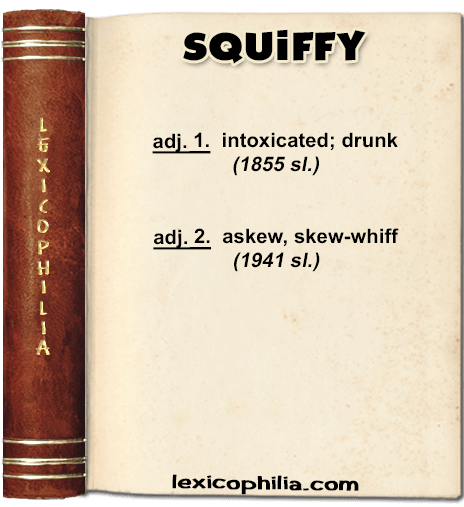
Word of the Day: SQUIFFY


ETYMOLOGY
of fanciful formation


EXAMPLE
“…Curious enough, there is a Lady Erskine, wife of Lord E, her husband’s eldest brother living at Bollington, who tipples & ‘gets squiffy‘ just like this Mrs E. …”

From: The Letters of Mrs. Gaskell
By Elizabeth Cleghorn Gaskell, 1855
Edited by J. A. V. Chapple, ‎Arthur Pollard, 1966