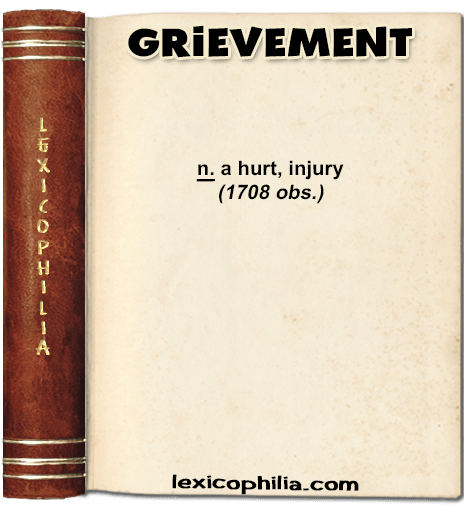
Word of the Day: GRIEVEMENT

ETYMOLOGY
from grieve + -ment

EXAMPLE
“…The manner of his Marching forth,
Some Authors tell us, and his Worth,
His Stature, Courage, Strength and Age,
His Armour and his Equipage,
His Warlike Feats in former Days,
Perform’d in Scotch and Gallick Frays,
His Battels won and great Atchievments,
Wounds, Bruises, Bangs, and other Grievments;
Which Happen’d oft to be his Fate,
For no Man’s always Fortunate:
All which I leave to Ancient story;
Now see the end of all his Glory
…”

From: England’s Reformation from the time of King Henry VIII to the End of Oates’s Plot,
A Poem in Four Canto’s
By Thomas Ward, 1708

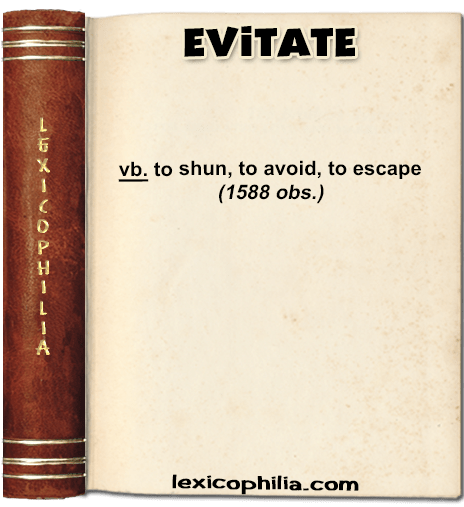
Word of the Day: EVITATE

ETYMOLOGY
from Latin evitatus, pa. ppl. of evitare (to shun),
from e– out + vitare (to shun)

EXAMPLE
“…So after the sayd father had informed himselfe of all that is sayde, and of many other thinges more, which is left out for to euitate tediousnes, till such time as of them may bee made a particular historie, hee departed from Goa and Cochin towardes Portingall, and passed by the Ilandes of Maldiuia which are many, & all are inhabited with Moores, nigh vnto the which they doe enter the poole Antartico, crossing the equinoctiall from the coast of Arabia, from thence they sayled with a faire winde till they came right against the Iland of sainct Lorenso, which is very great, for that it hath two hundreth seuentie and fiue leagues of longitude, and fourescore and tenne of latitude…”

From: The Historie of the Great and Mightie Kingdome of China
By Juan González de Mendoza
Translated out of Spanish by Robert Parke, 1588

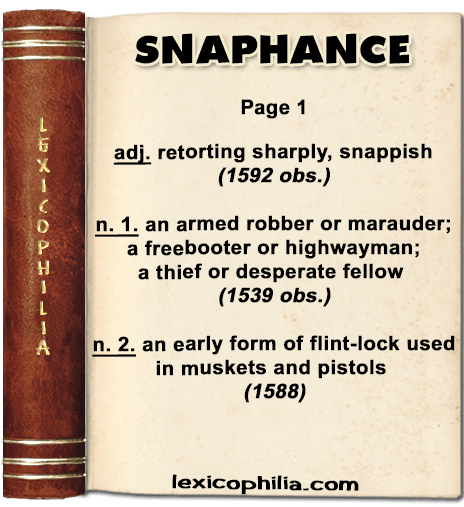
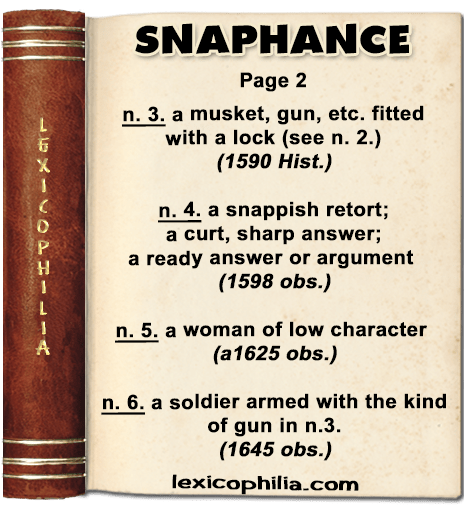
Word of the Day: SNAPHANCE

ETYMOLOGY
From OED: Of Continental origin, representing Dutch and Flemish snaphaan (in Kilian snap-haen ), Middle Low German snaphân , Low German snapphân , German schnapphahn (†-han ),
from snappen , schnappen (snap v.) + haan, hahn (cock).
It is not quite clear whether the sense is ‘snapping cock’ or ‘cock-snapper’ (i.e. cock-stealer).
In English the second element may have been confused with the personal name Hans; but Heyne (in Grimm’s Dict.) cites an early example of German schnaphons.

EXAMPLE
“…Fyrste to make this realme a praye to al venturers, al spoylers, all snaphanses, all forlornehopes, all cormerauntes, all rauenours of the worlde, that wyll inuade this realme…”

From: A Sermon of Cuthbert Tonstall, Bishop of Durham,
Preached on Palm Sunday, 1539, Before King Henry VIII;
By Cuthbert Tunstall

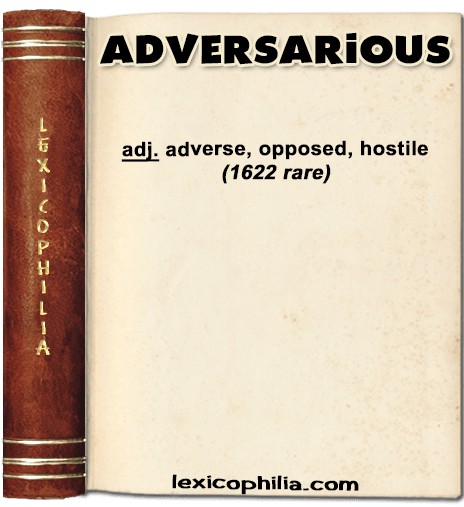
Word of the Day: ADVERSARIOUS

ETYMOLOGY
from Latin adversarius (opposed, hostile, adverse, harmful, injurious) + -ous

EXAMPLE
“…This resisting and aduersarious Empire, while it fought against Christ it serued Christ, while it killed his Church it increased his Church, and while it fought against Religion, it became a meanes to spread and inlarge it…”

From: Diseases of the Time Attended by their Remedies
By Francis Rous, 1622

Word of the Day: PIPPIN-HEARTED

ETYMOLOGY
from pippin, from Anglo-Norman pepinpepinepopin and Middle French pepin (seed or pip of a fleshy fruit), possibly a derivative of a Romance base meaning ‘small’

EXAMPLE
“…and were put under the command of very valiant tailors and man-milliners, who, though on ordinary occasions the meekest, pippin-hearted little men in the world, were very devils at parades and court-martials, when they had cocked hats on their heads, and swords by their sides…”

From: A History of New York,
From the Beginning of the World to the end of the Dutch Dynasty
By Washington Irving, 1809

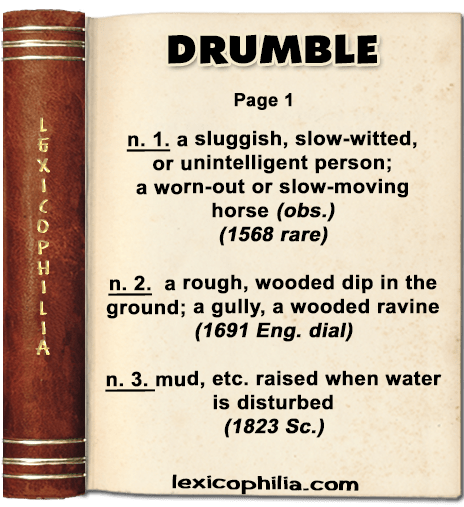
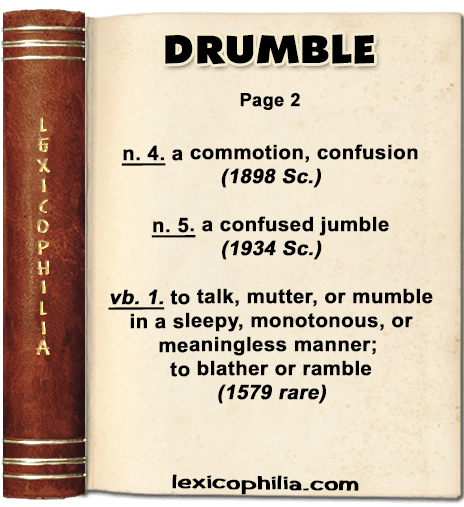
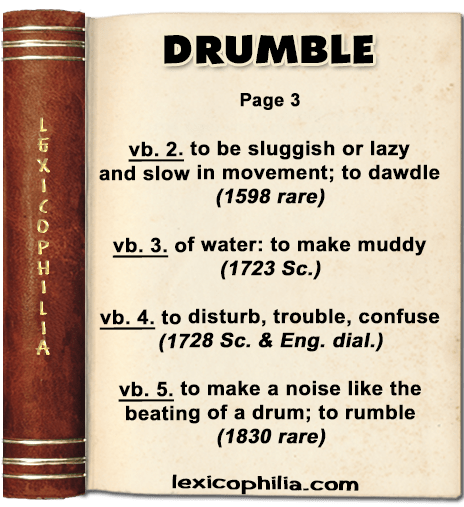
Word of the Day: DRUMBLE

ETYMOLOGY
n. 1.: ? variant of dumbledummel (Eng. dial., a stupid, slow person)

n. 2.: a variant or alteration of dimble (a deep, shady dell, a dingle)

vb. 4.: apparently a nasalized form of drubble (to trouble, disturb), parallel to drumblydrumly (adj.) from drubly; but possibly a back-formation from the adj.

vb. 5.: blend of drum and rumble

EXAMPLE
“…Yea but what am I, a Scholer, or a scholemaister, or els some youth.
A Lawier, a studient or els a countrie cloune
A Brumman, a Baskit maker, or a Baker of Pies,
A flesh or a Fishmonger, or a sower of lies:
A Louse or a louser, a Leeke or a Larke:
A  Dreamer, a Drommell, a fire or a sparke:
A Caitife, a Cutthrote, a creper in corners,
A herbraine, a hangman, or a grafter of horners
…”

(Note: drommell is the earliest variant of drumble)

From: A New Tragicall Comedie of Apius and Virginia
By R.B., 1575

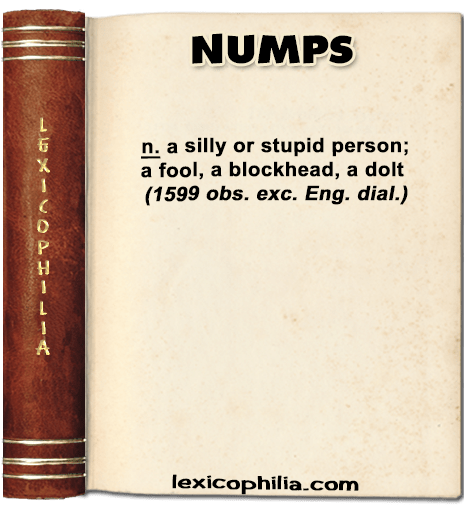
Word of the Day: NUMPS

ETYMOLOGY
of uncertain origin;
From the OED: “Perhaps originally a pet form of the male forename Humphry, as suggested by the context in … examples.”

EXAMPLE
“…to his worthie good patron, Lustie Humfrey, according as the townsmen doo christen him, little Numps, as the Nobilitie and Courtiers do name him, and Honest Humfrey, as all his friends and acquaintance esteeme him…”

From: Lenten Stuffe
By Thomas Nashe, 1599

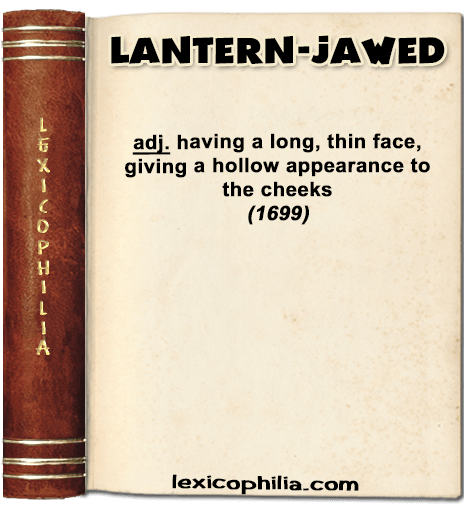
Word of the Day: LANTERN-JAWED

ETYMOLOGY
from the fancied resemblance of the face to the shape of a lantern

EXAMPLE
“…A lanthorn-jaw’d woman, with a hatchet face, sunk eyes, a hook nose, taper lips, leather cheeks, dark Gums, straggling teeth, and such a low forehead, that her hair serves instead of eyebrows…”

From: The Comical Works of Don Francisco de Quevedo
Translated by John Stevens, 1707