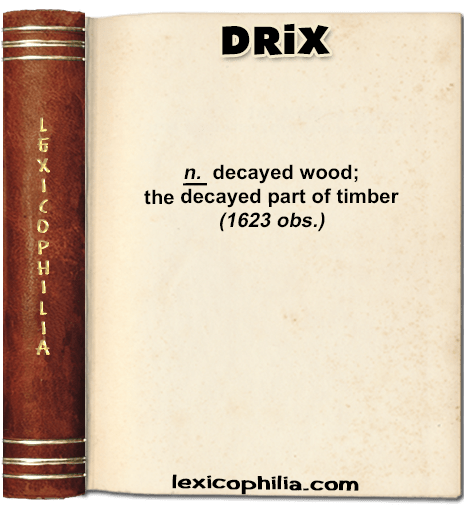
Word of the Day: DRIX

ETYMOLOGY
of uncertain origin

EXAMPLE
“…The Waspes neast is begun by one great Waspe, which you may therefore call the Mother-waspes, the which in Cancer (or in hot and dry springs somewhat rather) within some hole, vsually made in the ground by a Moale, Mouse, or other meanes, worketh a comb of the vtter drix of pales or other timber, in forme of a round tent hanging by the top to the ouer-part of the hole.…”

From: The Feminine Monarchie,
Or the Historie of Bees
By Charles Butler, 1623
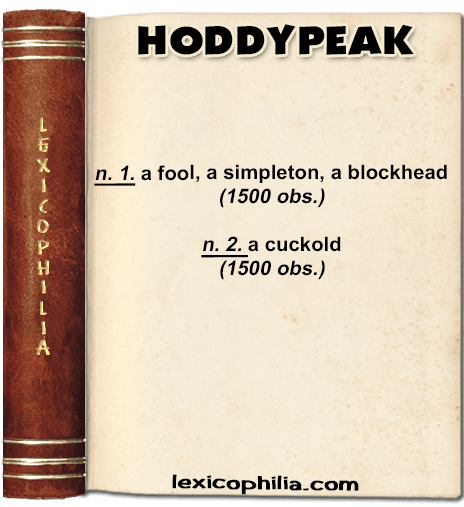
Word of the Day: HODDYPEAK

ETYMOLOGY
from hoddy (? snail or horned) + peak (a silly or foolish person, obs.),
but the sense is obscure

EXAMPLE
“…As well apparelyd at eche poynt of hys aray
Who dwelleth here wyll no man speke
Is there no fole nor hody peke
Now by the bell yt were almys to breke
…”

From: Nature, A Goodly Interlude of Nature
Compiled by Henry Medwall, 1500

Word of the Day: OVERSLOP

ETYMOLOGY
Old English oferslop (in Old Norse yfirsloppr), 
from over- + slop (a smock)

EXAMPLE
“…By cause of which men sholde hym reuerence
That of his worshipe rekketh he so lite
His ouerslope nys nat worth a myte
As in effect to hym / so moot I go
It is al baudy and to-tore also
…”

From: Canon’s Yeoman’s Tale
By: Geoffrey Chaucer, c1395

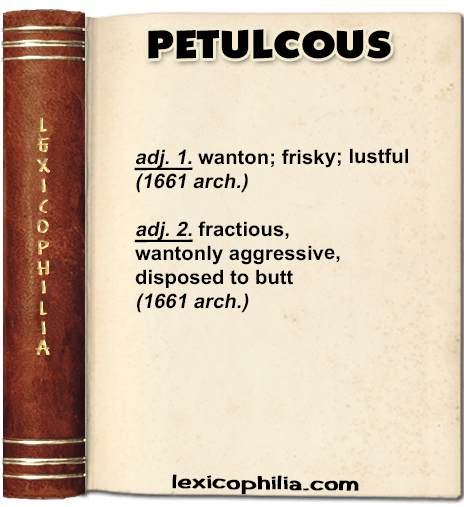
Word of the Day: PETULCOUS

ETYMOLOGY
from Latin petulcus (inclined to butt, butting, wanton, frisky);
(from petĕre – to aim at, assail + -ulcus (suffix forming adjectives) + -ous

EXAMPLE
“…But what does the Pape or Christian Pastour do in this case When the tumult is once raised and a disorder begun in any part of his flock by som proud turbulent spirit amongst them, the Pape first whistles him and his fellow petulcous rams into order by charitable admonition which still encreases lowder by degrees…”

From: Fiat Lux:
Or, A general Conduct to a right understanding and charity in the great Combustions and Broils about Religion here in England, Betwixt Papist and Protestant, Presbyterian and Independent
By John Baptist Vincent Canes

Word of the Day: MONNISHER

ETYMOLOGY
probably from Angloromani (English Romani) mónoshi (woman, wife),
from Romani månuš (man) +  (feminine suffix)

EXAMPLE
“…I was standing near the prosecutor’s shew-glass, talking to a young man; the prisoner and another came to the glass, where I saw the medal lying: I saw them point at it; the other said, it would just do for him, and bid the prisoner look who was in the shop; he answered there was a Monisher in the shop; I suppose a cant word for a woman: Mrs. Storey was there: they went in; then I went into the house where I live; they came out in about three or four minutes: I went after them to the corner, and saw them running along Leicester-fields as fast as they could: I came back, and asked Mrs. Storey whether that medal was gold? she said it was she looked, and it was gone…”

From: The Proceedings of the Old Bailey, London’s Central Criminal Court
18th September, 1765

Word of the Day: HOSPITALIOUS

ETYMOLOGY
from Latin hospitālis (hospitable) + -ous

EXAMPLE
“…Too much, too little, or a meane, sort out alike, we see,
House-keeping, nor Humilitie, in any of the Three.
Be hospitalious, Churchmen: Lay, cease sacrilegious sinne:
Your Soules-sore, but their Stores-salue, whence, euē whiningly, they winne,
By pinching from the Pulpet, and their Purses, with this note,
Scarse will their Studies stipend them, their wiues, and Children cote
…”

From: Albions England
A continued historie of the same kingdome, from the originals of the first inhabitants thereof
By William Warner, 1596