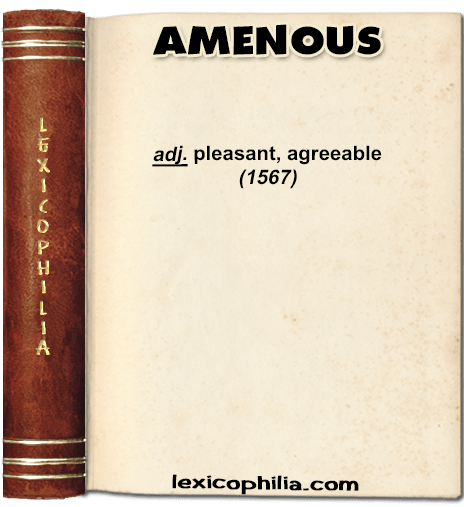
Word of the Day: AMENOUS

ETYMOLOGY
from Latin amœnus (pleasant) + –ous

EXAMPLE
“…Whose mynde was none other but to pass the time, and their predestinate perpetual captivitie in the amenous varietie of over reading and revoluting many volumes and sundry books of divers sciences and strange matters…”

From: Some Specimens of the Poetry of the Antient Welsh Bards
By the Rev. Mr. Evan Evans, 1764
A Poem Entitled, The Ode of the Months, composed by Bwilym Ddu of Arfon, to Sir John Griffydd Llwyd, of Tregarnedd and Dinornig

Word of the Day: KICKIE-WICKIE

ETYMOLOGY
apparently a humorous formation of kicksey-winsey (a whim or erratic fancy)

EXAMPLE
“…Parolles. I that would be knowne: too’th warrs my boy, too’th warres: He weares his honor in a boxe vnseene, That hugges his kickie wickie heare at home, Spending his manlie marrow in her armes Which should sustaine the bound and high curuet Of Marses fierie steed: to other Regions, France is a stable, wee that dwell in’t Iades, Therefore too’th warre…”

From: All’s Well that Ends Well
By William Shakespeare, a1616

Word of the Day: RUTTERKIN

ETYMOLOGY
from rutter (a dashing gallant) + -kin

EXAMPLE
“…COURTLY ABUSION. Huffa, huffa, taunderum, taunderum tayne, huffa, huffa
CLOAKED COLLUSION (To the audience.) This was properly prated, sirs. Wat said a?…”
COURTLY ABUSION. Rutty bully jolly rutterkin, heyda!
CLOAKED COLLUSION. De que pays este vous
…”

From: Magnyfycence
By John Skelton, a1529

Word of the Day: WANHOPE

ETYMOLOGY
from wan- (a prefix approximately equivalent to un- or mis-)  + hope

EXAMPLE
“…& is men as in wanhope wende hom aȝen bliue
So þat ich hopie to god pais þe wule ich am aliue
Messagers to denemarch sone isend were
& as þe king adde ised al clene hii founde þere
…”

From: The Metrical Chronicle of Robert of Gloucester, 1297

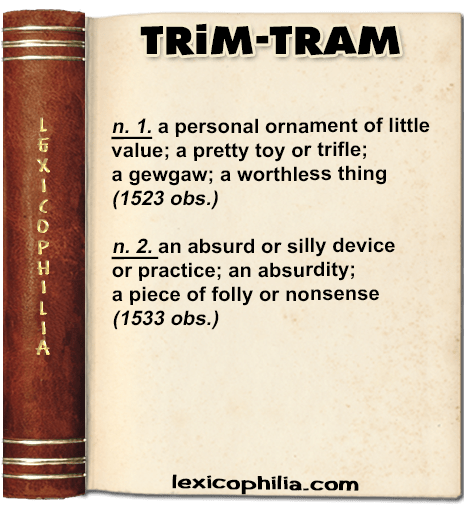
Word of the Day: TRIM-TRAM

ETYMOLOGY
for n.1., apparently a reduplication with vowel variation of trim (adj.);
for n. 2., apparently a whimsical application of n.1.

EXAMPLE
“…Esebon, Marybon, Wheston next Barnet;
A trym tram for an horse myll it were a nyse thyng;
Deyntes for dammoysels, chaffer far fet:
Bo ho doth bark wel, but Hough ho he rulyth the ring
…”

From: Speke Parott
By John Skelton, 1523

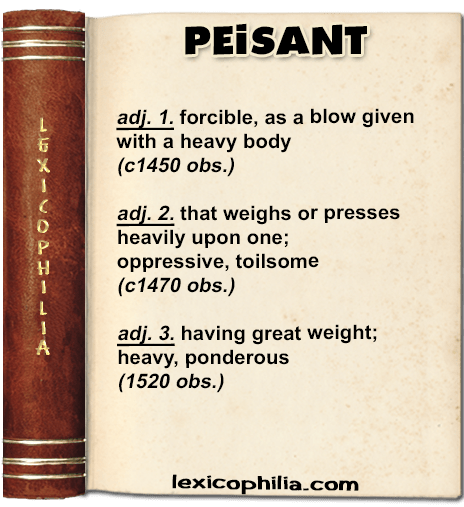
Word of the Day: PEISANT

ETYMOLOGY
from Anglo-Norman peisantpeisauntpesaunt, Anglo-Norman and Middle French pesant (of things – heavy, massive, oppressive, wearisome, difficult), (of the hand, a blow, etc. – forcible, coming down heavily), (of people – slow, sluggish), use as adjective of present participle of peiser , peser (to weigh)

EXAMPLE
“…But as for so poure a man as I, there would none aduocate pleden without wages paid byfore in honde; for pledours in worldly courtes hauen tonges lyke to t he languet of the balaunce that draweth hym alwey to the more peysaunt party, that better wyl rewarden…”

From: The Booke of the Pylgremage of the Sowle,
Translated from the French of Guillaume de Deguileville

Word of the Day: LITTLE SON

ETYMOLOGY
perhaps after Middle French, French petit-fils (grandson, grandchild)

EXAMPLE
“… is the transporting ȝoure littil son and my onelie child in this countrey. To the quhilk albeit I be never sa willing, I wald be glaid to have ȝoure advyse therein, as in all uther thingis tuiching him. I have born him…”

From: The Love Letters of Mary, Queen of Scots
– Hugh Campbell, 1824
Letter written to the Countess of Lennox, July 10, 1570