Word of the Day: PREALLABLE

ETYMOLOGY
from Middle French preallable (preceding, preliminary);
from preal(l)er (to precede);
from pre- aller (to go) + -able

EXAMPLE
… And it was not to bee modelled or directed by the patterne of regular and remisse friendship, wherein so many precautions of a long and preallable conversation, are required. This hath no other Idea than of it selfe, and can have no reference but to it selfe. …”

From:  The Essayes, or Morall, Politike, and Millitarie Discourses of Lord Michaell de Montaigne
Translated by John Florio, 1603
Of Friendship

Word of the Day: BELSIRE

ETYMOLOGY
from Middle English belsyre,
from belfair (beautiful) (from Old French)

EXAMPLE
“… With those delicious Brooks, by whose immortall streames
Her greatnesse is begunne: so that our Riuers King,
When he his long Descent shall from his
Bel-sires bring,
Must needs (Great Pastures Prince) deriue his stem by thee,
From kingly Cotswolds selfe, sprung of the third degree:
…”

From: Poly-Olbion
By Michael Drayton, 1612

Word of the Day: SOLEMNCHOLY

ETYMOLOGY
fancifully from solemn (adj.), after melancholy

EXAMPLE
[Dr. John Beatty to Philip Fithian]
Philadelphia, December 18th, 1772

“… I rode that evening you left me as far as Cormans; being very Solemncholly and somewhat tired, I concluded to stay there all night; and very early next morning breakfasted at Gloucester and got into Philadelphia before Eleven of the clock …”

From: Journal and Letters
By Philip Vickers Fithian, 1900

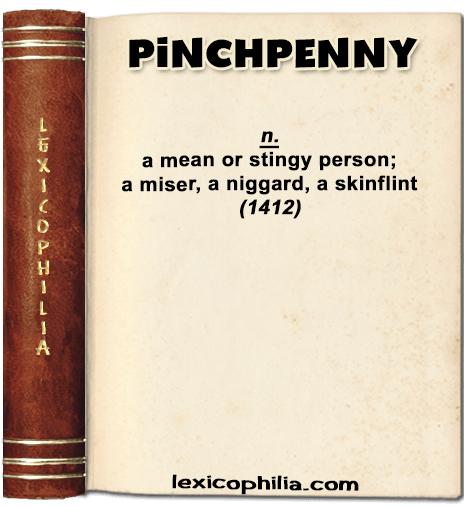
Word of the Day: PINCHPENNY

ETYMOLOGY
from pinch- (comb. form) + penny

EXAMPLE
“… A prince & kyng of al a regioun
Mot avarice thrist a-doune to grounde;
To hym þat lith in helle depe I-bounde,
The, auarice, by-take I to kepe;
Thow
pynepeny, [pynchepeny] ther ay mot þou slepe! …”

From: Hoccleve’s Works,
Edited by Frederick J. Furnivall, 1892
De Regimine Principum
By Thomas Hoccleve, Composed c1412

Word of the Day: PRITTLE-PRATTLE

ETYMOLOGY
reduplicated extension of prattle (to talk in a foolish, childish, or inconsequential way)

EXAMPLE (for vb.)
“… they are poore honest folkes, and haue here an honest company at their mariage, now they lacke wyne, I pray you helpe, She was not long in bibble bable, with saying she wist not what, but sayth at one word, helpe for it is nede. She doth not, as our Papistes do, whiche prittle prattle a whole day uppon their Beades, saying our Ladyes Psalter. But she only sayth, they haue no wyne; helpe. etc. …”

From: Frutefull Sermons
A Sermon Preached by Hugh Latymer, a1552

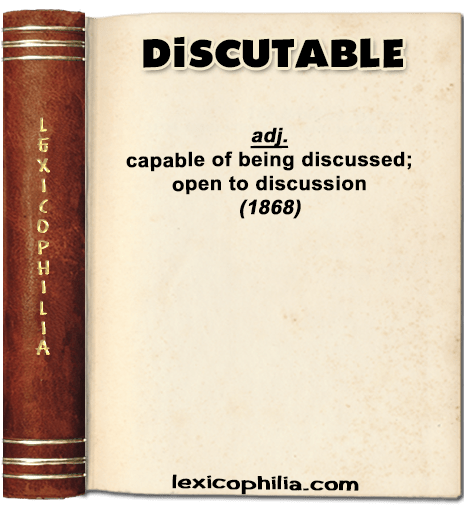
Word of the Day: DISCUTABLE

ETYMOLOGY
from French discutable,
from discuter (to discuss),
(from Latin discutere (to discuss) + -able)

EXAMPLE
“… A definite and complete study of all literary works of the period inspired by the event would be not only an enterprise worthy of an inquisitive erudition, but also a useful help in tracing a line of demarcation between legend and history, and would throw a flood of light on many insoluble or discutable points. …”

From: The Saturday Review of Politics, Literature, Science and Art, 1893
Christopher Columbus and Lope de Vega

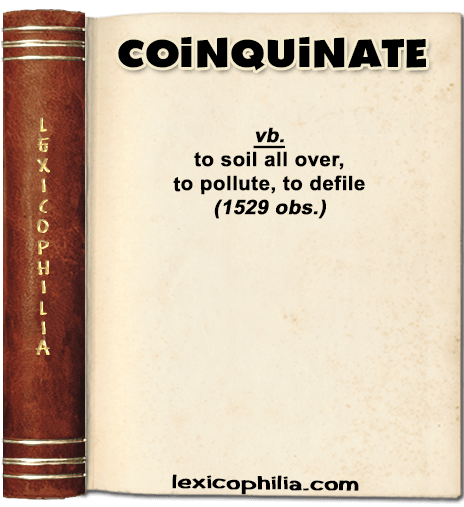
Word of the Day: COINQUINATE

ETYMOLOGY
from Latin coinquinat- participial stem of coinquinare (to defile all over),
from co- (together) + inquinare (to defile)

EXAMPLE
“... For the wele publyke
Of preesthode in this case
And alwayes to chase
Suche maner of sysmatykes
And halfe-heretykes
That wolde intoxicate
That wolde
conquinate
That wolde contemminate
And that wolde vyolate
And that wolde derogate
And that wolde abrogate
The churche hygh estates
…”

From: Colyn Cloute
By John Skelton, a1529

Word of the Day: PASSANCE

ETYMOLOGY
from passant (passing by or along, going, proceeding; travelling, journeying)

EXAMPLE
“… Thus passed they their passance, and wore out the wéerie way with these pleasant discourses, & prettie posies, where after their tedious toyle, they came to their Inne, where Phemocles coulde neither eate meate for ioy, nor sléepe in his bedde for the pleasure he cōceiued of his trauell. ..”

From: Narbonus The Laberynth of Libertie
By Austin Saker, 1580