Word of the Day

Word of the Day: DEVENUSTATE

ETYMOLOGY
from late Latin devenustare (to disfigure, deform),
from de- venustare (to beautify), venustus (beautiful)

EXAMPLE
“…but that Christ and his Servants may have comfort and stability amongst us, that those who Rule would fence the Vine, Learning, against beasts of Prey, and Foxes of spoil, who would rejoyce to see what yet remains of beauty and order, devenustated and exposed to shame and dishonour…”

From: An Humble Apologie for Learning and Learned men
By Edward Waterhouse, 1653

Word of the Day: EDULIOUS

ETYMOLOGY
from Latin edulis, from edere (to eat)

EXAMPLE
“…That the Prodigal Son desired to eat of Husks given unto Swine, will hardly pass in your apprehension for the Husks of Pease, Beans, or such edulious Pulses; as well understanding that the textual word or Ceration, properly intendeth the Fruit of the Siliqua Tree so common in Syria, and fed upon by Men and Beasts…”

From: Certain Miscellany Tracts
By Sir Thomas Brown, a1682

Word of the Day: MENTIMUTATION

ETYMOLOGY
from Latin menti-mens (mind) + mutation

EXAMPLE
“…I..shall be allowed the full benefit of all the..illaqueations, extrications,..mentimutations, rementimutations,..that I..can devise…”

From: Discolliminium: Or, A Most Obedient Reply to a Late Book, Called, Bounds & Bonds, So Farre as Concerns the First Demurrer and No Further
By Nathaniel Ward, 1650

Word of the Day: PHOTOGENY

ETYMOLOGY
from photo- (comb. form; relating to light) + -geny (comb. form; general sense = mode of production)

EXAMPLE
“…IMPROVEMENTS IN THE DAGUERREOTYPE. — Numerous improvements have been lately made in the beautiful art of photogeny….”

From: Burton’s Gentleman’s Magazine
A Chapter on Science and Art
By Edgar Allen Poe
Volume VI, April, 1840

Word of the Day: PAPELARD

ETYMOLOGY
from French papelard, papelart
as per OED: further etymology uncertain and disputed

EXAMPLE
“…Þe zeuende boȝ of prede ys fol drede and fole ssame huane me let wel to done uor þe wordle þet me ne by yhyealde ypocrite ne papelard huer me dret more þe wordle: þanne god…”

(The seventh bough of pride is foolish dread and foolish shame, when one ceases to do well because of the world, that one be not held a hypocrite or a canter, where one dreads the world more than God)

From: Dan Michel’s Ayenbite of Inwyt : or, Remorse of Conscience, 1340
Translation from: The Ayenbite of Inwyt, A Translation of Parts into Modern English
By A.J. Wyatt

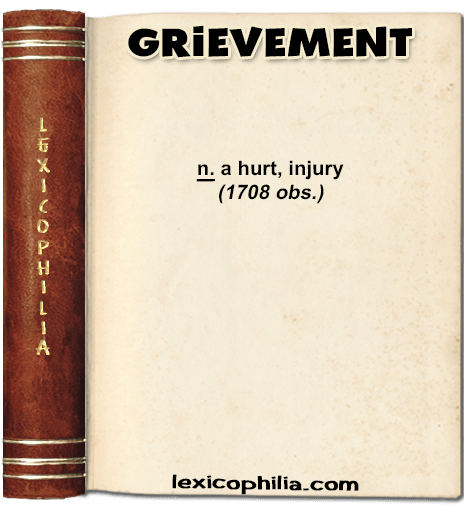
Word of the Day: GRIEVEMENT

ETYMOLOGY
from grieve + -ment

EXAMPLE
“…The manner of his Marching forth,
Some Authors tell us, and his Worth,
His Stature, Courage, Strength and Age,
His Armour and his Equipage,
His Warlike Feats in former Days,
Perform’d in Scotch and Gallick Frays,
His Battels won and great Atchievments,
Wounds, Bruises, Bangs, and other Grievments;
Which Happen’d oft to be his Fate,
For no Man’s always Fortunate:
All which I leave to Ancient story;
Now see the end of all his Glory
…”

From: England’s Reformation from the time of King Henry VIII to the End of Oates’s Plot,
A Poem in Four Canto’s
By Thomas Ward, 1708

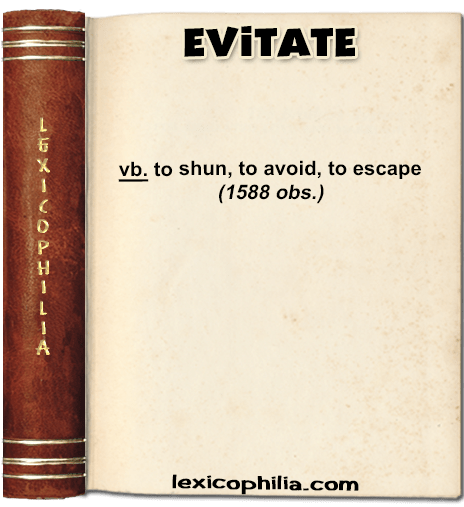
Word of the Day: EVITATE

ETYMOLOGY
from Latin evitatus, pa. ppl. of evitare (to shun),
from e– out + vitare (to shun)

EXAMPLE
“…So after the sayd father had informed himselfe of all that is sayde, and of many other thinges more, which is left out for to euitate tediousnes, till such time as of them may bee made a particular historie, hee departed from Goa and Cochin towardes Portingall, and passed by the Ilandes of Maldiuia which are many, & all are inhabited with Moores, nigh vnto the which they doe enter the poole Antartico, crossing the equinoctiall from the coast of Arabia, from thence they sayled with a faire winde till they came right against the Iland of sainct Lorenso, which is very great, for that it hath two hundreth seuentie and fiue leagues of longitude, and fourescore and tenne of latitude…”

From: The Historie of the Great and Mightie Kingdome of China
By Juan González de Mendoza
Translated out of Spanish by Robert Parke, 1588