ETYMOLOGY
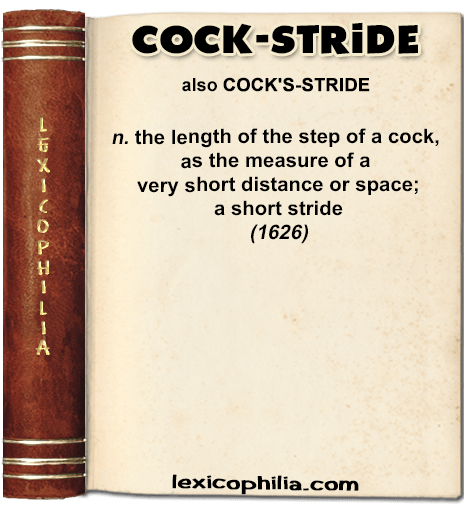
from cock + stride
EXAMPLE
“…It is now February and the Sun has gotten up a cocke-stride of his climbing, the vallies now are painted while, and the brooks are full of water…”
From: Fantasticks
– Nicholas Breton, 1626
ETYMOLOGY
from cock + stride
EXAMPLE
“…It is now February and the Sun has gotten up a cocke-stride of his climbing, the vallies now are painted while, and the brooks are full of water…”
From: Fantasticks
– Nicholas Breton, 1626

ETYMOLOGY
from naughty + pack
EXAMPLE
“…Calle hir a naughtie packe: withe that one woorde thou haste taken all from hir, and haste lefte hir bare and foule…”
From: A very frutefull and pleasant boke called the instructio[n] of a Christen woma[n]
By Juan Luis Vives, a1530
(translated by Richard Hyrde)
ETYMOLOGY
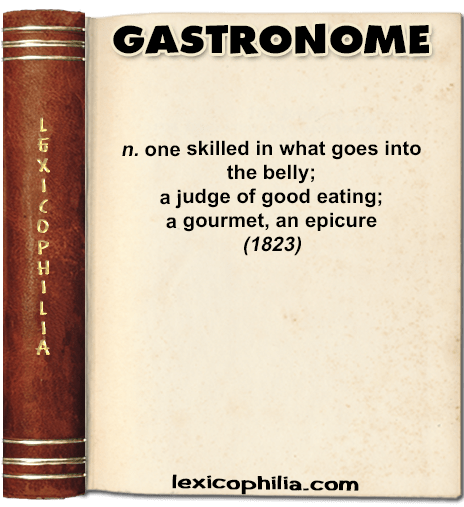
from French gastronome, back-formation from gastronomie (gastronomy, art of delicate eating)
EXAMPLE
“…Whereas, such and so interesting were the subjects of discussion betwixt Chiffinch and the French cook, that, without heeding the rules of etiquette, they rode on together, amicably abreast, carrying on a conversation on the mysteries of the table, which the ancient Comus, or a modern gastronome, might have listened to with pleasure. It was therefore necessary to venture on them both at once…”
From: Peveril of the Peak
– Sir Walter Scott, 1823

ETYMOLOGY
from xen- combining form of Greek ξένος (xenos stranger, guest & adj. foreign, strange) + mania
EXAMPLE
“…Germany received the first caresses of this strange xenomania from the hands of youthful Carlyle and old Coleridge, but the friendship developed into fashion only half a generation later…”
From: The Nineteenth Century
A Monthly Review
Edited by James Knowles, Vol. VI, July-December, 1879
Familiar Letters on Modern England, I.

ETYMOLOGY
from mis- (expressing negation of something good or desirable)
+ queem, queme (to please)
EXAMPLE
“…The kings law wol no man deme
Angerliche without answere:
But if any man these misqueme,
He shall be baighteth as a bere:
And yet wel worse they wol him tere,
And in prison woll him pende,
In giues, and in other gere.
When God woll, it may amend…”
From: The Ploughman’s Tale, c1535

ETYMOLOGY
from Greek καλός (fair, excellent) + -ϕαντης (shower) (from ϕαίνειν to show) + -ic
EXAMPLE
“…T’is only wisht your work from Dolts, your Hiues from Drones were free:
T’is wisht in These, in Fugitiues, in Papists, and (more bad,
Whom to perswade to reason, were with reason to be mad)
In Calophantick Puritaines, amisse amendment had…”
From: Albions England
A continued historie of the same kingdome, from the originals of the first inhabitants thereof
– William Warner, 1596

ETYMOLOGY
from Latin exheredat- participial stem of exheredare (to disinherit), from ex- + heredem (heir)
EXAMPLE
“…’Tis fit indeed, fortitude should be encouraged, all ages and Nations have need of it, and are made happy by it, therefore ought to reward it, and so have done, and so (for example sake) will do; but other vertues of equal merit, must not be exhaeredated, or become spurious, to advance its legitimation…”
From: A discourse and defence of arms and armory,
shewing the nature and rises of arms and honour in England, from the camp, the court, the city
By Edward Waterhouse, 1660

ETYMOLOGY
from idio- (own, personal, private, peculiar, separate, distinct) + glottic (pertaining to language)
EXAMPLE
“…This impression he uttered with the word “pupu,” meaning a very big papa. The boy soon gave up his idioglottic endeavors, learning German before his next-born sister had reached the age of beginning speech. So that language could have no further grammatical development…”
From: Proceedings of the Royal Canadian Institute
Being a Continuation of the “Canadian Journal” of Science, Literature, and History
October, 1888, Vol. XXIV
The Development of Language, by Horatio Hale

ETYMOLOGY
from hen (a woman, a wife) + house
EXAMPLE
“…That was another one. She’s got two daughters. Hold me, big boy,; I’m heading for the hen-house…”
From: Sanctuary
By William Faulkner, 1931

ETYMOLOGY
from ruggy (Sc. – rough, hard, difficult) + duggy (Sc. – ? diminutive of dog)
EXAMPLE
“…Noo loudly swell’d, wi’ cheery soun’
Ye banks an’ braes o’ bonnie Doon,
When Watty, daiz’d, said, lookin’ roun’,
We’re a’ as fou as puggies!
Syne Jamie Gould, an Embro’ chiel’,
Grew fidgin’ fain at ilka heel –
Up wi’ a a dance! – a reel! – A reel!
A reel, ye ruggy-duggies!…”
From: The Merry Bridal O’ Firthmains
And Other Poems and Songs
By James Smith, 1866
 Lexicophilia