Word of the Day

Word of the Day: RUTTERKIN

ETYMOLOGY
from rutter (a dashing gallant) + -kin

EXAMPLE
“…COURTLY ABUSION. Huffa, huffa, taunderum, taunderum tayne, huffa, huffa
CLOAKED COLLUSION (To the audience.) This was properly prated, sirs. Wat said a?…”
COURTLY ABUSION. Rutty bully jolly rutterkin, heyda!
CLOAKED COLLUSION. De que pays este vous
…”

From: Magnyfycence
By John Skelton, a1529

Word of the Day: WANHOPE

ETYMOLOGY
from wan- (a prefix approximately equivalent to un- or mis-)  + hope

EXAMPLE
“…& is men as in wanhope wende hom aȝen bliue
So þat ich hopie to god pais þe wule ich am aliue
Messagers to denemarch sone isend were
& as þe king adde ised al clene hii founde þere
…”

From: The Metrical Chronicle of Robert of Gloucester, 1297

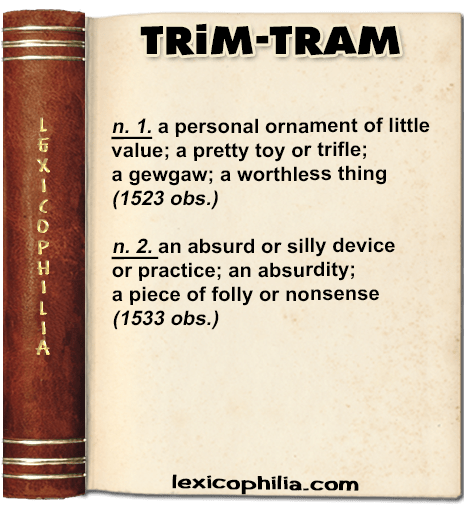
Word of the Day: TRIM-TRAM

ETYMOLOGY
for n.1., apparently a reduplication with vowel variation of trim (adj.);
for n. 2., apparently a whimsical application of n.1.

EXAMPLE
“…Esebon, Marybon, Wheston next Barnet;
A trym tram for an horse myll it were a nyse thyng;
Deyntes for dammoysels, chaffer far fet:
Bo ho doth bark wel, but Hough ho he rulyth the ring
…”

From: Speke Parott
By John Skelton, 1523

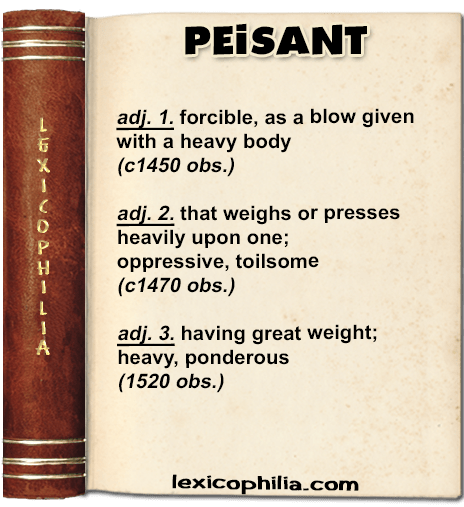
Word of the Day: PEISANT

ETYMOLOGY
from Anglo-Norman peisantpeisauntpesaunt, Anglo-Norman and Middle French pesant (of things – heavy, massive, oppressive, wearisome, difficult), (of the hand, a blow, etc. – forcible, coming down heavily), (of people – slow, sluggish), use as adjective of present participle of peiser , peser (to weigh)

EXAMPLE
“…But as for so poure a man as I, there would none aduocate pleden without wages paid byfore in honde; for pledours in worldly courtes hauen tonges lyke to t he languet of the balaunce that draweth hym alwey to the more peysaunt party, that better wyl rewarden…”

From: The Booke of the Pylgremage of the Sowle,
Translated from the French of Guillaume de Deguileville

Word of the Day: LITTLE SON

ETYMOLOGY
perhaps after Middle French, French petit-fils (grandson, grandchild)

EXAMPLE
“… is the transporting ȝoure littil son and my onelie child in this countrey. To the quhilk albeit I be never sa willing, I wald be glaid to have ȝoure advyse therein, as in all uther thingis tuiching him. I have born him…”

From: The Love Letters of Mary, Queen of Scots
– Hugh Campbell, 1824
Letter written to the Countess of Lennox, July 10, 1570

Word of the Day: BUFFLE-BRAINED

ETYMOLOGY
from buffle (buffalo; a fool) + brained (having a brain of the specific kind)

EXAMPLE
“…An’ there we would swing, an’ hang there we must,
Till the hoodoo was busted. Eternally cussed,
So he said, was the buffle-brained feller that dared
To touch the witch-web that was holding us snared
…”

From: Up in Maine:
Stories of Yankee Life Told in Verse
– Holman Day, 1900

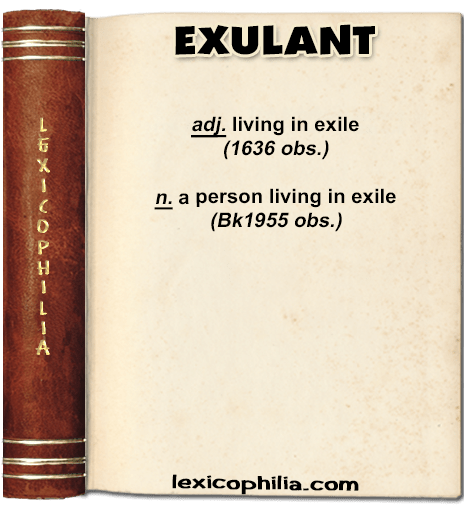
Word of the Day: EXULANT

ETYMOLOGY
from Latin ex(s)ulantem, present participle of ex(s)ulare (to be in exile

EXAMPLE
“…This Emperor made his brother Heraclius a Generall, whom he sent into the East against the Agarens with a powerfull Army. He endeavoured to put Iustinian to death who was now exulant in Cersonia: but notwithstanding all his plots to that purpose, he prevailed nothing, not could he bring his intent to any effect…”

From: The lives of all the Roman emperors being exactly collected,
from Iulius Cæsar, unto the now reigning Ferdinand the second
– Giovanni Antonio de Paoli 
Translated by Robert Basset, 1636