
ETYMOLOGY
from Latin labascere (to fall to pieces, break up, dissolve, to waver),
from labāre (to totter) + -ate
EXAMPLE
We watched with helplessness as she labascated down the stairs after a few too many drinks at the Christmas party.
ETYMOLOGY
from Latin labascere (to fall to pieces, break up, dissolve, to waver),
from labāre (to totter) + -ate
EXAMPLE
We watched with helplessness as she labascated down the stairs after a few too many drinks at the Christmas party.

ETYMOLOGY
from Latin rēiectānea (things which, while not absolutely bad, fall beneath the level of indifference),
from rejicĕre (to reject) + -āneus + -ous
EXAMPLE
“…Let them looke carefully about them, and let them be assured of this, that God will haue his glory upon them either in their conversion, if they belong to the number of his chosen servants, or in their confusion, if they be rejectaneous and castawaies.…”
From: Romphaiopheros = the Sword-Bearer.
Or, The Byshop of Chichester’s armes emblazoned in a sermon preached at a synod by T.V. B. of D. sometimes fellow of Queenes Colledge in Oxford,
and now pastor of the church at Cockfield in Southsex.
by Thomas Vicars, 1627
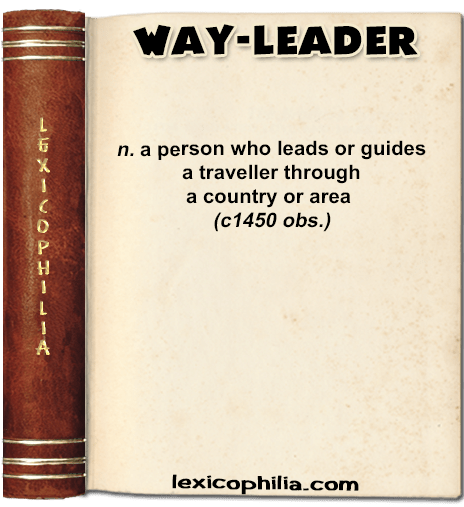
ETYMOLOGY
from way (a track, a road, a path) + leader
EXAMPLE
“…who shall perfeitely accomplyshe and fulfyll the lawe in the right kynde as it ought to be, but thy sonne beeyng as a waye leader vnto the heauenly preaching of thissame Messias, shall prepare the heartes of menne, that he may deliuer vp vnto Messias at his cumming…”
From: The First Tome or Volume of the Paraphrase of Erasmus vpon the Newe Testamente
– Erasmus, Desiderius
– Translated by Nicholas Udall et al, 1548

ETYMOLOGY
from straddle (with the legs astride)
EXAMPLE
“…If he even seen a straddle-bug start to go anywheres, he would bet you how long it would take him to get wherever he was going to, and if you took him up, he would foller that straddle-bug to Mexico but what he would find out where he was bound for and how long he was on the road. …”
From: The Notorious Jumping Frog of Calaveras County,
By S. L. Clemens (Mark Twain), 1867

ETYMOLOGY
– from Latin prōstibulum (a prostitute, also a brothel),
from prōstāre (to stand forth publicly as for sale), + -bulum (suffix denoting instrument)
EXAMPLE
“…Jack Reacher: What I mean is, the cheapest woman tends to be the one you pay for.
– Sandy: I am not a prostibule!
– Jack Reacher: Well, a prostibule would get the joke…”
From: The movie “Jack Reacher”
(the original word ‘hooker‘ has been replaced with ‘prostibule‘)

ETYMOLOGY
– from Latin opitulārī (to bring aid, to assist),
from op-em (aid) + tul- (to bring)
EXAMPLE
“…A conserve to opitulate & helpe the digestione, of the stomacke…”
From: The Boock of Physicke
Wherin … Most of Them Selected, and Approved Remedyes, for All Corporall Diseases, and Sicknesses, which Out of Manye Highe, and Common Persons Written Physick-boockes, are Compacted, and United Together
By Oswald Gäbelkover, 1599
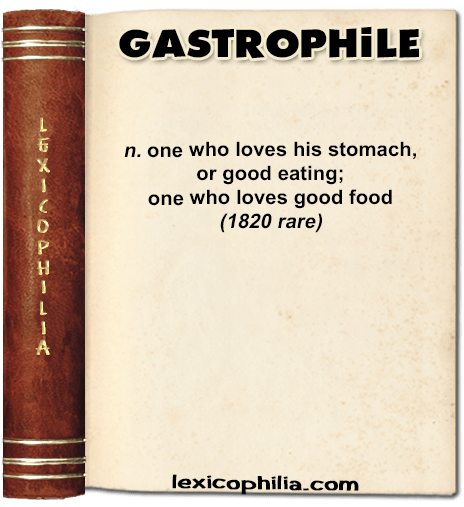
ETYMOLOGY
– from Greek γαστρ(ο)-, γαστήρ (gaster – stomach) + θίλ-ος (filos – friend)
EXAMPLE
“…From the foregoing observations we must conclude that the glutton practises without any regard to theory; and we call him Gastrophile. The gormand unites theory with practice, and may be denominated Gastronomer…”
From: Tabella Cibaria.
The Bill of Fare:
A Latin Poem,
Implicitly translated and fully explained in copious and interesting notes, relating to the Pleasures of Gastronomy, and the Mysterious Art of Cookery,
Ange Denis M’Quin, 1820

ETYMOLOGY
– from Latin clanculārius (secret),
from clanculum (adv.), diminutive of clam (in secret, private)
EXAMPLE
He was host to many clancularious gatherings, always conducted under cover of darkness.
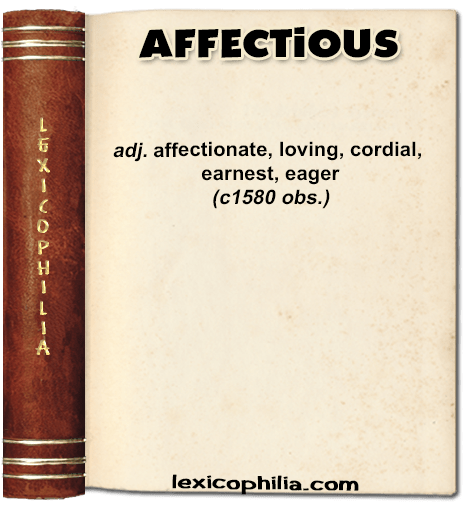
ETYMOLOGY
– from affection on analogy of caution, cautious, action, actious, etc.
EXAMPLE
“…and geif ze think it meit, I pray zou, wryt ane afectious letter to my mother, that scho may mak delygens…”
From: Memoirs of the Maxwells of Pollok
By William Fraser, 1863
“Lady Elizabeth Maxwell to Sir John Maxwell of Pollok, 23d July, c. 1580”

ETYMOLOGY
– from purse (receptacle for money) + leech (a person who will ‘stick to’ another for the purpose of getting gain out of him)
EXAMPLE
“…False Counsellors (Concealers of the law),
Turn-coate Attornes, that with both hands draw,
Slie Peti-foggers, Wranglers at the barr,
Proud purse-leaches, Harpies of Westminster,
With fained chiding, and foul iarring noise
Breake not his braine, nor interrupt his ioyes…”
From: Bartas his deuine weekes and workes
– Guillaume de Saluste Du Bartas
Translated and dedicated to the Kings most excellent Maiestie By Iosuah Syluester
(translated by Joshua Sylvester)
 Lexicophilia