Word of the Day

Word of the Day: OMNISCIOUS

ETYMOLOGY
from Latin omniscius all-knowing, from omni- scire (to know) + -ous

EXAMPLE
“… Schoolemen may phantastically dreame, or philosophically discourse of new Adams, Salomons, and diuers putatiue wisemen, euen in that omniscious, and omnisufficient veine: but I wis such blacke Swans are very rare birds: and true prophets in the rightest, purest, and diuinest kinde, euen full as rare, or percase rarer, than they: as may haply be discussed more fully, and exactly, at more conuenient leisure. …”

From: A Discoursiue Probleme concerning Prophesies how far they are to be valued, or credited, according to the surest rules, and directions in diuinitie, philosophie, astrologie, and other learning;
By John Harvey, 1588

Word of the Day: SCRIPTITATION

ETYMOLOGY
from Latin scriptitation-scriptitatio (act of writing down, act of writing or composing, that which is written, text) from scriptitat-, past participial stem of scriptitare (to be in the habit of writing, to write regular or repeated letters), (frequentative formation from scribere (to write))

EXAMPLE
“… There is something in this Amory’s manner of scriptitation which is..utterly void of all pretensions to the business of argument. …”

From: The Church of England Vindicated, 1779

Word of the Day: CLOTTYMOLES

also CLOTTIMAULS

ETYMOLOGY
from ‘clotty‘ related to clot (vb.);
with ‘mauls‘ ‘mauley‘ (the hand, fist, sl.)

EXAMPLE
“… sich a passionate chap, I wor afreead o´ his clottymoles comin´ i´ contact wi´ my bowster: soa thowt I, I´d wesh ´em, an´ just sponge my cloas dahn at t´ same toime. …”

From: The Salamanca Corpus
Wadsley Jack; or, The Humours & Adventures of a Travelling Cutler
By Reuben Hallam, 1866

Word of the Day: INDULCATE

also INDULCIATE

ETYMOLOGY
from ppl. stem of Latin indulcare (to sweeten), from in- + dulcare (to sweeten), dulcis (sweet)

EXAMPLE
“… as guilt imbitters our comforts, it is like drinking out of a wormwood cup; so assurance would indulciate and sweeten all. …”

From: A Body of Practical Divinity
By Thomas Watson, 1759
Of Assurance.

Word of the Day: TIB

ETYMOLOGY
perhaps the same as Tib, a shortened hypocoristic form of the female name Isabel; now rather rude or slighting (except playfully);
also with dim. -y or -ieTibbie, a common female name in the north

EXAMPLE
“… .Trupeny. Mary then prickmedaintie come toste me a fig,
Who shall then know our
Tib Talke apace trow ye?

An. Alyface. And why not Annot Alyface as fyne as she?

Trupeny. And what had Tom Trupeny, a father or none?

An. Alyface. Then our prety newe come man will looke to be one …”

From: Ralph Roister Doister 
By Nicholas Udall, a1556

Word of the Day: DUREFUL

ETYMOLOGY
from dure (to last, continue in existence) + -ful

EXAMPLE
“… Be nought dismayd that her vnmoued mind,
doth still persist in her rebellious pride:
such loue not lyke to lusts of baser kynd,
the harder wonne, the firmer will abide.
The
durefull Oake, whose sap is not yet dride,
is long ere it conceiue the kindling fyre:
but when it once doth burne, it doth diuide
great heat, and makes his flames to heauen aspire.
…”

From: Amoretti vi, in Amoretti and Epithalamion 
By Edmund Spenser, 1595

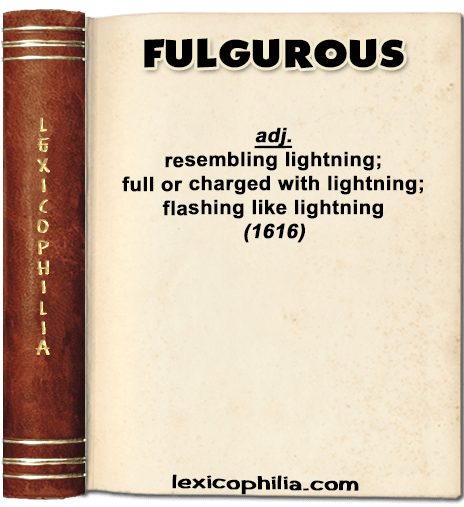
Word of the Day: FULGUROUS

also FULGROUS

ETYMOLOGY
from Latin fulgur (lightning, a flash of lightning) + -ous

EXAMPLE
“… and, iust at thinstant, all the canons plaien
frome towne to Campe, from Camp to towne againe,
in suche ann horrid noise, and flaminge light,
as if noone daie weare wedded to midd night:
or as if th’ pitchie clowdes of
fulgrous heavn
had taen their In vp, neath the spheres seaven.
…”

From: John Lane’s Continuation of Chaucer’s ‘Squire’s Tale’
By John Lane, 1616

PRONUNCIATION
FUL-gyuh-ruhss

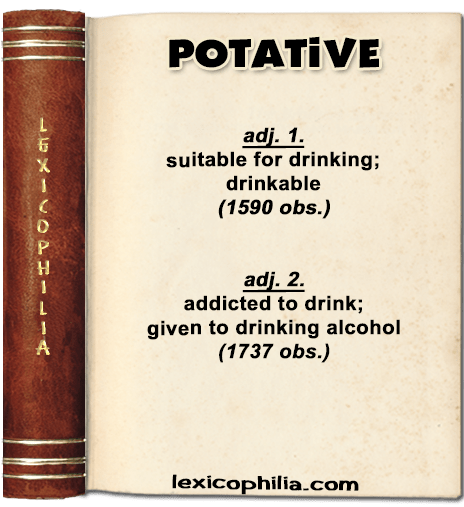
Word of the Day: POTATIVE

ETYMOLOGY
from Latin potat-, past participial stem of potare (to drink) + ‑ive

EXAMPLE
“… desireth to cure these or such like infectious diseases, must chiefly prepare and season the body with waters of cold and naturall hearbes, in the first and second degree, be­fore the disease be possessed: then foorthwith flux the body, by some gentle and potatiue electuarie, in equall and artificial de­gree, fauourably casting out the infected humours. …”

From: The Flower of Phisicke
VVherein is perfectlie comprehended a true introduction and method for mans assured health
By William Clever, 1590