Word of the Day

Word of the Day: DULCARNON


ETYMOLOGY
from Latin dulcarnon Pythagoras’ theorem
from Arabic ḏu’l-qarnayn (two-horned, lit. ‘possessor of the two horns’)
from ḏu (lord, possessor) + al (the) + qarnayn, dual of qarn (horn)


EXAMPLES
“…Criseyde answerde, :As wisly God at reste
My soule bringe, as me is for hym wo!
If that ich hadde grace to do so.
And eem, y-wis, fayn wolde I doon the beste,
But whether that ye dwelle or for him go,
I am, til God me bettre mynde sende,
At dulcarnoun, right at my wittes ende
…”

From: Letter from Mrs. M. Roper in Thomas More’s Works, 1441


“…Siva holds the drums of creation in one hand and the fires of destruction in the other—an either/or dulcarnon from which there seems no escape…”

From: A Wake Newslitter
December, 1974
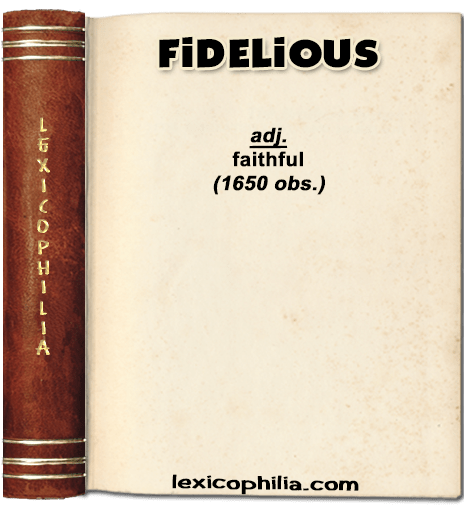
Word of the Day: FIDELIOUS


ETYMOLOGY
from Latin fidelis (faithful, loyal) + -ous


EXAMPLE
“…I ever (quoth Rhoxenor) have found thee cordially fidelious, doe but doe as thou hast indented, and expect what wealth, or honour thou canst covet, while Clodomer lives, and when his death, puts the Diadem upon my head, to be my only favourite…”

From: The Loves of Amandus and Sophronia
By Samuel Sheppard, 1650


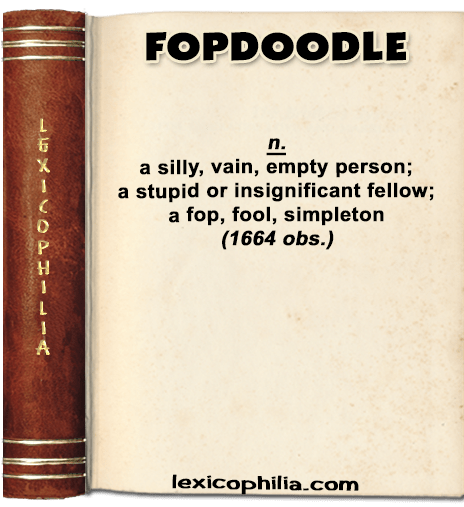
Word of the Day: FOPDOODLE


ETYMOLOGY
from fop (n.) + doodle (n.)


EXAMPLE
“…Quoth he, This scheme of th’ heavens set,
Discovers how in fight you met
At Kingston with a may-pole idol,
And that y’ were bang’d both back and side well;
And though you overcame the bear,
The dogs beat you at Brentford fair;
Where sturdy butchers broke your noddle,
And handled you like a fop-doodle
…”

From: Hudibras: The Second Part
By Samuel Butler, 1664

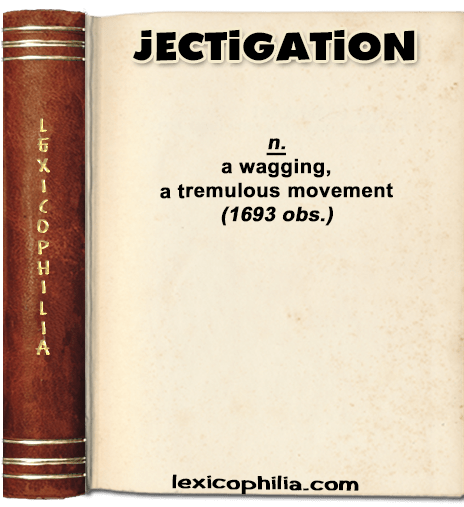
Word of the Day: JECTIGATION


ETYMOLOGY
from French jectigation (‘wagging, shrugging’ (Cotgrave)), 
from medieval Latin jectigare, from jact-ject-, ppl. stem of Latin jacere (to throw)


EXAMPLE
“…both Men and Women seemed to Prophetize and Vaticinate, because of an affected kind of wagging of the Head, shrugging of the Shoulders, and Jectigation of the whole Body, which they used then most punctually…”

From: The Third Book of the Heroick Deeds and Sayings of the Good Pantagruel
By François Rabelais
Translated by Thomas Urquhart and Peter Anthony Motteux, 1693

Word of the Day: BEBLUBBERED


ETYMOLOGY
from be- + blubber (to weep effusively) + -ed


EXAMPLE
“…Thee seas, thee regions and eeche place worldlye beholding,
On Lybye land lastly fixt his celestial eyesight.
And thus as he mused, with tears Venus heauye beblubberd
Prest foorth in presence, and whimpring framed her errand
…”

From: The First Booke of Virgil His Aeneis
Translated by Richard Stanyhurst, 1582

Word of the Day: DEBATOUS


ETYMOLOGY
from debat (debate, a controversy or discussion + -ous


EXAMPLE
“…Appetytes of auaryce be to them so amerous
Abusyon and arrogaunce ben of one affynyte
Aduenture and angre ben aye so debatous.
Faynynge estate of counterfet auctoryte
Adulacyon of aduenture mayst thou not auaunt the
As a lyer in goodnes in thyne araye doest appere
Englande may wayle that euer it came here
…”

From: Here Begynneth a Treatyse of this Galaunt
By John Lydgate (attributed name), ?1510

Word of the Day: CLIP-SHEARS


ETYMOLOGY
formed by compounding clip (that which is clipped or cut);
apparently from the form of its feelers, as having some resemblance to a pair of shears, 
or scissors


EXAMPLE
“…turned out their russet recesses to the birsling sun, and the foggie-toddlers hirpled about their business in the warm sod, among golacks and clip-shears, while the grasshoppers chirped in merry concert…”

From: Proceedings of the Philosophical Society of Glasgow
Edited by Agnes McLean, Vol. XXX. 1898
V. Dr. James Colville on the Scottish Vernacular.

Word of the Day: VIDENDA


ETYMOLOGY
Latin, plural of videndum, from videre (to see)


EXAMPLE
“…In my list, therefore, of Videnda at Lyons, this, tho’ last, – was not, you see, least; so taking a dozen or two of longer strides than usual cross my room, just whilst it passed my brain, I walked down calmly into the basse cour, in order to sally forth; and having called for my bill – as it was uncertain whether I should return to my inn, I had paid it – had moreover given the maid ten sous, and was just receiving the dernier compliments of Monsieur Le Blanc, for a pleasant voyage down the Rhône – when I was stopped at the gate…”

From: The Life and Opinions of Tristram Shandy, Gentleman
by Laurence Sterne, 1765