Word of the Day

Word of the Day: HIGHFUL


ETYMOLOGY
either from a) high (adj.) + -ful;
or perhaps from b) the same word as eyeful (arousing or inspiring awe, fear, or dread; terrible, dreadful)


EXAMPLE
“…So þat he was riche him sulf · & þat lond pouere al out
Sturne he was þoru out al · & heiuol & prout
Suiþe þikke mon he was · & of grete strengþe…”

From: The Metrical Chronicle of Robert of Gloucester, c1325-c1425

Word of the Day: APPROPINQUE


ETYMOLOGY
from Latin appropinquāre (to approach),
from ad (to), and propinquus, from prope (near)


EXAMPLE
“…The knotted bloud within my hose,
That from my wounded body flows,
With mortal Crisis doth portend
My dayes to appropinque an end.
I am for action now unfit,
Either of fortitude or wit…”

From: Hudibras, Written in the Time of the Late Wars
By Samuel Butler, 1663
Canto III. The Argument

Word of the Day: HIBBER-GIBBER


ETYMOLOGY
reduplicated derivative of gibber (unintelligible talking, rapid and inarticulate utterance)


EXAMPLE
“…and I wott not what maruelous egges in mooneshine: but a flye for all your flying Speculations, when one good fellow with his oddiestes, or one madd knaue with his awke hibber-gibber, is able to putt downe twentye of your smuggest artificiall men, that simper it so nicely, and coylie in their curious pointes…”

From:  Pierces Supererogation
Or A New Prayse of The Old Asse,
Gabriell Harvey, 1593

Word of the Day: VAGITATE


ETYMOLOGY
from medieval Latin vagitare, from Latin vagari (to wander)


EXAMPLE
“…But we must consider, that they euermore kept the coast, and crept by the shores, which made the way exceeding long. For before the vse of the Compasse was knowne, it was impossible to vagitate athwart the Ocean; and therefore Salomons ships could not finde Peru in America…”

From: The History of the World
By Sir Walter Raleigh, 1614

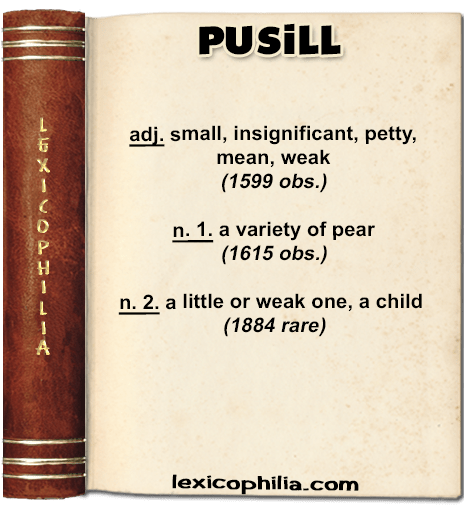
Word of the Day: PUSILL


ETYMOLOGY
from: a) Middle French pusillepuzilpusil (very small, weak),
b) Latin pusillus (very small, insignificant, petty) from pusus (boy) + -illus 


EXAMPLE
“…And to amase her weake, and pusill minde,
In creepe through crannies of imagination.
Deformd Idean formes, and phansies blinde.
Sent foorth by hir sicke sences, instigation.
Like staringe greisly fendes, threatninge invasion.
Presenting to her heart, the homely iarres.
And houshold cares, accurringe nuptiall warres…”

From: Eustathia, or the Constancie of Susanna
By Robert Roche, 1599

Word of the Day: SAMSONISTIC


ETYMOLOGY
from Samson (in reference to his enormous strength) + -istic


EXAMPLE
“…The new Governor-General seemed to be impressed with the idea that all political officers, small and great, were in fault. Forthwith he commenced dealing out upon them the most ferocious and Samsonistic blows. The shower unfortunately fell, like Don Quixote’s strokes on a certain occasion, upon an innocent race of puppets…”

From: Dry Leaves from Young Egypt
Being a Glance at Sindh Before the Arrival of Sir Charles Napier,
By An Ex-Political (Edward Backhouse Eastwick), 1849
Chapter XII. A Flea

Word of the Day: WAKERLY


ETYMOLOGY
from waker (unsleeping, watchful, vigilant obs.) + -ly


EXAMPLE
“…Sothely he, as a good herde, was ful wakkerly and besy vppon the kepynge of that litell flok, his byloued disciples…”

From: The Mirror of the Blessed Life of Jesus Christ;
an adaptation/translation of Pseudo-Bonaventure’s Meditations on the Life of Christ into English
By Nicholas Love, c1400

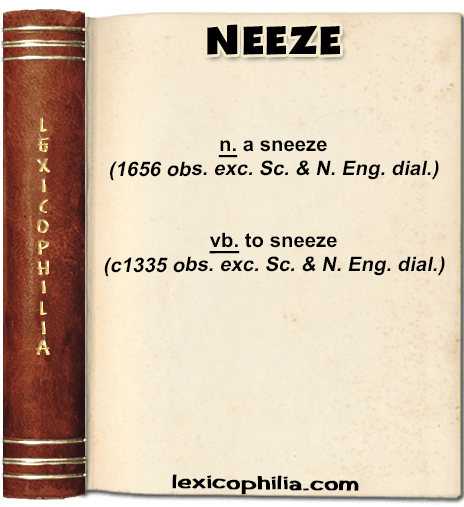
Word of the Day: NEEZE


ETYMOLOGY
From Oxford English Dictionary: either from early Scandinavian (compare Old Icelandic hnjósa , Norwegian nyse , †njosa , Old Swedish niusa (Swedish nysa ), Danish nyse ), or the reflex of an unattested Old English word from the same Germanic base, as is perhaps suggested by the number of cognates in other West Germanic languages: Middle Dutch niesen (Dutch niezen ), Middle Low German nēsen , neysen , neesen , etc., Old High German niesan , niosan , niusan (German niesen)


EXAMPLE (for noun)
“…Soto was in an exteam Agony for his Master: Lamia was grieved and her Hand-Maids heavie, but the Inchantress soon recovered him by watering his Visnomy with her warm Urine (the customary way (it seems) of that Countrey to revive the enfeebled) which not onely illuminated his dim eyes, but circumgyring about his weasand, enforced him to a manly neese, so that within a little time (to their great comfort) he sate up, calling for some Wine, which being brought, he drank a hearty draught to the Inchantress, though one might perceive (with half an eye) wrath and disdain in Capitall Characters on his front; which Lamia perceiving, administred this Julip to allay his fiery Choller….”

From: Don Zara del Fogo; A Mock-Romance
By Samuel Holland, 1656