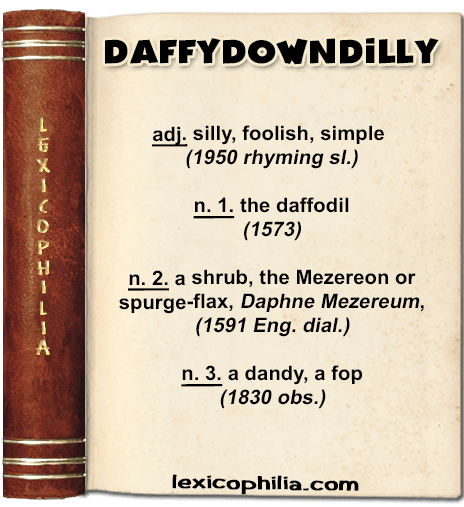
Word of the Day: DAFFYDOWNDILLY


ETYMOLOGY
n. 1. a playful expansion of daffodilly. (from daffodil + -y);
n. 2: so called in Yorkshire from the slight similarity of the Greek name Daphne with Daffodil


EXAMPLE

“…Herbes, branchis & flowers for windowes & potts
• 1 Bayes, sowe or set in plants in Ianuarie.
2 Batchelers buttens,
3 Botles, blewe, red & tauney,
4 Collembines.
5 Campions.
6 Daffadondillies.
7 Eglantine, or swete bryer.
8 Fetherfewe.
9 Flower armour, sowe in Maye.
10 Flower deluce,
11 Flower gentil, whight & red.
12 Flower nyce.
13 Gelyflowers, red, whight & carnacions, set in Spring, & Heruest in potts, payles or tubs, or for sommer in bedds.
14 Holiokes, red, whight & carnacions.
15 Indian eye, sowe in Maye, or set in slips in March.
16 Lauender, of al sorts
…”

From: Fiue Hundreth Points of Good Husbandry
By Thomas Tusser, 1573

Word of the Day: ELOQUIOUS


ETYMOLOGY
from Latin eloquium (eloquence) + -ous


EXAMPLE
“…Eloquious hoarie beard father Nestor, you were one of them, and you M. Vlisses the prudent dwarfe of Pallas another, of whome it is Illiadizd that your very nose dropt sugar candie, and that your spittle was honye. Natalis Comes if he were aboue ground…”

From: Lenten Stuffe
By Thomas Nashe, 1599

Word of the Day: PERQUIRE


ETYMOLOGY
adj. & adv.: from French par cœur (by heart, by memory, perfectly, exactly)
vb.: from Latin perquirere (to make diligent search for), formed on  per-  + quærere (to seek)


EXAMPLE (for vb.)
“…Sweetly disposed soul (for so I hope)
Though most deluded by thy self, and Pope;
Perquire Zoographers, and none recite,
A Romane Pope turn’d willing Anchorite.
Now they so much abhor such doubtful ways,
They’ll not to Heaven go, without false ayes.
…”

From: Divine Glimpses of a Maiden Muse
By Christopher Clobery, 1659

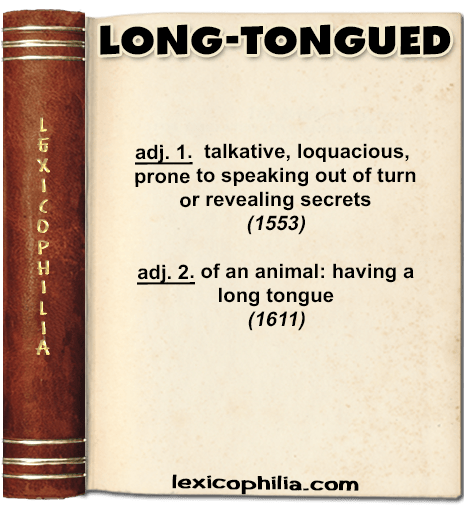
Word of the Day: LONG-TONGUED


ETYMOLOGY
from long + tongued


EXAMPLE
“…And tyme hathe this one vngracious propertee,
   to blab at length open all that he doothe see.
   Than a daughter eke he hath called veritee,
   As vnhappie a longtounged girle as can bee.
   she bringeth all to light, some she bring[eth] to shame,
   she careth not a grote what manne hathe thanke or blame.
   yf men be praise worthie she dothe so declare them
   And if otherwyse in faithe she dothe not spare them
…”

From: Respublica: an interlude for Christmas
Attributed to Nicholas Udall, 1553

Word of the Day: CONCITATE


ETYMOLOGY
from Latin concitat- participle stem of concitare (to move violently, to excite),
from con- + citāre (to move)


EXAMPLE
“…Cyrus king of Persia, mynding to concitate the myndes of his people, to wery & anger them, with payneful labour, held thē all one day at worke and vtterly tyred thē, in hewing vp a certayne Wood, on the morow after he made for them a very plentitious feast, demaunding in the feast tyme…”

From: A Right Exelent and Pleasaunt Dialogue Betwene Mercury and an English Souldier contayning his Supplication to Mars
Barnabe Rich, 1574

Word of the Day: QUARTER-CLEFT


ETYMOLOGY
from quarter + cleft (n. and adj. split asunder)


EXAMPLE
“…It is the fashion to talk of Lord Ellenborough in contemptuous terms, as a mere nincompoop, or quartercliff, or what else you will, that implies feebleness of intellect and deficiency of talents; but those who so describe him either mistake his character, or wilfully misrepresent it…”

From: Fraser’s Magazine for Town and Country
Vol. IV. August, 1831 to January 1832
Parliamentary Eloquence, No. IV, House of Lords, by Oliver Yorke

Word of the Day: PERLEGATE


ETYMOLOGY
from Latin perlegere to read through, from per- + legere (to read) + ate


EXAMPLE
“…I am vouchsafede to perlegate vvith pleasure, & imploye a small of their time in the readinge, of my scriptsons, and vvritinges, I most courtiouslye desire thē, that they vvould more vvith good vvill, then vvith a spirite…”

From: The Frenche Chirurgerye, or all the Manualle Operations of Chirurgerye
By Jacques Guillemeau
Translated by A.M., 1598

Word of the Day: NIDDICOCK


ETYMOLOGY
of obscure formation: possibly a blend of nidiot and nodcock (a fool, a simpleton)


EXAMPLE
“…And as touching implements for warre, they were neuer such fond niddicockes, as to offer anie man a rod to beat their owne tailes, or to betake their mastiues vnto the custodie of the woolues, maruelling much that their capteine would so farre ouershoot himselfe, as to be taken with such apparent repugnancie….”

From: R. Holinshed’s Chronicles of England, Scotland, and Ireland, 1577

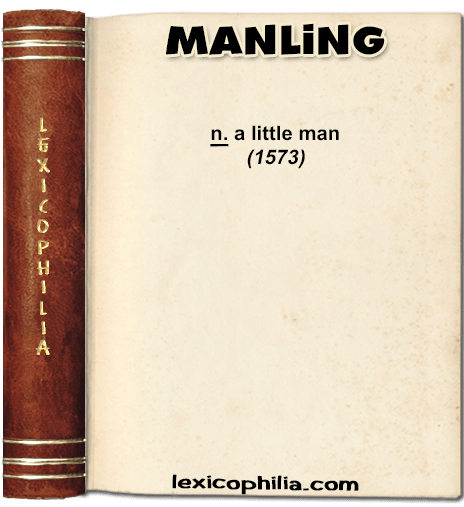
Word of the Day: MANLING


ETYMOLOGY
from man + -ling


EXAMPLE
“…Marry sir euen all in all, a well lyned pursse, wherwith he could at euery call, prouide such pretie conceytes as pleased hir péeuish fantasie, and by that meanes he had throughly (long before) insinuated him selfe with this amorous dame. This manling, this minion, this slaue, this secretary, was nowe by occasion rydden to London forsothe: and though his absence were vnto hir a disfurnishing of eloquence…”

From: A Discourse of the Aduentures Passed by Master F. I.
In ‘A Hundreth Sundrie Flowres bounde vp in one small poesie’
By George Gascoigne, 1573