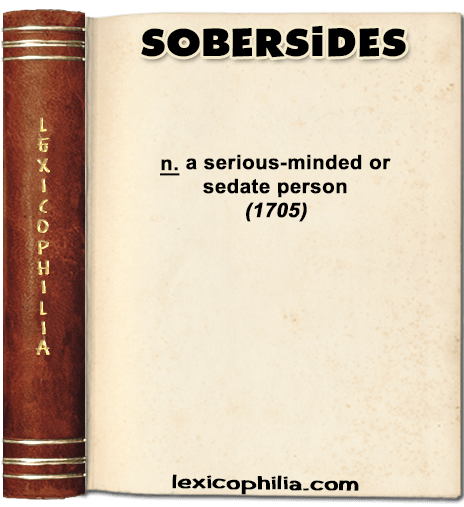
Word of the Day: SOBERSIDES


ETYMOLOGY
from sober + the plural of side


EXAMPLE
“…I am sorry you have been again out of luck with a horse; but do not despair. I have got a sober sides on trial for a week past, but really & truly cannot make time to put him to the proof, & he stands idle in my stable, but hope as I have often, very often hoped before that I shall have more time the next week…”

From: The Selected Letters of Josiah Wedgwood, Feb, 1779
Edited by Anne Finer and George Savage, 1965
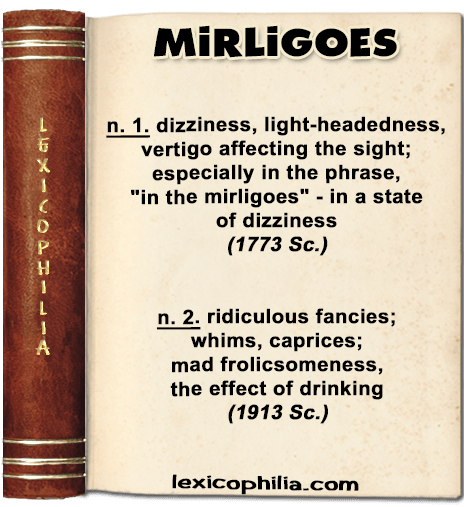
Word of the Day: MIRLIGOES


ETYMOLOGY
of uncertain origin;
perhaps from Scots mirl (to speckle, to spot),
with reference to the pattern seen before the eyes when in a state of dizziness + -igo 


PRONUNCIATION
MUR-luh-gohz


EXAMPLE
“…Sure Major Weir, or some sic warlock wight,
Has flung beguilin’ glamer o’er your sight;
Or else some kittle cantrup thrown, I ween,
Has bound in mirlygoes my ain twa ein,
If ever aught frae sense cou’d be believ’d
(And seenil hae my senses been deceiv’d),
This moment, o’er the tap of Adam’s tomb,
Fu’ easy can I see your chiefest dome:
Nae corbie fleein’ there, nor croupin’ craws,
Seem to forspeak the ruin of thy haws,
But a’ your tow’rs in wonted order stand,
Steeve as the rocks that hem our native land
….”

From: The Poems of Robert Fergusson
By Robert Fergusson, 1785
The Ghaists: A Kirk-yard Eclogue

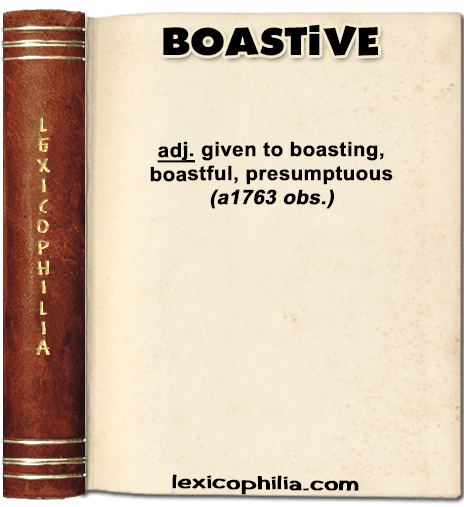
Word of the Day: BOASTIVE


ETYMOLOGY
from boast (vb.) + -ive


EXAMPLE
“…Of acid blood, proclaiming Want’s disease
Amidst the bloom of shew. The scanty stream,
Slow-loit’ring in its channel, seems to vie
With Vaga’s depth; but should the sedgy pow’r,
Vain-glorious, empty his penurious urn
O’er the rough rock, how must his fellow streams
Deride the tinklings of the boastive rill
…”

From: The Poetical Works of William Shenstone, 1768
By William Shenstone, a1763

Word of the Day: TETTY


ETYMOLOGY
for adj.: of obscure origin
for n.1.: from teat () + -y 


EXAMPLE
“…but if they loose, though it be but a trifle, two or three games at tables, or a dealing at Cards for 2d a game, they are so cholericke and tetty that no man may speake with them, and breake many times into violent passions, oaths, imprecations, and vnbeseeming speeches, little differing from mad men for the time…”

From: The Anatomy of Melancholy
By Robert Burton, 1621

Word of the Day: MERRYTHOUGHT


ETYMOLOGY
from merry (adj.) + thought (n.)
‘The name alludes to the custom of two persons pulling the furcula of a fowl until it breaks; according to the popular notion, the one who gets the longer (in some districts, the shorter) piece will either be married sooner than the other, or will gain the fulfilment of any wish he may form at the moment.


EXAMPLE
“…Fetherstone. O youle make her sicker then.
Greeneshield. I warrant you; would all women thought no more hurt then thou doost now, sweet villaine, Kate, Kate.
Kate. I longd for the merry thought of a phesant.
Greeneshield. She talkes in her sleepe….”

From: North-ward Hoe
By Thomas Dekker & John Webster, 1607

Word of the Day: DUMBLEDORE


ETYMOLOGY
compound of dumble (similar to bumble) +‎ dor (a buzzing flying insect)


EXAMPLE
“…I thank you for your poetry. What is the burnie-bee? Is it not the humble-bee, or what we call the ‘dumbledore‘ – a word whose descriptive droning deserves a place in song?…”

From: A Memoir of the Life and Writing of William Taylor
By John Warden Robberds, Sir Robert Southey, 1799

Word of the Day: PEDESTRIAL


ETYMOLOGY
from Latin pedestr-pedester, also pedestris (going on foot), in prose, prosaic
(from pedes a person who goes on foot
(from ped-pēs (foot) + -es (after eques) + -ter + -al 


PRONUNCIATION
puh-DESS-tree-uhl


EXAMPLE
“…For, the formall esteemed causes (which are pedestriall, equestriall, or nauti∣call) stand either at the disposition of the efficient; or pretend perfection and vse from the finall…”

From: An Essay of the Meanes Hovv to Make our Trauailes, into Forraine Countries,
the More Profitable and Honourable
By Sir Thomas Palmer, 1606

Word of the Day: FALSILOQUENCE


ETYMOLOGY
from Latin falsiloquus (from falsus (false) + loqui (to speak)) + -ence


EXAMPLE
“…And that their Mutual Forces Join’d,
Harnass’d with Wit so much refin’d;
And so adorn’d instead of Sense,
With Trappings of Falsiloquence,
Might draw misjudging Fools to be,
In Love with their Sincerity;
…”

From: The Fifth and last Part of Vulgus Britannicus
By Edward Ward, 1710

Word of the Day: BERSATRIX


ETYMOLOGY
from French berseaux (cradle) + –trix a feminine ending


EXAMPLE
“…High rewards, as was then customary, were bestowed on the messenger who attended the child, and on the bersatrix who rocked the cradle of the infant hero…”

From: A History of the Life of Edward the Black Prince, 
By George Payne Rainsford James, 1836