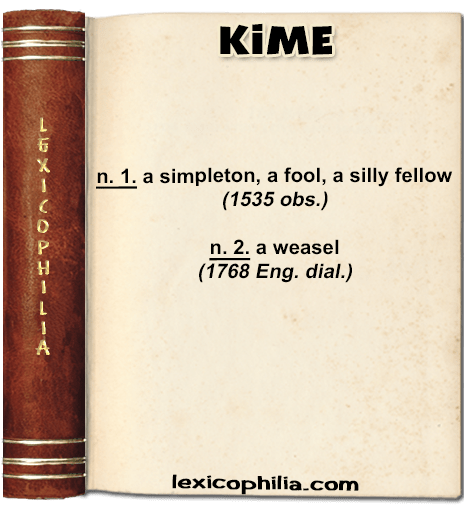
Word of the Day: KIME


ETYMOLOGY
of uncertain origin


EXAMPLE
“…The Emperour yaf the Pope somtyme
So hyghe lordshyp hym aboute,
That at the laste the sely kyme
The proude Pope putte hym out!
So of thys realme is in doute,
But lordes be ware and them defende;
For nowe these folke be wonder stoute:
The kynge and lordes nowe thys amende!
…”

From: The Ploughman’s Tale, c1535

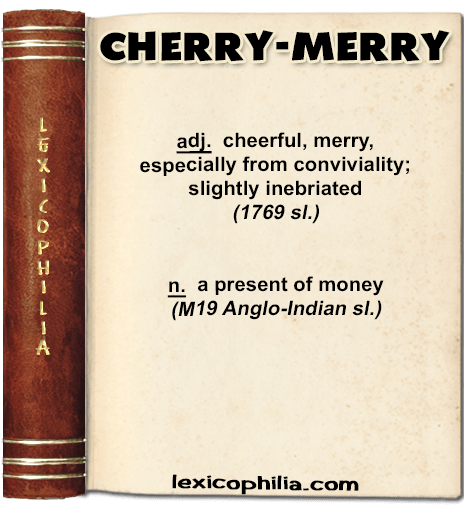
Word of the Day: CHERRY-MERRY


ETYMOLOGY
perhaps from cheery + merry; possibly only a jingling combination


EXAMPLE
“…how few of you are enemies to a glass (or two or three) of generous wine, and how much food of such a heating nature, promotes the circulation of the bottle, it is not at all astonishing, that every convivial assistant should go home cherry-merry, after having been a guest at such a repast…”

From: Yorick’s Sentimental Journey Continued,
By John Hall-Stevenson, 1769

Word of the Day: TARADIDDLE


ETYMOLOGY
the first element, tara, is of obscure origin;
+ diddle (n. a swindle, deception) (vb. to cheat, to swindle)


EXAMPLE
“…Bar. My dear Anna Matilda, I don’t know myself; so how can I tell you?
Mrs. B. There’s a bare-faced tarradiddle, Mr. Barbottle…”

From: The Duel:
Or, My Two Nephews 
A Farce, in Two Acts
By R. B. Peake, 1823

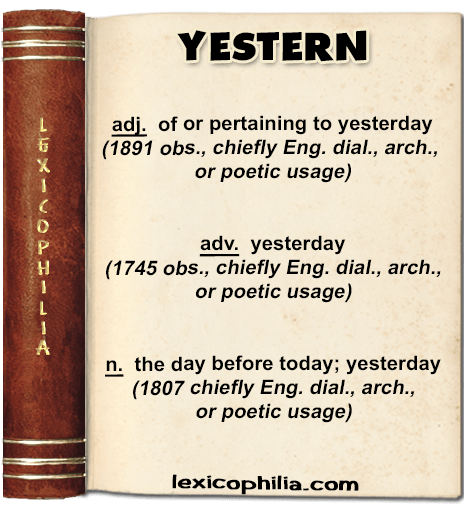
Word of the Day: YESTERN


ETYMOLOGY
? partly a) (in English editions of Scots texts) a variant or alteration of yestreen (adv. during the evening of yesterday), after yester (adv. yesterday); and partly
b) a variant or alteration of yester (adv.), yester (n.), and yester (adj.), respectively


EXAMPLE
“…Now wat ye wha I met yestern,
Coming down the street, my jo?
My mistress in her tartan screen,
For bony, braw and sweet, my Jo…”

From: Allan Ramsay in Aviary, 1745
‘Edinburgh Kate’

Word of the Day: POTHERY


ETYMOLOGY
from pother (disturbance, turmoil, bustle; noise, tumult) + -y


EXAMPLE
“…Meer Heat and Cold are very different things from that Pothery and Sultry, that Frosty and Congealing Weather, which alternately in Summer and Winter, at the Line and the Poles we usually now feel….”

From: A New Theory of the Earth
By William Whiston, 1696

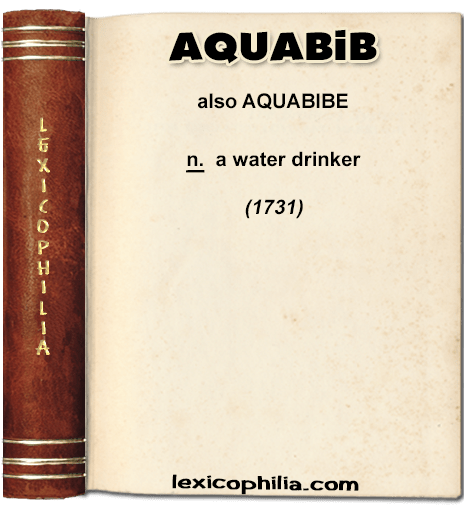
Word of the Day: AQUABIB


ETYMOLOGY
from Latin aqua (water) + bibere (to drink)


EXAMPLE
“…To call a man a total abstainer would imply that he abstained from everything; to call him a temperance man is absurd, because from time immemorial men have drunk, as they still drink, wine temperately. Aquabib and hydropot may mean one who drinks water, but most men do that. I drink it always to quench thirst, but then I drink also a moderate quantity of wine…”

From: The Medical Times and Gazette,
A Journal of Medical Science, Literature, Criticism, and News
Volume I for 1883
“Temperance Appellations”

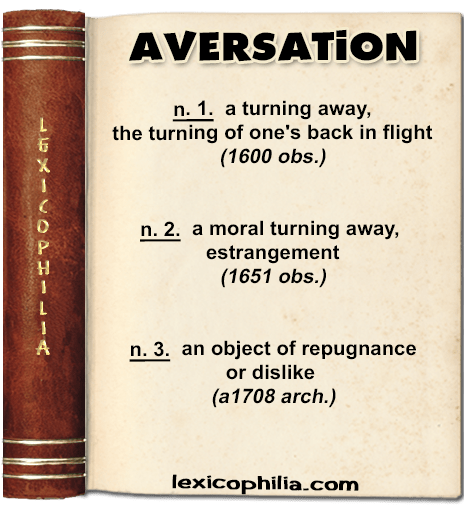
Word of the Day: AVERSATION


ETYMOLOGY
rom Latin aversationem, noun of action from aversat-


EXAMPLE
“…He can bear glory to their fleet, or shut up all their toils In his one suff’rance on thy lance.” With this deceit she led, And, both come near, thus Hector spake: “Thrice have I compassed This great town, Peleus’ son, in flight, with aversation That out of fate put off my steps; but now all flight is flown, The short course set up, death or life. Our resolutions yet Must shun all rudeness, and the Gods before our valour set For use of victory;…”

From: The Whole Works of Homer in his Iliads and Odysses
Translated by George Chapman, 1616