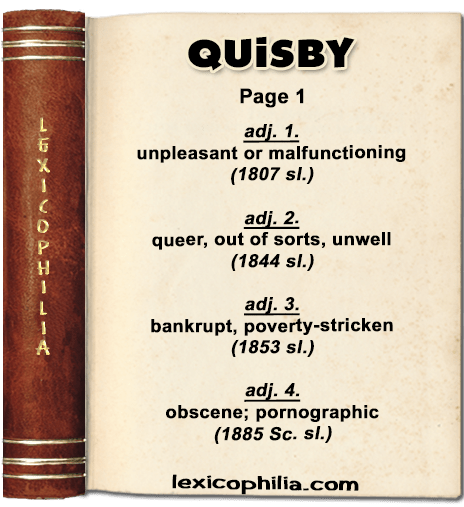
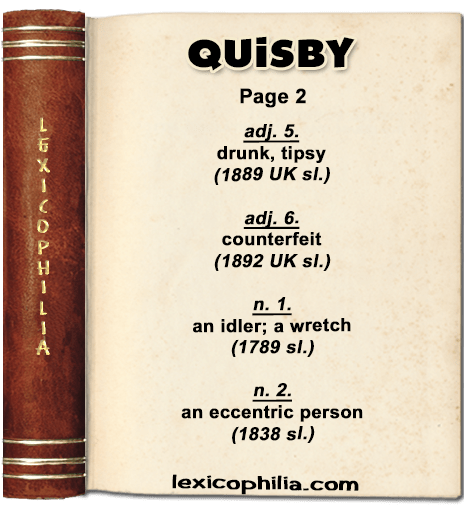
Word of the Day: QUISBY

ETYMOLOGY
of uncertain origin;
possibly from quiz (n.) + -by

EXAMPLE
“… Alibi. What wou’d I do then?
Air. Aye, Sir, what wou’d you do then?
Soph. Cou’dn’t he push a little feeble old quisby like you down into a chair?
Alibi, How, pray?
Soph. Shew him how, Robin?
Air. Why there – (puts him into a chair) Just that way
Alibi. Well, now Old Quisby’s down in the chair – what wou’d he do then?…”

From: The Toy
By John O’Keeffe, 1789

Word of the Day: JENTACULAR

ETYMOLOGY
from Latin ientaculum (breakfast); (from ientare (to breakfast)) + -ar

EXAMPLE
“… I wonder that you did not, under this head, acquaint us with that wise injunction, which you have caused to be promulgated within your dominions, against the consumption of tea and coffee; a fashionable vice, which tends only to squandring away money, and mispending the morning, since (as you once ingeniously express’d it) nothing more can be expected from those jentacular confabulations. …”

From: Terræ-filius; or, the secret history of the University of Oxford
By Nicholas Amhurst, 1721

Word of the Day: RUMBUSTICAL

ETYMOLOGY
possibly an alteration of rumbustious (boisterous, unruly);
or perhaps an alteration of obsolete English robustic (robust, robustious), 
from robust + -ic + -al

EXAMPLE
“… I will, your worship: but I am glad his honour, the Major, is not to be jocum tenus for your worship, he’s so much upon the roguish order with the women, now and ten. I did not care to mention it to your worship before; but as true as I’m alive he was a little rombustical to our Bridget, no longer ago than last Sunday was se’night, as she was coming home from church. …”

From: The Flitch of Bacon; a comic opera
By Henry Bate Dudley, 1779

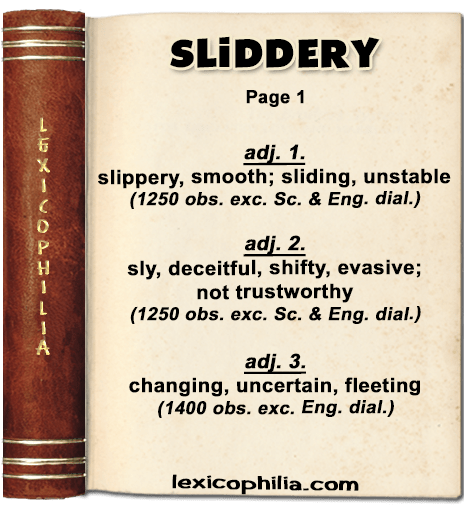
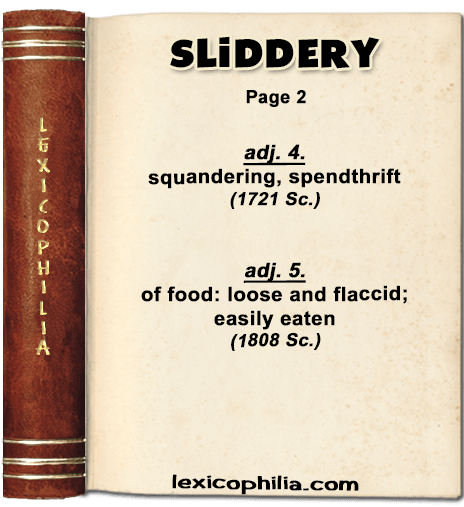
Word of the Day: SLIDDERY

ETYMOLOGY
from slidder (to slide, to slip) + -y

EXAMPLE (for adj. 3)
“… Full slyddrie is the sait that thay on sit,
And for thair fault till Hell sune sall thay flit,
For suddanlie thay sall die with mischeif,
Thair distructioun salbe without releif.
…”

From: A compendious book of godly and spiritual songs : commonly known as ‘The gude and godlie ballatis’
By John Wedderburn , Robert Wedderburn
Reprinted from the edition of 1567
Edited by Alexander Ferrier Mitchell, 1897
Quam bonus Deus Israell. Psal. lxxiij

Word of the Day: JOCOCIOUS

ETYMOLOGY
compound of jocose and facetious

EXAMPLE
“… “Yes, you have, you saucy baggage, and I will have them again from your ruddy lips,” at the same time smacking them with great glee. The girl was glad to find the ‘squire so jococious, and particularly too, as he gave her a shilling, and a chuck under the chin. …”

From: The Child of Providence
Or, The Noble Orphan, A Novel
By Miss H. L. Porter, 1820

Word of the Day: CRAB-STICK

ETYMOLOGY
from crab (the common name of the wild apple) + stick

EXAMPLE (for n. 2.)
“… Yes, I remember. I was remarking that sangaree and calipash, mangoes and guava jelly, dispose the heart to love, and so they do. I was not more than six weeks in Jamaica when I felt it myself. Now, it was a very dangerous symptom, if you had it strong in you, for this reason. Our colonel, the most cross-grained old
crabstick that ever breathed, happened himself to be taken in when young, and resolving, like the fox who lost his tail and said it was not the fashion to wear one, to pretend he did the thing for fun, determined to make every fellow marry upon the slightest provocation. …”

From: Charles O’Malley
The Irish Dragoon
By Charles Lever, 1840

Word of the Day: EFFUTITIOUS

ETYMOLOGY
from Latin effutitius, from Latin effutio (to chatter, prate)

EXAMPLE
“… No xenodochium allays
Radicate thirst with “Bass” or “Booth.”
Unaccendible paradigm!
Call not this
effutitious prate;
‘Tis ecphonesis, though it seem
But babbling to balbucinate.
…”

From: The Savage-Club Papers
Edited by Andrew Halliday, 1867
A Social Science Valentine, By Thomas Archer

Word of the Day: LUCTISONOUS

ETYMOLOGY
from Latin luctisonus (from luctus (grief )+ son- root of sonus (sound)) + -ous

EXAMPLE
“… Let me coacervate a few
Ambagious words amarulent,
Ludificatory, but true,
Ere I become so macilent,
That without voice to ululate
My lov’d one’s
luctisonous name,
My honour I impignorate,
And raise a temulentive flame.
…”

From: The Savage-Club Papers
Edited by Andrew Halliday, 1867
A Social Science Valentine, By Thomas Archer.

Word of the Day: GRIMGRIBBER

ETYMOLOGY
from Grimgribber, an imaginary estate subject of a legal discussion in the play Conscious Lovers (1722) by Sir Richard Steele, British essayist and dramatist

EXAMPLE
“… Mankind in general are not sufficiently aware that words without meaning, or of equivocal meaning, are the everlasting engines of fraud and injustice; and that the grimgribber of Westminster Hall is a more fertile, and a much more formidable, source of imposture than the abracadabra of magicians. …”

From: Epea pteroenta, or, The diversions of Purley
By John Horne Tooke, 1786