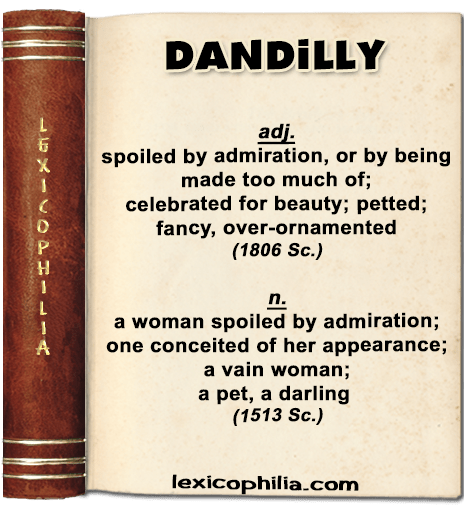
Word of the Day: DANDILLY

ETYMOLOGY
apparently a derivative of dandle (to move (a child, etc.) lightly up and down in the arms or on the knee)

EXAMPLE
“… I wes in youthe, on nureice kne,
Cald
dandillie, bischop, dandillie,
And quhone that age now dois me greif,
A sempill vicar I can nocht be:
Exces of thocht dois me mischief.
…”

From: Dunbar: A Critical Exposition of the Poems
By Tom Scott, 1965
Don is a Battell on the Dragon Blak
Composed by William Dunbar, a1513

Word of the Day: DOCUS

ETYMOLOGY
of unknown origin

EXAMPLE (for n. 1.)
“… Eh man, but ye maun be an unco docus to mistak the yowlin’ o’ a wheen dougs for the squeelin’ o’ ghaists an’ deevils ! I wonner what ye made o’ the twa grumphies it ye had row’t up amang your falalls; gin ye thought it they war young de’ils or what, snoukin’ for a sappy emmeldyug about the harigals o’ ye. …”

From: Saint Patrick: A National Tale of the Fifth Century
By J. Rennie, 1819

Word of the Day: FIRE-FLAUGHT

ETYMOLOGY
from fire (n.) + flaught (a flash; a flash of lightning)

EXAMPLE (for n. 1.)
“… Bot lo, onon, a wonder thing to tell!
Ane huge bleys of flambys braid doun fell
Furth of the clowdis, at the left hand straucht,
In maner of a lychtnyng or
fyre flaucht,
And dyd alicht rycht in the sammyn sted
Apon the crown of fair Lavinias hed;
…”

From: The Æneid of Virgil
Translated by Gavin Douglas, a1522

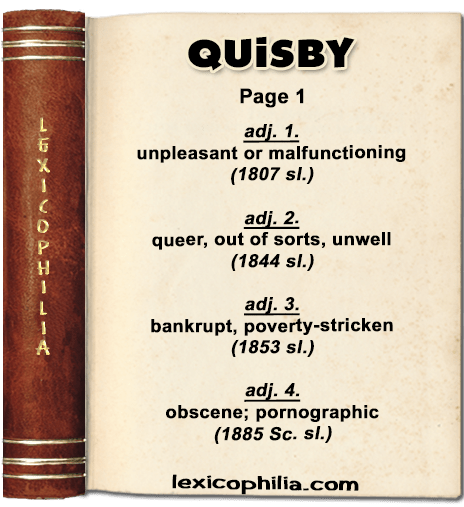
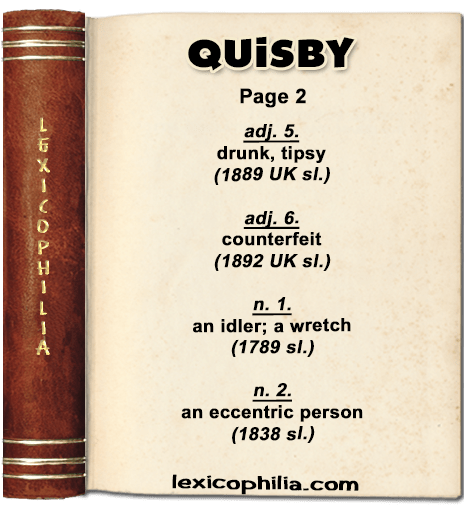
Word of the Day: QUISBY

ETYMOLOGY
of uncertain origin;
possibly from quiz (n.) + -by

EXAMPLE
“… Alibi. What wou’d I do then?
Air. Aye, Sir, what wou’d you do then?
Soph. Cou’dn’t he push a little feeble old quisby like you down into a chair?
Alibi, How, pray?
Soph. Shew him how, Robin?
Air. Why there – (puts him into a chair) Just that way
Alibi. Well, now Old Quisby’s down in the chair – what wou’d he do then?…”

From: The Toy
By John O’Keeffe, 1789

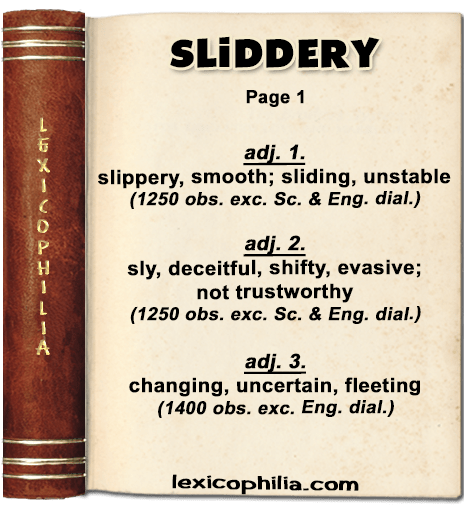
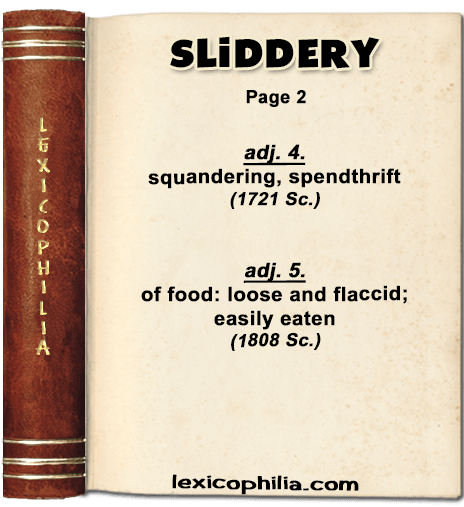
Word of the Day: SLIDDERY

ETYMOLOGY
from slidder (to slide, to slip) + -y

EXAMPLE (for adj. 3)
“… Full slyddrie is the sait that thay on sit,
And for thair fault till Hell sune sall thay flit,
For suddanlie thay sall die with mischeif,
Thair distructioun salbe without releif.
…”

From: A compendious book of godly and spiritual songs : commonly known as ‘The gude and godlie ballatis’
By John Wedderburn , Robert Wedderburn
Reprinted from the edition of 1567
Edited by Alexander Ferrier Mitchell, 1897
Quam bonus Deus Israell. Psal. lxxiij

Word of the Day: SMICKER

ETYMOLOGY
from Old English smicer (possessing charm and attractive; beautiful)

EXAMPLE 1 (for adj. 1)
“… Þatt wollde ben effninng wiþþ Godd
Abufenn alle shaffte,
Þurrh whatt he fell off heffne dun
Inntill niþ hellepine,
& warrþ till atell defell þær
Off shene & smikerr enngell. …”

From: The Ormulum (Burchfield transcript), c1175


EXAMPLE 2 (for vb. 1)
“…Humph. This will not pass; for, though I’m stuft in the head, yet I can blow my Nose as well as another to smell things out. No, no, I see I may make love long enough before you smicker at me. You may e’en keep your Portion, I shall find my Land in the old Place. …”

From: The Man’s the Master, a comedy
By Sir William D’Avenant, 1668

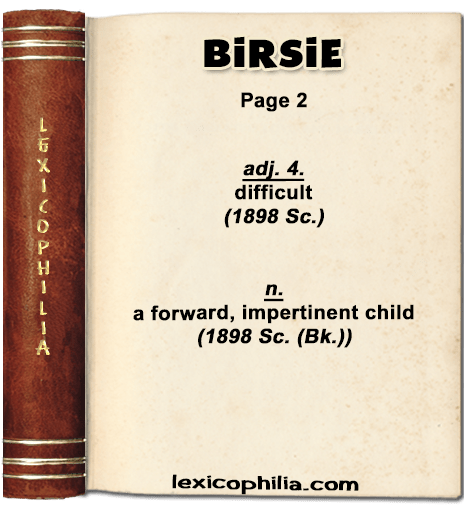
Word of the Day: BIRSIE

ETYMOLOGY
adj. 1. from birse (Sc. – a bristle, hair) + -y
n. from birse (Sc. – to push, to press, to squeeze) + -y

EXAMPLE
“…The mekill howke hym bair was Tryton callyt,
For in hir forstam was the monstre stallyt,
With watry trumpe fleyand the fludis gray;
Quhar as scho salyt, men mycht se hym ay
With  
byrsy body porturyt, and vissage
All rowgh of harys, semyng of cullage
In mannys form fra hys cost to hys crown,
…”

From: Virgil’s Aeneid translated into Scottish verse
By Gavin Douglas, a1522

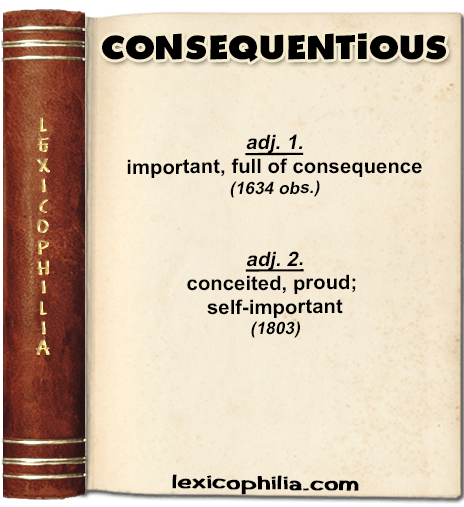
Word of the Day: CONSEQUENTIOUS

ETYMOLOGY
from. obs. French consequentieux, from Latin consequentia: + -ous

EXAMPLE
“…Now when the politicke Ambassadour, had wrought Prince Temeriske, as he desired, he then perswades with Abbas, that the Georgians hated him, that their King had entertained discourse with the Grand Signior, and sought but an aduantage to betray his trust, that if his words seemed of no moment, the matter was not consequentious, and his employment carried him, to other ends then forreigne Obiects. …”

From: A Relation of some Yeares Trauaile begunne anno 1626. Into Afrique and the greater Asia
By Thomas Herbert, 1634

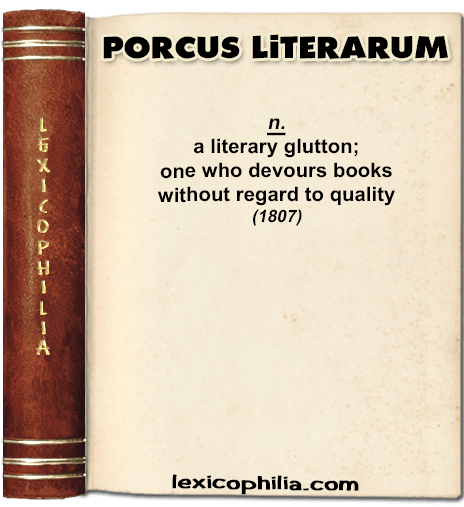
Word of the Day: PORCUS LITERARUM

ETYMOLOGY
from Latin porcus (a pig, hog) + literarum (letters, written knowledge, literature)

EXAMPLE
“…Epics he wrote and scores of rebusses,
All as neat as old Turnebus’s;
Eggs and altars, cyclopædias,
Grammars, prayer books – oh! ’twere tedious,
Did I but tell the half, to follow me,
Not the scribbling bard of Ptolemy,
No – nor the hoary Trismegistus,
(Whose writings all, thank heaven! have miss’d us,)
E’er fill’d with lumber such a ware-room
As this great “
porcus literarum!” …”

From: Epistles, Odes, and Other Poems
By Thomas Moore, 1807
“The Devil Among The Scholars”

Word of the Day: BAWTIE


ETYMOLOGY
from Old Sc. bawtébawtie (a dog’s name), extended to dogs;
bawd is a Sc. term for a hare


EXAMPLE
“…I rew the race that Geordie Steill
Brocht Bawte to the kingis presence.
I pray God lat hym neuer do weill,
Sen syne I gat na audience.
For Bawte now gettis sic credence,
That he lyis on the Kingis nycht goun.
Quhare I perforce for my offence,
Man in the clois ly lyke ane loun
….”

From: The Warkis of the Famous and Vorthie Knicht Schir Dauid Lyndesay of the Mont, alias, Lyoun King of Armes
By David Lindsay, 1568
‘The Complaint and Publiet Confessioun of the Kingis Auld Hound, callit Bagsche, directit to Bawte, the Kingis best belouit dog, and his Companʒeonis’


PRONUNCIATION
BAW-tee