Word of the Day: PECKSNIFF

ETYMOLOGY
from the name of Mr. Pecksniff, a hypocritical character in Charles Dickens’s novel “The Life and Adventures of Martin Chuzzlewit

EXAMPLE
“… Should Welby Pugin ever favour us with a Supplement to his Contrasts, he will uo doubt bring forward as one most egregious instance of architectural bathos the unlucky structure commented upon in the preceding paragraph. He might also hold up for reprehension a good many Pecksniff specimens of Gothic and Tudor of very recent date – certainly more recent than would be imagined, for some of them seem to be almost twin-brothers to Strawberry Hill, or else to the front of Guildhall …”

From: The Civil Engineer and Architect’s Journal, Scientific and Railway Gazette
Volume 7, 1844

Word of the Day: GIG-LAMPS

ETYMOLOGY
from gig (a light two-wheeled one-horse carriage) + lamp

EXAMPLE (for n. 1.)
“… A “Wo-ho-ho, my beauties!” brought the smoking wheelers upon their haunches; and Jehu, saluting with his elbow and whip finger, called out in the husky voice peculiar to a dram-drinker, “Are you the two houtside gents for Hoxfut?” To which Mr. Green replied in the affirmative; and while the luggage (the canvas-covered, ladylike look of which was such a contrast to that of the other passengers) was being quickly transferred to the coach-top, he and Verdant ascended to the places reserved for them behind the coachman. Mr. Green saw at a glance that all the passengers were Oxford men, dressed in every variety of Oxford fashion, and exhibiting a pleasing diversity of Oxford manners. Their private remarks on the two new-comers were, like stage “asides,” perfectly audible.

“Decided case of governor!” said one.

“Undoubted ditto of freshman!” observed another.

“Looks ferociously mild in his gig-lamps!” remarked a third, alluding to Mr. Verdant Green’s spectacles.

And jolly green all over!” wound up a fourth. …”

From: The Adventures of Mr. Verdant Green
By Cuthbert Bede, (real name Edward Bradley), 1853

Word of the Day: BEDOOZLE

ETYMOLOGY
perhaps from  bedazzle + bamboozle 

EXAMPLE
“… O Shadrack, my Shadrack! Prissilla did speak,
While the rosy red blushes surmantled her cheek,
And the tears of affection
bedoozled her eye,
Shadrack, my Shadrack! I ‘m yourn till I die!
…”

From: The Gazette of the Union, Golden Rule, and Odd-Fellow’s Family Companion
A Saturday Family Journal of General Literature, Odd-Fellowship and Amusement.
Volume X – From January to June Inclusive, 1849
From the Scrabble Hill Luminary

Word of the Day: AILUROPHOBIA

ETYMOLOGY
from Greek αἴλουρος [ailouros] (cat) + –phobos (fear)

EXAMPLE
“… Of Ailurophobia and the Power to be Conscious of the Cat as Near, when Unseen and Unheard. …” (Title)

From: Transactions of the Association of American Physicians.
Twentieth Session held at Washington, D.C., May 16 and 17. 1905
By S. Weir Mitchell

PRONUNCIATION
ay-lyoor-oh-FOH-bee-uh

Word of the Day: TIB

ETYMOLOGY
perhaps the same as Tib, a shortened hypocoristic form of the female name Isabel; now rather rude or slighting (except playfully);
also with dim. -y or -ieTibbie, a common female name in the north

EXAMPLE
“… .Trupeny. Mary then prickmedaintie come toste me a fig,
Who shall then know our
Tib Talke apace trow ye?

An. Alyface. And why not Annot Alyface as fyne as she?

Trupeny. And what had Tom Trupeny, a father or none?

An. Alyface. Then our prety newe come man will looke to be one …”

From: Ralph Roister Doister 
By Nicholas Udall, a1556

Word of the Day: WAG-TONGUE

ETYMOLOGY
from wag (vb.) + tongue (n.)

EXAMPLE
“…but now indeet her tongue is loosened, and she talks, yes indeet, she does talk nineteen to the dozen and more. A silent woman she was. It is the nearest approach to a miracle I ever care to see. A chatterbox she is, and worse – a regular woman wag-tongue, a regular woman wag-tongue. I cannot get in a word edgeways now …”

From: Macmillan’s Magazine
Volume LXXXVI, May to October,1902
A Woman Wag-tongue

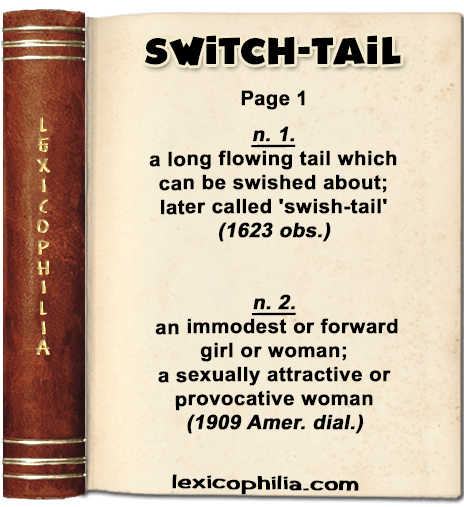
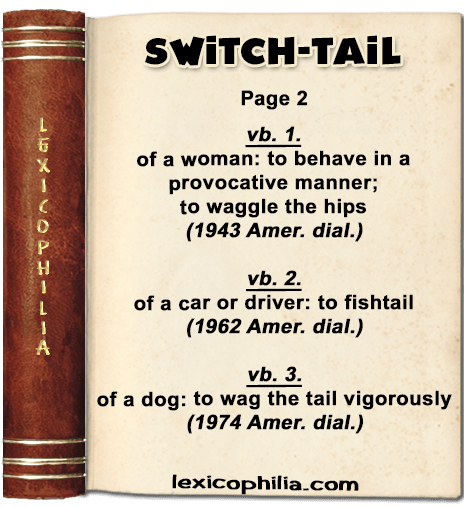
Word of the Day: SWITCH-TAIL


ETYMOLOGY
from switch + tail


EXAMPLE 1 (for n.1)
“…she was observed to ride forth in a Cavalcade somewhat extraordinary pleasant , viz. a good rich Velvet Saddle, and fashionable upon a sorry Horse with a Switch-Tail that us’d to carry Lime, and not Ladies; A gentile Surtout or riding-Suit; with her Shoulders warmly wrapt up in a good White Serge whittle: A pretty handsome Commode of the newest fashion, upon which was gracefully plac’d a good homely Straw Hat, with a long Pole like a Sugar Loaf, so that Cit and Bumpkin seem’d never better met or set off since the Creation …”

From: The Adventures of the Helvetian Hero, with the Young Countess of Albania;
Or, The Amours of Armadorus and Vicentina: a Novel
Unknown author, 1694


EXAMPLE 2 (for n. 2.)
“…I can look a gangster in the eye and make him change his mind, but I can’t do a thing with a woman no more. At one time I had nine big switch-tail women on my personal payroll, and they all stole from me, picked me clean. Buzzards!

From: McSorley’s Wonderful Saloon
By Joseph Mitchell, 1943

Word of the Day: JIMMYCANE


ETYMOLOGY
probably a jocular variation of hurricane


EXAMPLE
“…”Well, I’ll be everlastin’ly bamboozled! I never seen Doc Barwood melt and’ leak away like that before. I was countin’ on a storm – a reg’lar cyclone an’ jimmycane rolled into one; an’ ther’ wasn’t even a puff o’ wind n’r a clap of thunder...”

From: Ralph Marlowe
A Novel
By James Ball Naylor, 1901

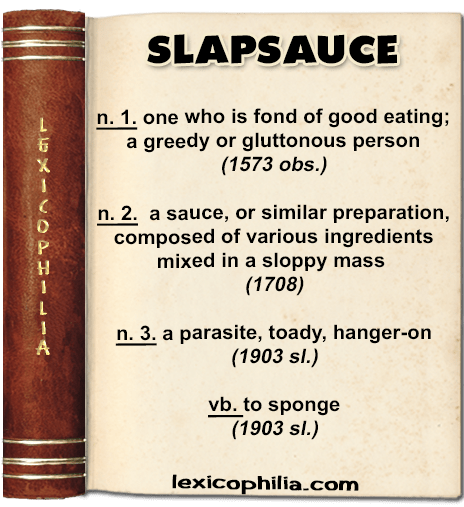
Word of the Day: SLAPSAUCE


ETYMOLOGY
from slap (to lap → Eng. dial.) + sauce


EXAMPLE
“…At dinner and supper the table doth craue
good fellowly neighbour good manner to haue.
Aduise thee well therefore, ere tongue be too free,
or slapsauce be noted too saucie to bee…”

From: Points of Huswifrie
In Fiue Hundreth Points of Good Husbandry
By Thomas Tusser, 1573

Word of the Day: CHATTERMAG


ETYMOLOGY
from chatter + mag (a chatterbox)


EXAMPLE
“…Now then, stop that; we don’t want no such dal’d nonsense; we come here to work. Now then, you women, divide into twos, and begin at both ends, or we shan’t get any work done for your chattermagging…”

From: Stubble Farm;
Or, Three Generations of English Farmers
By Hubert A. Simmons, Vol. II, 1880
Chapter I. P. 14