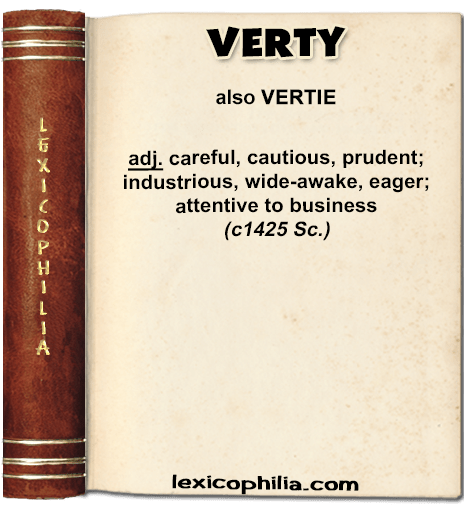
Word of the Day: STIVER-CRAMPED


ETYMOLOGY
– a stiver was a small coin (originally silver) of the Low Countries:
applied to the nickel piece of 5 cents of the Netherlands


EXAMPLE
“…as, according to a very nice calculation, that cutaneous reservoir, vulgarly called the breeches-pocket, and notorious for its unaffected sympathy with the animal spirits, will be stiver-cramped: I shall then indulge them with a touch of the sublime!…”

From: The Life and Extraordinary Adventures of James Molesworth Hobart
By N. Dralloc, 1794
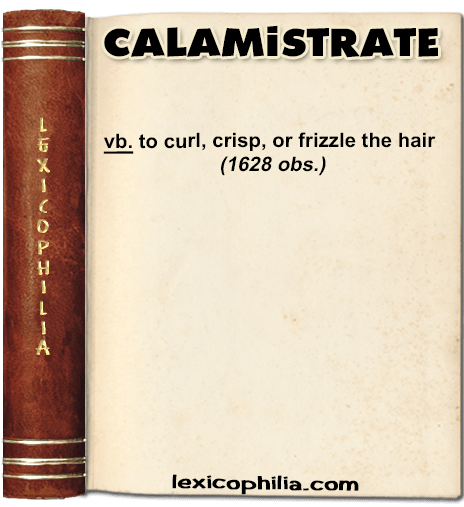
Word of the Day: CALAMISTRATE

ETYMOLOGY
from Latin calamistratus (crisped, curled with the curling iron), 
from calamistrum (curling iron)

EXAMPLE
“…Which belike makes our Venetian Ladies at this day, to counterfeit yellow haire so much, great women to Calamistrate and curle it up, vibrantes ad gratiam crines, & quot orbibus in captivitatem flexos, to adorne their heads with spangles, pearles, and made flowres, and all Courtiers to affect a pleasing grace in this kinde…”

From: The Anatomy of Melancholy
By Robert Burton, 1628

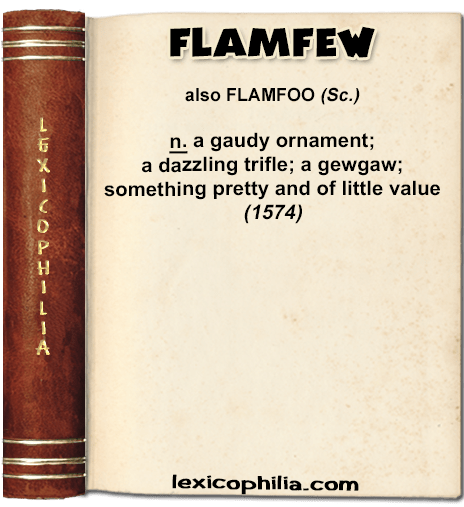
Word of the Day: FLAMFEW

ETYMOLOGY
corruption of French fanfelue, from medieval Latin famfalūca (bubble, lie),
apparently from Greek πομϕόλυξ (bubble)

EXAMPLE
“…In brest of the Godesse Gorgon was cocketed hardlye,
With nodil vnioyncted, by death, light vital amoouing.
Voyd ye fro theese flamfews, quoa the God, set a part the begun wurck
…”

From: Thee First Foure Bookes of Virgil his Aeneis
Translated intoo English heroical verse by Richard Stanyhurst, 1582

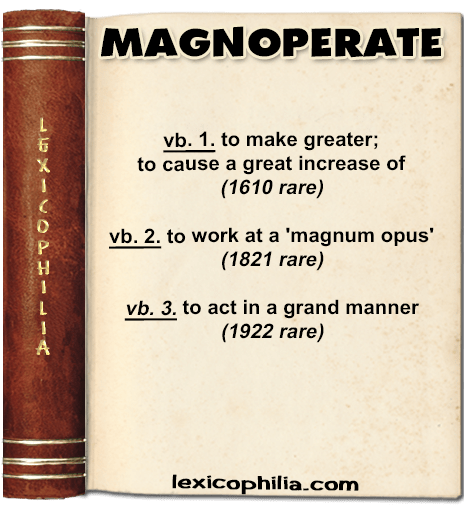
Word of the Day: MAGNOPERATE

ETYMOLOGY
from Latin magnopere (greatly) (short for magno opere [with great labour, especially, much]) + -ate

EXAMPLE
“…so that after-ages may rightly admire what noble Mecaenas it was that so inchayned the aspiring wits of this understanding age to his only censure, which will not a little magnoperate the splendor of your well knowne honor to these succeeding times…”

From: Baculum Geodæticum 
By Arthur Hopton, 1610

Word of the Day: DEVENUSTATE

ETYMOLOGY
from late Latin devenustare (to disfigure, deform),
from de- venustare (to beautify), venustus (beautiful)

EXAMPLE
“…but that Christ and his Servants may have comfort and stability amongst us, that those who Rule would fence the Vine, Learning, against beasts of Prey, and Foxes of spoil, who would rejoyce to see what yet remains of beauty and order, devenustated and exposed to shame and dishonour…”

From: An Humble Apologie for Learning and Learned men
By Edward Waterhouse, 1653

Word of the Day: EDULIOUS

ETYMOLOGY
from Latin edulis, from edere (to eat)

EXAMPLE
“…That the Prodigal Son desired to eat of Husks given unto Swine, will hardly pass in your apprehension for the Husks of Pease, Beans, or such edulious Pulses; as well understanding that the textual word or Ceration, properly intendeth the Fruit of the Siliqua Tree so common in Syria, and fed upon by Men and Beasts…”

From: Certain Miscellany Tracts
By Sir Thomas Brown, a1682

Word of the Day: MENTIMUTATION

ETYMOLOGY
from Latin menti-mens (mind) + mutation

EXAMPLE
“…I..shall be allowed the full benefit of all the..illaqueations, extrications,..mentimutations, rementimutations,..that I..can devise…”

From: Discolliminium: Or, A Most Obedient Reply to a Late Book, Called, Bounds & Bonds, So Farre as Concerns the First Demurrer and No Further
By Nathaniel Ward, 1650

Word of the Day: PHOTOGENY

ETYMOLOGY
from photo- (comb. form; relating to light) + -geny (comb. form; general sense = mode of production)

EXAMPLE
“…IMPROVEMENTS IN THE DAGUERREOTYPE. — Numerous improvements have been lately made in the beautiful art of photogeny….”

From: Burton’s Gentleman’s Magazine
A Chapter on Science and Art
By Edgar Allen Poe
Volume VI, April, 1840

Word of the Day: PAPELARD

ETYMOLOGY
from French papelard, papelart
as per OED: further etymology uncertain and disputed

EXAMPLE
“…Þe zeuende boȝ of prede ys fol drede and fole ssame huane me let wel to done uor þe wordle þet me ne by yhyealde ypocrite ne papelard huer me dret more þe wordle: þanne god…”

(The seventh bough of pride is foolish dread and foolish shame, when one ceases to do well because of the world, that one be not held a hypocrite or a canter, where one dreads the world more than God)

From: Dan Michel’s Ayenbite of Inwyt : or, Remorse of Conscience, 1340
Translation from: The Ayenbite of Inwyt, A Translation of Parts into Modern English
By A.J. Wyatt