Word of the Day: COMPUNCTIOUS


ETYMOLOGY
from stem of compunction (pricking of the conscience, remorse) + -ous


EXAMPLE
“…The Rauen himselfe is hoarse,
That croakes the fatall entrance of Duncan
Vnder my Battlements. Come you Spirits,
That tend on mortall thoughts, vnsex me here,
And fill me from the Crowne to the Toe, top-full
Of direst Crueltie: make thick my blood,
Stop vp th’ accesse, and passage to Remorse,
That no compunctious visitings of Nature
Shake my fell purpose, nor keepe peace betweene
Th’ effect, and hit. Come to my Womans Brests,
And take my Milke for Gall, you murth’ring Ministers,
Where-euer, in your sightlesse substances,
You wait on Natures Mischiefe. Come thick Night,
And pall thee in the dunnest smoake of Hell,
That my keene Knife see not the Wound it makes,
Nor Heauen peepe through the Blanket of the darke,
To cry, hold, hold
….”

From: Macbeth
By William Shakespeare, a1616
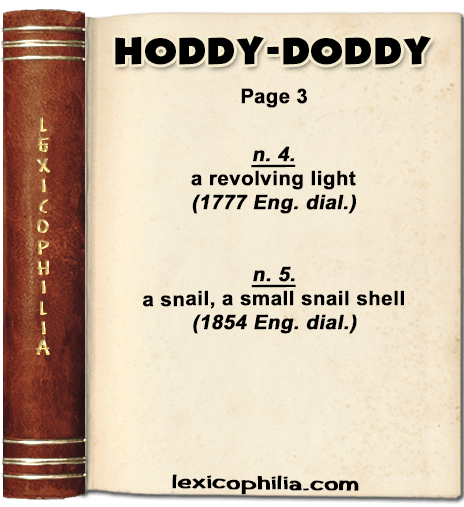
Word of the Day: HODDY-DODDY


ETYMOLOGY
the element dod is evidently the same as in dodman (a shell-snail);
hoddy-dodhoddy-doddy, & hodman-dod, are perhaps from nursery reduplications;
but the element hoddy- appears itself to have come to be associated to mean ‘snail’ (or ? horned);
for n. 2. (a cuckold) – with reference to the ‘horns’ of a cuckold


EXAMPLE (for n. 1.)
“…My living lieth here and there, of God’s grace,
Sometime with this good man, sometime in that place;
Sometime Lewis Loiterer biddeth me come near;
Somewhiles Watkin Waster maketh us good cheer;
Sometime Davy Diceplayer, when he hath well cast,
Keepeth revel-rout, as long as it will last;
Sometime Tom Titivile keepeth us a feast;
Sometime with Sir Hugh Pie I am a bidden guest;
Sometime at Nichol Neverthrive’s I get a sop;
Sometime I am feasted with Bryan Blinkinsop;
Sometime I hang on Hankyn Hoddydoddy’s sleeve;
But this day on Ralph Roister Doister’s, by his leave
…”

From: Ralph Roister Doister,
By Nicholas Udall, a1556

Word of the Day: INSTIGATRIX


ETYMOLOGY
from Latin instigatrix, female agent-n. from instigare (to instigate, bring about by incitement or persuasion)


EXAMPLE
“…She was (saies Salme∣ron, a main Supporter of the Roman Church among the Tridentine Fathers) cooperatrix, that is, Christs Fellow-laborer in the very Passion to the end, that as a Man and a Woman did work out the utter ruine of Man-kind, so a Man and a Woman might perfect their Salvation; and as well here as there, the Woman should be the Instigatrix, or the first Sollicitress, Eve to temt, and Mary to set the Man to work. Thus she is, saies another, the Mother of Redemtion, by shedding her Soul into compassion under, as Christ did his in Passion upon the Cross…”

From: Saul and Samuel at Endor,
or The new waies of salvation and service, which usually temt men to Rome, and detain them there Truly represented, and refuted,
By Daniel Brevint, 1674

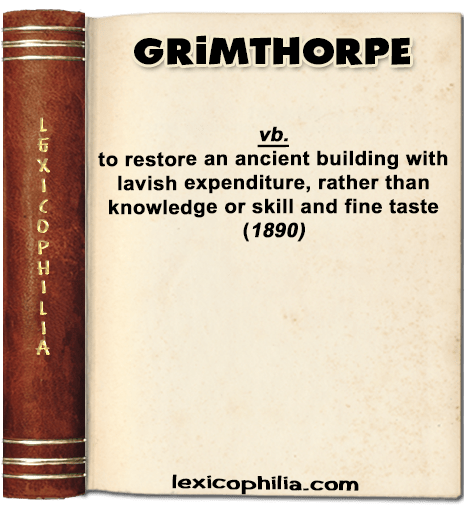
Word of the Day: GRIMTHORPE


ETYMOLOGY
from the name of Sir Edmund Beckett, first Lord Grimthorpe (1816–1905), whose restoration of St. Albans Cathedral, completed in 1904, aroused fierce criticism and controversy


EXAMPLE
“…Talking of Lord Grimthorpe reminds us of an honour that has recently been done unto his name. It shall not be the Antiquary’s fault if this honour is not perpetuated; so that, perchance, the dictionaries of the future may immortalize his titular name in the same way as they have already treated the family appellation of Boycott. Last November, a group of appreciative visitors were standing in the nave of the abbey church of Selby, discussing its probable reparation. “Ah!” remarked one, “if only the wealthy and generous man could be found, what a fine field for his labours!” To this a keen and well-known Yorkshire ecclesiologist replied: “Heaven forbid! the building might be grimthorped!…”

From: The Antiquary,
A Magazine Devoted to the Study of the Past, Vol. XXI, January – June, 1890
‘Notes of the Month’

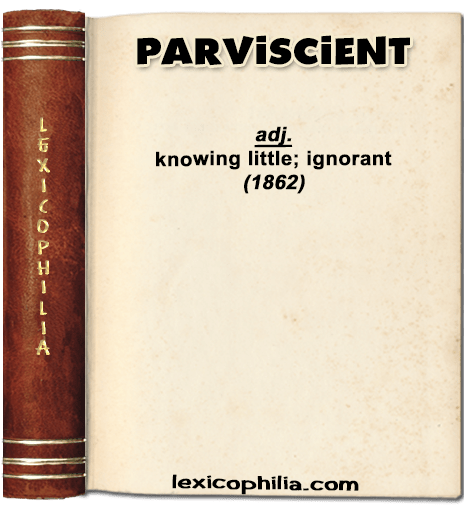
Word of the Day: PARVISCIENT


ETYMOLOGY
from parvi- comb. form of Latin parvus (small) + scient (knowledgeable, skilled);
probably after omniscient (having infinite knowledge)


EXAMPLE
“…It is called his causal body. Neither can do anything without one. The aggregate of the causal bodies of all souls, that is to say, distributive ignorances, make up I’s’wara’s causal body, which is illusion. Strange to say, the ignorance of a single soul renders that soul subject to misapprehension, and keeps it parviscient, parvipotent, &c; but the aggregation of these individual ignorances, or illusion, allows I’s’wara to be exempt from misapprehension, and communicate to him such attributes as omniscience and omnipotence…”

From: A Rational Refutation of the Hindu Philosophical Systems
By Nehemiah Nilakantha S’Astri’ Gore
Translation by Fitz-Edward Hall, 1862


PRONUNCIATION
par-VISS-ee-uhnt

Word of the Day: INCAUTELOUS


ETYMOLOGY
from in- + cautelous (cautious, wary)


EXAMPLE
“…The bold Physitian, too incautelous,
By those he cures, himselfe is murdered,
Kindnes infects, pitie is dangerous,
And the poore infant, yet not fully bred,
Thear where he should be borne, lies buried,
So the darke Prince, from his infernall cell,
Casts vp his griesly Torturers of hell,
And whets them to revenge, with this insulting spell
….”

From: Christs Cictorie, and Triumph in Heauen, and Earth, Ouer, and After Death
By Giles Fletcher, 1610

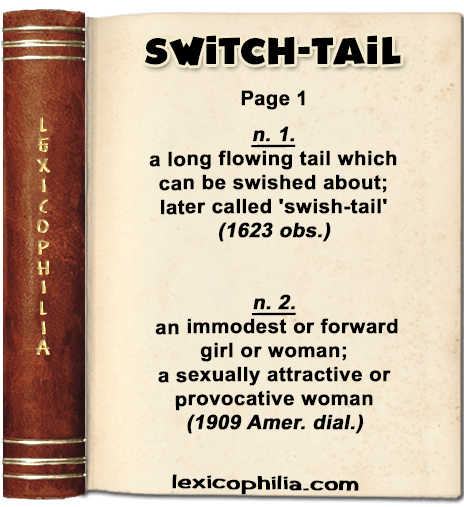
Word of the Day: SWITCH-TAIL


ETYMOLOGY
from switch + tail


EXAMPLE 1 (for n.1)
“…she was observed to ride forth in a Cavalcade somewhat extraordinary pleasant , viz. a good rich Velvet Saddle, and fashionable upon a sorry Horse with a Switch-Tail that us’d to carry Lime, and not Ladies; A gentile Surtout or riding-Suit; with her Shoulders warmly wrapt up in a good White Serge whittle: A pretty handsome Commode of the newest fashion, upon which was gracefully plac’d a good homely Straw Hat, with a long Pole like a Sugar Loaf, so that Cit and Bumpkin seem’d never better met or set off since the Creation …”

From: The Adventures of the Helvetian Hero, with the Young Countess of Albania;
Or, The Amours of Armadorus and Vicentina: a Novel
Unknown author, 1694


EXAMPLE 2 (for n. 2.)
“…I can look a gangster in the eye and make him change his mind, but I can’t do a thing with a woman no more. At one time I had nine big switch-tail women on my personal payroll, and they all stole from me, picked me clean. Buzzards!

From: McSorley’s Wonderful Saloon
By Joseph Mitchell, 1943

Word of the Day: TERRACULTURE


ETYMOLOGY
irregularly from Latin terra (earth) + culture


EXAMPLE
“…We venture at the outset to introduce a new term, and that for the only justifiable reason, viz: because there is no single word heretofore in use in our language expressive of the idea we wish to express. Agriculture is the culture of the field, and includes the operations of farming or the tillage of large portions of land. Horticulture is the culture of the garden, and has reference to the production of kitchen vegetables, fruits and flowers. We have often felt at a loss for a word to include all these, and as Terraculture, or the culture of the earth, exactly expresses the idea, and as it is derived from the Latin in a manner exactly similar to the other terms, we think there must result a decided advantage from its introduction. It comprehends all things which are produced from the earth, by the labor of man and beast, through the agency of vegetable life. Every thing that germinates and grows by receiving its nourishment from the soil, belongs to this department…”

From: The Franklin Farmer,
Devoted to Improvements in the Science of Agriculture, the Practice of Husbandry, and the Mind, Morals, and Interests, of the Cultivators of the Soil.
Vol. I., Edited by Tho. B. Stevenson, 1837-8

Word of the Day: MISPROUD


ETYMOLOGY
from mis- (wrong, unfavourably) + proud


EXAMPLE 1
“…Ȝyf a man haue mysdo or seyde,
And men hym blame for þat mysbreyde,
Ȝyf he susteynë hys mysdede,
And hys mysawe wyl nat drede,
Þat cumþ of mysprout herte and hy
Þat wyl nat knowe hys owne foly
…”

From: Robert of Brunne’s “Handlyng Synne” (Harley MS)
By Robert Mannyng, a1400


EXAMPLE 2
“…It was in 1397, ninety years since the first assertion of Swiss independence, when Leopold the Handsome, Duke of Austria, a bold but misproud and violent prince, involved himself in one of the constant quarrels with the Swiss that were always arising on account of the insulting exactions of toll and tribute in the Austrian border cities…”

From: A Book of Golden Deeds of All Times and All Lands
By Charlotte Mary Yonge, 1864