Word of the Day: VOUTER


ETYMOLOGY
aphetic formed on avouter (an adulterer, esp. a male one);
in its oldest form from Old French avoutre, aoutre


EXAMPLE
“…For in þis werlde is no doge for þe bowe
þat knowe an hurt dere fro an holde bet cowe
þan þis Somenour knewe a licour
Or a vouter or elles a paramour
And for þat was þe fruyte of al þe rente
Ther-for on it he set al his entente
…”

From: The Lansdowne Manuscript of Chaucer’s Canterbury Tales,
Geoffrey Chaucer, c1386
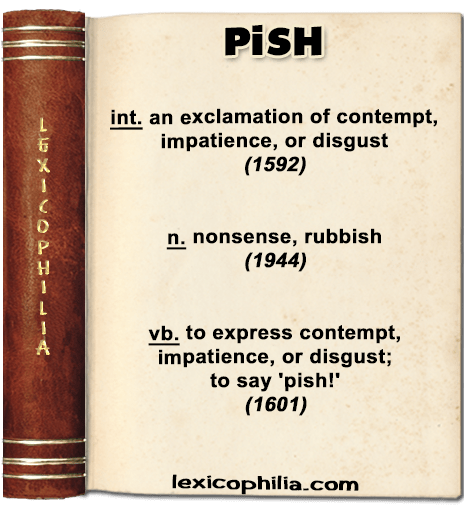
Word of the Day: PISH


ETYMOLOGY
an imitative or expressive formation


EXAMPLE
“…Hoe! God, be here! on their bald, burnt, parchment pates. Pish, pish! what talke you of olde age or balde pates? Men and women that haue gone vnder the south pole, must lay of theyr furre night-caps in spyght of their teeth, and become yeomen of the vineger bottle…”

From: Pierce Penilesse, His Supplication to the Diuell
By Thomas Nashe, 1592

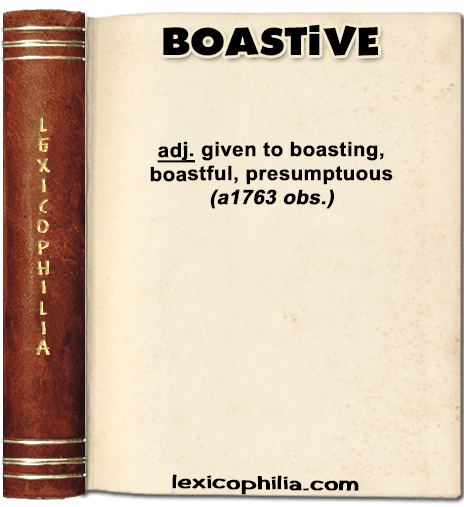
Word of the Day: BOASTIVE


ETYMOLOGY
from boast (vb.) + -ive


EXAMPLE
“…Of acid blood, proclaiming Want’s disease
Amidst the bloom of shew. The scanty stream,
Slow-loit’ring in its channel, seems to vie
With Vaga’s depth; but should the sedgy pow’r,
Vain-glorious, empty his penurious urn
O’er the rough rock, how must his fellow streams
Deride the tinklings of the boastive rill
…”

From: The Poetical Works of William Shenstone, 1768
By William Shenstone, a1763

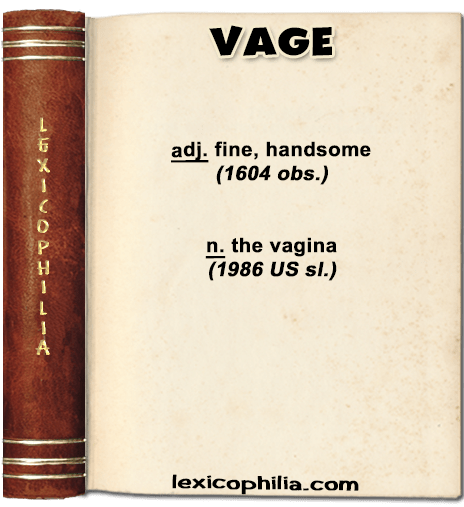
Word of the Day: VAGE


ETYMOLOGY
adj,: apparently from Italian vago


EXAMPLE
“…no doubt but better parts, finer colours, purer lights proportionably combined, cause a more excellent beautie, shew, and lustre: as the siner gold, the richer stones (if art bee correspondent) the more vage and beautifull iewell…”

From: The Passions of the Minde in Generall
By Thomas Wright, 1604

Word of the Day: TETTY


ETYMOLOGY
for adj.: of obscure origin
for n.1.: from teat () + -y 


EXAMPLE
“…but if they loose, though it be but a trifle, two or three games at tables, or a dealing at Cards for 2d a game, they are so cholericke and tetty that no man may speake with them, and breake many times into violent passions, oaths, imprecations, and vnbeseeming speeches, little differing from mad men for the time…”

From: The Anatomy of Melancholy
By Robert Burton, 1621

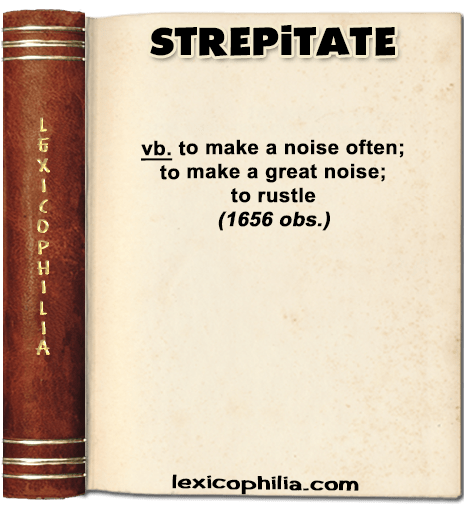
Word of the Day: STREPITATE


ETYMOLOGY
from Latin strepitat-, ppl. stem of strepitare (to make a repeated noise),
frequentative of strepere (to make a noise)


EXAMPLE
“…It’s yet, I say, to be mentioned to Uncle Harcourt, who’ll blow a stout gale, I know, enough to wreck some of us, when it is mentioned. He’ll strepitate finely, to use one of his own great words…”

From: Farquhar Frankheart; Or, Incidents in the Introduction of Methodism into Yorkshire
By Farquhar Frankheart, 1860